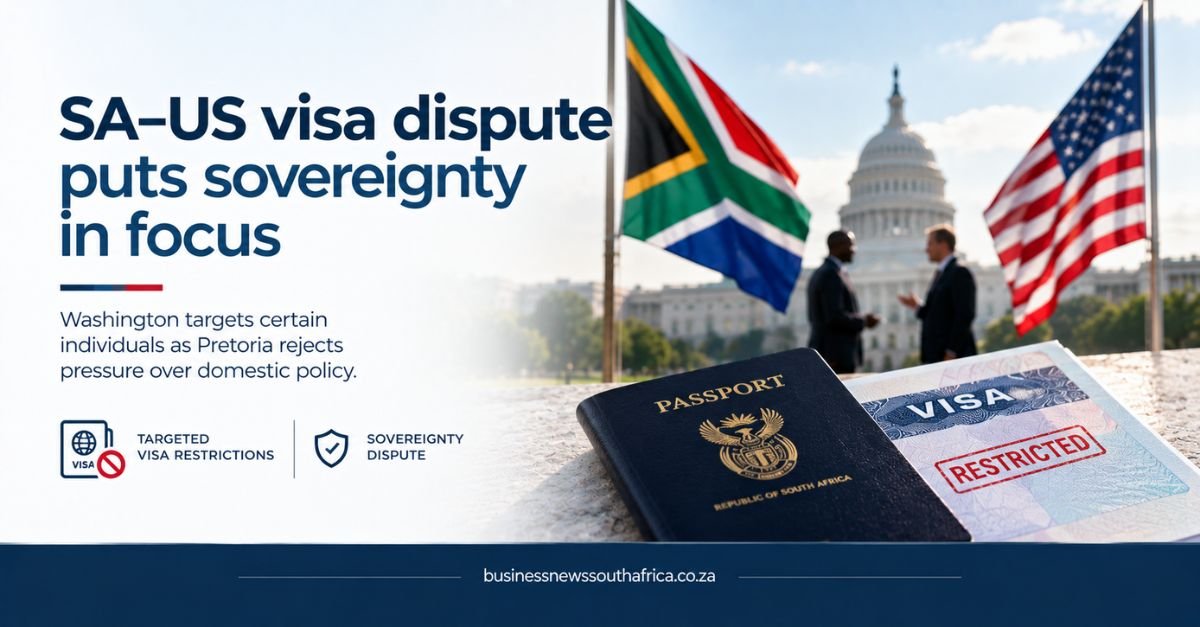
International Relations Minister Ronald Lamola says South Africans should prepare for the worst-case scenario in the dispute with the United States, because “we are expected to surrender our sovereignty”. He was reacting to visa restrictions that US Secretary of State Marco Rubio announced on 15 September 2026, according to BusinessTech.
What Washington announced
The restrictions apply to foreign nationals who are responsible for, or complicit in, laws or policies that enable uncompensated land seizures, race-based discrimination, or the incitement of imminent violence against minority ethnic or racial groups in South Africa. UPI reported that Rubio cited “government-sponsored discrimination occurring against the Afrikaners” and said the United States “will not allow such behavior to go unchecked”.
Briefly reported that the policy is made under Section 212(a)(3)(C) of the US Immigration and Nationality Act, builds on Executive Order 14204, titled “Addressing Egregious Actions of the Republic of South Africa”, and extends to the immediate family members of those affected. It is aimed at people tied to the Expropriation Act and to legislation Washington regards as racially discriminatory, not at South African travellers in general.
UPI noted that the land expropriation law is not yet operational. It also gave the background: a 2017 land audit found that white South Africans owned 72% of individual farms while making up 7.3% of the population, and Black Africans owned 4%. Within weeks of taking office, President Donald Trump signed an order cutting US assistance to South Africa and prioritising Afrikaners for refugee resettlement, and the first group arrived in May 2025.
The Expropriation Act is itself before the courts. Daily Maverick reported that the Western Cape High Court heard a consolidated challenge in the week of 3 to 7 August 2026, brought by the Democratic Alliance, AfriForum, IRR Legal and the Vaderland Stigting. The Presidency, Parliament and the Economic Freedom Fighters are defending the law. President Cyril Ramaphosa signed the Act in December 2024. The challengers focus on the provisions that allow expropriation for “nil compensation” where it is “just and equitable” and in the public interest.
Pretoria’s response
Lamola said Washington wants changes to Black Economic Empowerment policy, land expropriation rules and South Africa’s foreign policy, according to BusinessTech. He said the country’s positions come from its democratic processes and constitutional framework, which the government treats as non-negotiable.
The Mail & Guardian reported on 24 September that Lamola named Black Economic Empowerment, land reform and the genocide case against Israel at the International Court of Justice as areas where South Africa will not retreat. He said South Africa will not obstruct the US refugee resettlement programme for Afrikaners, although it opposes it, and would attend the G20 summit if invited. The newspaper listed the visa restrictions alongside earlier US measures: 30% tariffs on exports, aid cuts, exclusion from the G20 and the refugee programme. Analyst Donovan E Williams called the campaign a “diplomatic war”.
Diplomats point to a broken channel
South Africa’s ambassador to Washington, Roelf Meyer, blamed the tension partly on communication. “There’s no regulated channel,” he said. “Everyone speaks for themselves, and that brings a lot of challenges.” He said he is optimistic that the disputes can be resolved through dialogue, provided both sides engage “as equal partners”.
The US ambassador to South Africa, Brent Bozell, took a harder line on 21 September, as Newsday reported. “The time for endless dialogue has run its course,” he said, calling the visa restrictions “the first step in a series of escalatory measures”.
Trade exposure
Exporters are watching a separate US decision on the African Growth and Opportunity Act, which we cover in a separate report on AGOA eligibility.
Further coverage of the diplomatic row and its trade effects is in the regulatory and policy and markets and finance sections.