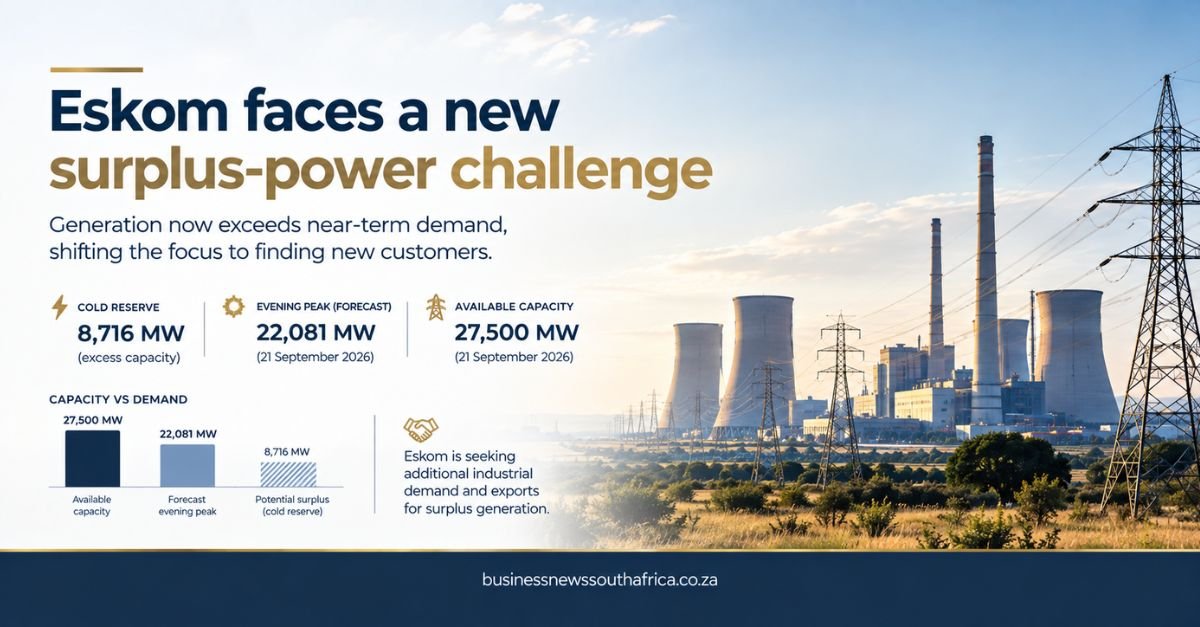
Imagine rows of wind turbines humming at full tilt while the national grid sits idle, that is the paradox Eskom faces as South Africa begins to generate more power than it can use. The issue was the centrepiece of a recent Moneyweb podcast, where three experts unpacked what “too much electricity” means for businesses, investors and the country’s power system.
Safeera Loonat, a partner at KPMG South Africa, warned that a persistent surplus could force the utility to lower tariffs or even pay large generators to curtail output. “When supply outstrips demand, the market price can turn negative, and that erodes the revenue base for both Eskom and independent power producers,” she said.
Nick Kunze of Sanlam Private Wealth highlighted the knock-on effect for investors. “If Eskom’s earnings dip because it has to sell power at a loss, the ripple spreads to banks, bond markets and equity portfolios that hold utility debt,” he explained.
Adding a corporate twist, AlexForbes announced a share-buy-back financed by a R2.1 billion borrowing. The company’s chief executive told the podcast that the move is meant to boost earnings per share, the profit per share after stripping one-off items, and signal confidence despite the looming energy surplus.
Why the surplus matters for SMEs
For small and medium-size enterprises, electricity costs are a major line item. A sudden drop in tariffs could improve cash flow, but the opposite, higher tariffs to cover Eskom’s shortfall, would squeeze margins. Moreover, an unstable grid can lead to more load-shedding events, which directly halt production lines and increase operating costs.
The guests agreed that policy reform is essential. Johann Els of PSG Financial Services” target=”_blank” rel=”noopener nofollow external”>PSG Financial Services noted that reforms introduced over the last decade are finally bearing fruit, but they need to be accelerated to manage the new supply-demand imbalance.
For business owners looking to navigate this uncertainty, the Markets & Finance section offers tools to model tariff scenarios and assess the impact on cash flow.