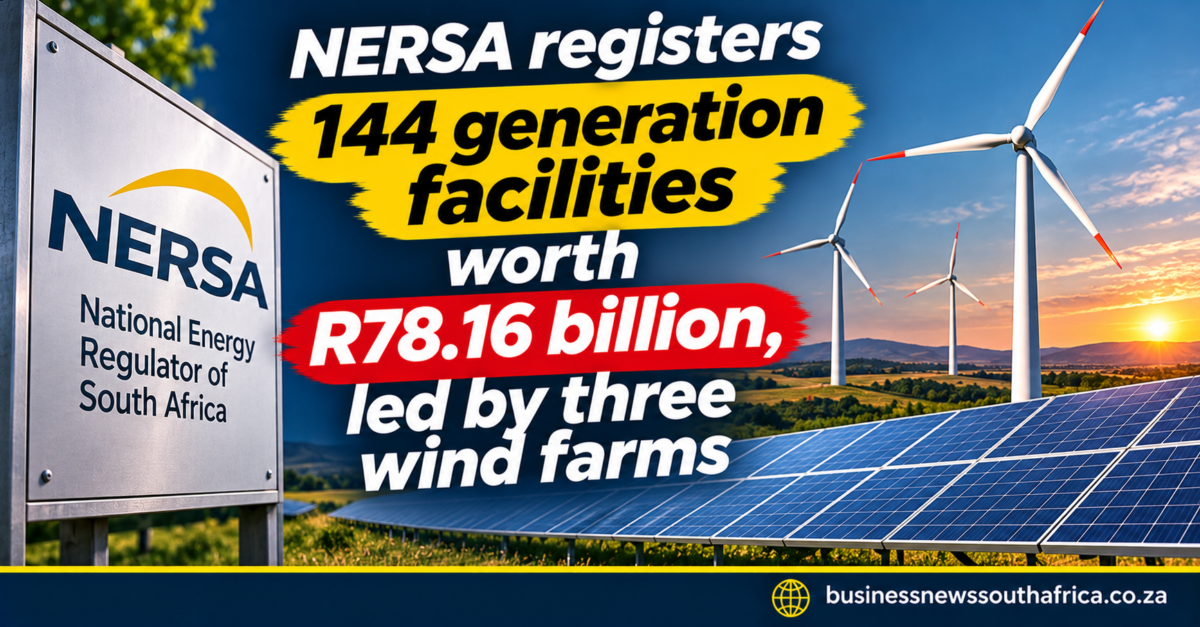
The National Energy Regulator of South Africa (NERSA) says it registered 144 generation facilities between July and September 2026, with a combined capacity of 3 129 MW (about 3.13GW) and an estimated investment value of R78.16 billion. The figures come from a media statement the regulator issued on 5 November 2026 for the second quarter of its 2026/27 financial year, available on the NERSA media statement of 5 November 2026.
Three wind farms carry a third of the capacity
Solar photovoltaic was the most common technology by count. NERSA registered 139 solar plants totalling 2 045 MW, spread across all nine provinces: 34 in the Western Cape, 47 in Gauteng, 13 in Limpopo, 14 in KwaZulu-Natal, eight each in the Eastern Cape, Mpumalanga and the Free State, six in North West and one in the Northern Cape.
Wind is the reason the capacity total is so large. Only three wind facilities were registered, two in the Western Cape and one in Mpumalanga, but together they add 1 063 MW. That is roughly a third of the quarter’s capacity from about two per cent of the facilities. The remaining registrations were a single 3 MW battery energy storage system in KwaZulu-Natal and one 18 MW co-generation facility, also in KwaZulu-Natal.
The regulator compared its processing speed with the previous quarter of the 2025/26 financial year, when 181 applications were handled in an average of 10 working days. This quarter’s 144 applications took an average of nine working days.
Where the money and megawatts are going
Gauteng, the Western Cape and KwaZulu-Natal led on the number of registrations. By capacity and investment value, the Western Cape, the Free State and Limpopo took the top three places. The Western Cape recorded the highest investment of the quarter, about R24.60 billion for 1 189 MW across 36 facilities.
The province table in the statement shows how uneven the picture is:
- Western Cape: 36 facilities, 1 189 MW, R24 604 million.
- Gauteng: 47 facilities, 25 MW, R343 million.
- Free State: eight facilities, 543 MW, R15 032 million.
- Limpopo: 13 facilities, 484 MW, R16 266 million.
- North West: six facilities, 416 MW, R6 070 million.
- Northern Cape: one facility, 240 MW, R11 000 million.
- Mpumalanga: nine facilities, 191 MW, R4 601 million.
- KwaZulu-Natal: 16 facilities, 39 MW, R215 million.
- Eastern Cape: eight facilities, 2 MW, R32 million.
Gauteng had the most registrations but, at 25 MW across 47 facilities, its projects are small on average. A single Northern Cape project of 240 MW attracted R11 billion, more than 30 times the R343 million recorded for Gauteng’s 47 facilities.
On connection, 76 facilities will connect to the Eskom network, adding 3 079 MW and about R77.58 billion of investment. The other 68 will connect to municipal distribution networks, with a combined 50 MW and an estimated R584 million. NERSA puts the average investment cost for the quarter at around R24 980 per kilowatt.
The registration regime since 2018
Since the registration regime started in 2018, NERSA has registered 2 763 generation facilities with a combined 23 260 MW and an estimated total investment of R487 billion. This quarter alone therefore accounts for about 13 per cent of all capacity registered in that period, calculated from the regulator’s own totals.
The annual table in the statement shows the pace picking up: 124 facilities and 53 MW in 2020, 406 facilities and 1 646 MW in 2022, and 597 facilities and 7 464 MW in 2025, worth R158 029 million. The figure for 2026 covers only the first three quarters of the calendar year, yet it already stands at 380 facilities, 5 260 MW and R126 564 million. The July to September quarter makes up a little under 60 per cent of that year-to-date capacity.
What it means for businesses
For companies that buy electricity, the registrations are a measure of how much privately financed supply is lining up behind the Eskom grid. NERSA says registration ensures legal and technical compliance, supports grid reliability and safety, and improves national electricity planning. It also describes the volume of registrations as evidence of growing private investment.
For developers, equipment suppliers and lenders, the investment figures show where project spending is concentrated: the Western Cape, Limpopo, the Free State and the Northern Cape. The statement covers registrations, however, not construction or commercial operation. It does not say how many of the 144 facilities are built or when they will deliver power, so the registered capacity should not be read as electricity already on the grid.
Related coverage
We have covered the wider private power story in our report on private wind investment, the Ekurhuleni decision to buy up to 2 400MW from private producers, the report on 4.6GW of battery storage and the regulator’s call for comment on grid cost rules.