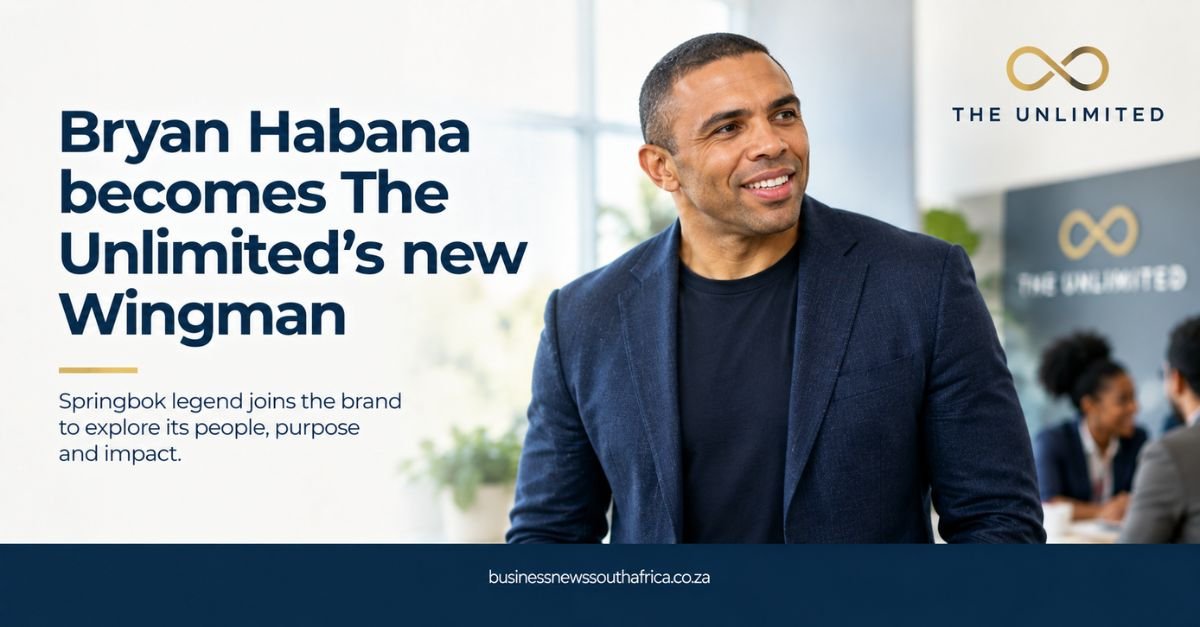
On a modest set called The Coral Couch, former Springboks wing Bryan Habana settles in, not to talk rugby but to learn about The Unlimited. The scene was captured in a press release posted by Bizcommunity. The visual presentation, with Habana seated in a relaxed environment, is designed to signal a shift from the usual corporate boardroom to a more conversational space where curiosity can thrive.
The Unlimited says Habana will act as a “Wingman”, essentially a brand ambassador who will sit with staff, ask unscripted questions and then help customers navigate the insurer’s products and services. As Susie Hart, head of brand at The Unlimited, explains, the aim is to have someone genuinely curious experience the business from the inside and then take South Africans on that journey. The concept of a “Wingman” builds on the idea that a familiar public figure can act as a bridge between complex financial language and everyday understanding, a bridge that is especially valuable in a market where many consumers still associate insurance with paperwork and uncertainty.
Understanding the South African insurance landscape
The Unlimited is a South African insurer that has been operating for about 30 years. It covers more than three million lives and has paid out over R1bn in claims, according to the company. Those figures illustrate the scale of the business that Habana will be exploring. In the broader context, the South African insurance sector has long been a pillar of the financial services industry, contributing to economic stability by providing risk mitigation tools for individuals, families and businesses. While the sector is mature, it continues to evolve in response to changing consumer expectations, technological advances and the need for greater financial inclusion.
Insurance penetration in South Africa, measured as the ratio of total premiums to gross domestic product, remains modest compared to some global benchmarks. This gap reflects a combination of factors, including limited awareness of the full range of products, perceived cost barriers and a historical reliance on traditional distribution channels such as agents and brokers. For many small and medium enterprises (SMEs), the decision to purchase coverage is often delayed until a claim event forces a reactive approach. The result is a market where proactive education and clear communication can unlock significant growth potential.
Why brand ambassadors matter in financial services
For owners of small and medium enterprises, the partnership highlights a growing trend: large financial services firms are turning to well-known personalities to make insurance and financial products feel more approachable. The use of a sports icon such as Habana taps into a cultural reservoir of trust and admiration. Rugby, in particular, holds a special place in South African society, and the values associated with the sport, teamwork, resilience and discipline, resonate with the core promises of insurance: protection, reliability and long-term support.
Brand ambassadors in the financial sector serve several functions. First, they humanise a brand that might otherwise appear faceless or overly technical. Second, they generate media interest that extends beyond traditional industry publications, reaching audiences that consume content on social platforms, lifestyle blogs and mainstream news outlets. Third, they provide a narrative hook that can be woven into broader marketing campaigns, educational webinars and customer outreach programmes. By positioning Habana as a “Wingman” who asks unscripted questions, The Unlimited signals a willingness to expose internal processes to public scrutiny, thereby reinforcing transparency.
The regulatory backdrop and consumer protection
Insurance companies in South Africa operate under a regulatory framework that emphasizes prudential soundness, fair treatment of customers and market conduct standards. While the specific names of regulators are not mentioned here, the overarching requirement is that insurers maintain sufficient capital, adhere to risk-management protocols and provide clear, accurate information about policy terms. Initiatives such as The Unlimited’s “Wingman” project must therefore align with these expectations, ensuring that any public communication does not mislead consumers or create unrealistic expectations about product performance.
From a compliance perspective, the use of a public figure introduces additional considerations. Advertising standards require that claims be substantiated and that any endorsement be disclosed as such. The Unlimited’s approach, framing Habana’s role as an inquisitive participant rather than a guaranteed outcome provider, helps to meet these standards. Moreover, by focusing on education and navigation rather than direct sales pitches, the campaign aligns with the principle of treating customers fairly, a cornerstone of South African financial regulation.
Implications for SMEs and the broader business community
The company claims the initiative will help customers understand the opportunities inside the business and see what is possible when people are given room to grow. If the campaign resonates, The Unlimited hopes to attract new policy-holders, including families and small firms that need affordable cover. The impact on sales or market share, however, remains a claim by the company until independent data emerges. For SME owners, the potential benefits are twofold.
First, the campaign may reduce the perceived complexity of insurance. When a familiar face asks straightforward questions about coverage limits, claim processes and pricing structures, it demystifies the language that often deters small business owners from engaging with insurers. Second, the visibility of the partnership can inspire confidence that the insurer is actively listening to its customers. In a market where trust is a decisive factor, the perception that an insurer is open to scrutiny can be a differentiator.
Beyond the immediate educational value, the partnership may also signal a shift in distribution strategy. Traditional reliance on agents and brokers is being complemented by digital channels, self-service portals and content-driven engagement. By creating a narrative that can be shared across social media, video platforms and the insurer’s own website, The Unlimited is building a repository of assets that can be repurposed for lead generation, onboarding and retention activities.
The power of storytelling in financial services
Whether the partnership will translate into measurable growth remains to be seen, but it signals a shift toward storytelling in financial services. Storytelling has long been a tool for brands seeking to connect emotionally with audiences, but its application in the insurance sector has been relatively cautious. The Unlimited’s approach demonstrates that a well-crafted story, one that blends authenticity, curiosity and cultural relevance, can serve as a conduit for education.
For SMEs watching the move, the lesson may be simple: authentic storytelling can be a powerful tool for reaching customers who are otherwise wary of complex financial products. By embedding a narrative that highlights real-world experiences, insurers can move beyond abstract policy descriptions to illustrate how coverage can protect a family’s home, a retailer’s inventory or a tech startup’s intellectual property. When the story is anchored by a trusted public figure, the message gains additional credibility.
In practice, storytelling can be operationalised through a series of touchpoints. Short video clips of Habana asking questions can be embedded in email newsletters, while longer interview-style pieces can appear on the insurer’s blog. Interactive webinars where Habana joins a panel of experts can provide a live forum for SMEs to ask questions. Each of these formats reinforces the central theme that insurance is not a distant, bureaucratic service but a partner in business continuity.
Looking ahead: measuring impact and scaling the model
The initiative’s success will ultimately be judged by data that goes beyond anecdotal feedback. Independent research firms, industry analysts and consumer advocacy groups will likely monitor key performance indicators such as new policy uptake, renewal rates, claim satisfaction scores and brand perception metrics. While The Unlimited has not yet released such data, the company’s willingness to frame the partnership as an exploratory journey suggests an openness to iterative learning.
If the “Wingman” model proves effective, it could inspire other insurers and financial service providers to adopt similar approaches. The scalability of the concept rests on the ability to match the right public figure with the brand’s values and target audience. In South Africa’s diverse market, cultural relevance and linguistic inclusivity will be essential considerations. Moreover, the model may evolve to incorporate multiple ambassadors, each representing different segments such as youth entrepreneurship, agricultural enterprises or the gig economy.
For now, the partnership offers a tangible example of how a legacy insurer can innovate within the constraints of regulation, consumer expectations and market dynamics. By inviting a celebrated athlete to sit at The Coral Couch, ask unscripted questions and share the experience with the broader public, The Unlimited is testing the hypothesis that curiosity, authenticity and storytelling can bridge the gap between complex financial products and everyday business needs.
Read more about similar branding strategies in the SME & Entrepreneurship section.