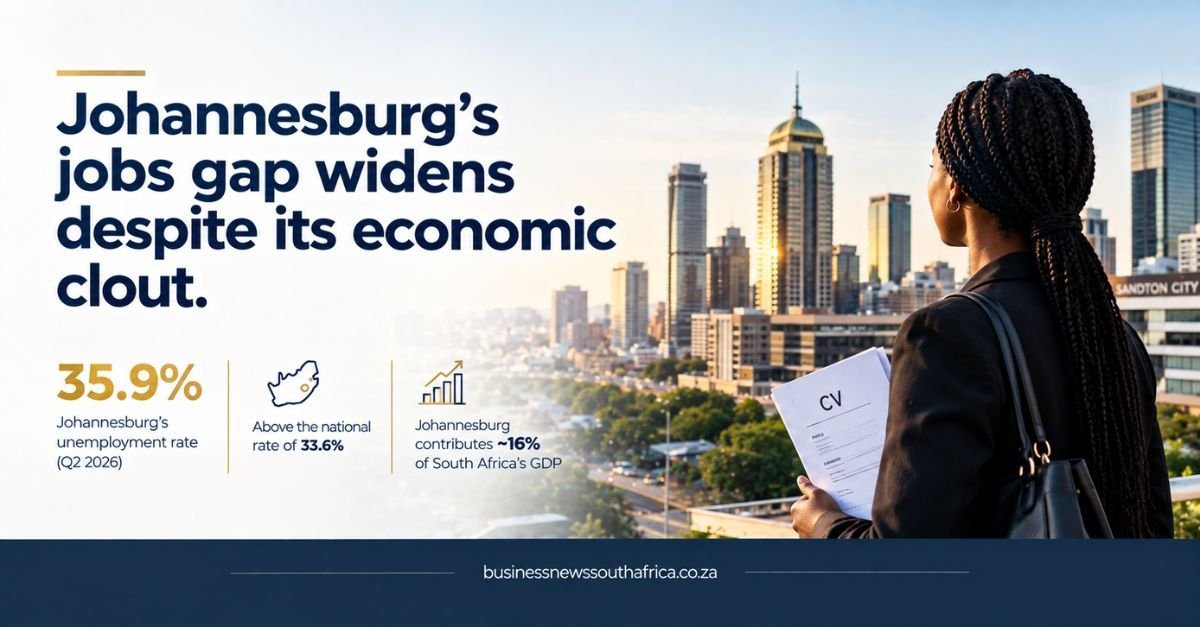
From the glitter of Sandton’s office towers to the streets where many struggle to find work, Johannesburg presents a stark contrast. The city’s unemployment rate sits at 35.9% in the second quarter of 2026, a figure that dwarfs most of its African peers.
According to BusinessTech, the unemployment rate measures the share of the labour force that is without a job but actively looking for one. Johannesburg’s 35.9% is above the national average of 33.6% and far higher than Egypt’s 5.8% and Morocco’s urban rate of 11.9%.
Understanding Unemployment Figures
Unemployment is a statistical concept that captures the proportion of people who are willing and able to work, who are actively seeking employment, but who have not found a job. The calculation typically relies on household surveys that ask respondents about their current work status, job search activities, and availability for work. Because the measure excludes those who have stopped looking, it reflects the intensity of labour market distress rather than the total number of people without income. In a city such as Johannesburg, where the formal sector is concentrated in finance, professional services and corporate headquarters, the gap between the number of job seekers and the number of vacancies can become especially pronounced when macro-economic headwinds limit hiring.
The contrast with the national average highlights a structural challenge. While the country as a whole faces high unemployment, the capital’s rate is higher still, suggesting that the city’s economic dynamism does not automatically translate into jobs for the majority of its residents. The comparison with Egypt and Morocco, two economies that have managed to keep urban unemployment at single-digit levels, underscores how divergent labour market outcomes can be across the continent, even when cities share similar roles as economic hubs.
Johannesburg’s Economic Contribution in Context
The city still drives South Africa’s economy, contributing roughly 16% of the country’s gross domestic product (GDP). South Africa’s GDP was about $427 billion at the end of 2025, making Johannesburg’s output larger in absolute terms than Lagos, which supplies about 30% of Nigeria’s $290 billion GDP, or Cairo, which accounts for 42% of Egypt’s GDP. In other words, the city’s economic weight is undeniable, even if its labour market lags.
That level of contribution is rooted in a concentration of corporate headquarters, financial institutions, and a well-developed services sector. The Johannesburg Stock Exchange, the continent’s largest equity market by market capitalisation, is headquartered in the city and provides a platform for capital formation that benefits firms across South Africa and the broader region. The presence of multinational banks, insurance companies and consulting firms creates a demand for high-skill talent, which in turn attracts a pool of educated workers from across the country.
However, the same concentration also creates a dual economy. High-value jobs tend to be clustered in the central business district and surrounding financial precincts, while many residents of the greater metropolitan area rely on informal work, low-wage retail or service jobs that are more vulnerable to economic shocks. This spatial segregation of opportunity is a key factor behind the city’s elevated unemployment rate.
Implications for Small Business and Entrepreneurship
For small-business owners and entrepreneurs, the high unemployment rate translates into a mixed picture. On the one hand, households in the metro earn an average salary that is 57% higher than the South African average and 9% higher than the Gauteng provincial average, suggesting a market with purchasing power. On the other hand, a large share of the population is without income, which can suppress demand for non-essential goods and services, a reality that retailers and consumer-facing firms must factor into pricing and staffing decisions.
The disparity between income levels creates pockets of affluent consumers who are able to spend on premium products, dining experiences and technology, while simultaneously generating a sizable base of price-sensitive shoppers who look for value and discount options. Entrepreneurs who can navigate these divergent segments, by offering tiered product lines, flexible payment terms or services that address basic needs, stand to benefit from the city’s overall wealth while mitigating the risk of over-reliance on a single consumer group.
In addition, the high unemployment environment can be a source of labour supply for businesses that require manual or semi-skilled workers. The willingness of many job seekers to accept entry-level positions can reduce recruitment costs for firms that are able to provide on-the-job training. Yet this advantage is offset by the need for businesses to invest in skills development, health and safety measures, and retention strategies that keep workers engaged in a competitive labour market.
Service Delivery Challenges and Their Business Impact
Service delivery problems add another layer of risk. Johannesburg has struggled with frequent water and power outages and has accumulated significant debts to bulk service providers. The city recently settled a R5.25 billion arrears bill with Eskom, the national power utility, but similar liabilities to Rand Water remain a concern. Interruptions in electricity and water supply can increase operating costs for businesses, especially those that rely on continuous power for production or refrigeration.
When power is unavailable, firms often resort to diesel generators or battery backup systems, which raise operating expenses and can affect profitability. Water shortages can disrupt manufacturing processes, increase cleaning costs, and even lead to temporary shutdowns for businesses that depend on a reliable water supply. Moreover, the uncertainty surrounding service delivery can influence location decisions, prompting some companies to consider relocating to areas with more stable infrastructure, or to invest in on-site solutions that add to capital expenditure.
Beyond the direct cost implications, unreliable services can erode consumer confidence. Frequent outages may discourage customers from visiting retail outlets during certain hours, reduce foot traffic in commercial districts, and affect the overall perception of the city as a place to do business. For service-oriented enterprises such as restaurants, hotels and entertainment venues, the impact can be especially pronounced, as ambience and reliability are core components of the customer experience.
Strategic Considerations for Investors and Policymakers
Despite these challenges, the city remains South Africa’s economic engine. The concentration of large corporations in Sandton, often described as the “richest square mile in Africa”, and the presence of the Johannesburg Stock Exchange keep investment flowing. Yet the persistent unemployment rate, which has stayed above 30% since 2021, signals a structural issue that could erode consumer confidence if left unaddressed.
Policymakers and business leaders will need to balance the city’s productive capacity with the need for job creation, improved service delivery and fiscal stability. For entrepreneurs, the message is clear: opportunities exist, but they come with heightened risk in a market where a third of the potential workforce is idle.
From a policy perspective, initiatives that promote skills training, support small-scale manufacturing and encourage the formalisation of informal enterprises can help bridge the gap between the city’s economic output and its employment outcomes. Investment in infrastructure upgrades, particularly in electricity and water, can reduce the hidden costs that businesses currently bear and improve the overall business climate.
Investors looking at Johannesburg must therefore assess not only the size of the market but also the quality of the operating environment. Due diligence should include an evaluation of the reliability of utilities, the regulatory framework governing service delivery, and the potential for public-private partnerships that address infrastructure deficits. Understanding the interplay between high-value corporate activity and the broader labour market will be essential for making informed decisions.
Conclusion
Johannesburg’s dual reality, an economic powerhouse with a soaring unemployment rate, creates a complex landscape for South African business owners. The city’s contribution to national GDP underscores its importance as a hub for finance, trade and innovation. At the same time, the high share of jobless residents, coupled with service delivery challenges, introduces risk factors that cannot be ignored.
For entrepreneurs, the key lies in recognising the pockets of purchasing power that exist alongside a large pool of unemployed talent, and in designing business models that are resilient to utility disruptions. For policymakers, the priority is to create an environment where the city’s productive capacity can translate into broader employment opportunities, thereby sustaining consumer confidence and long-term economic growth.
In sum, Johannesburg remains a city of opportunity, but one that demands careful navigation of its labour market dynamics, infrastructure constraints and the broader socioeconomic context that shapes everyday business decisions.