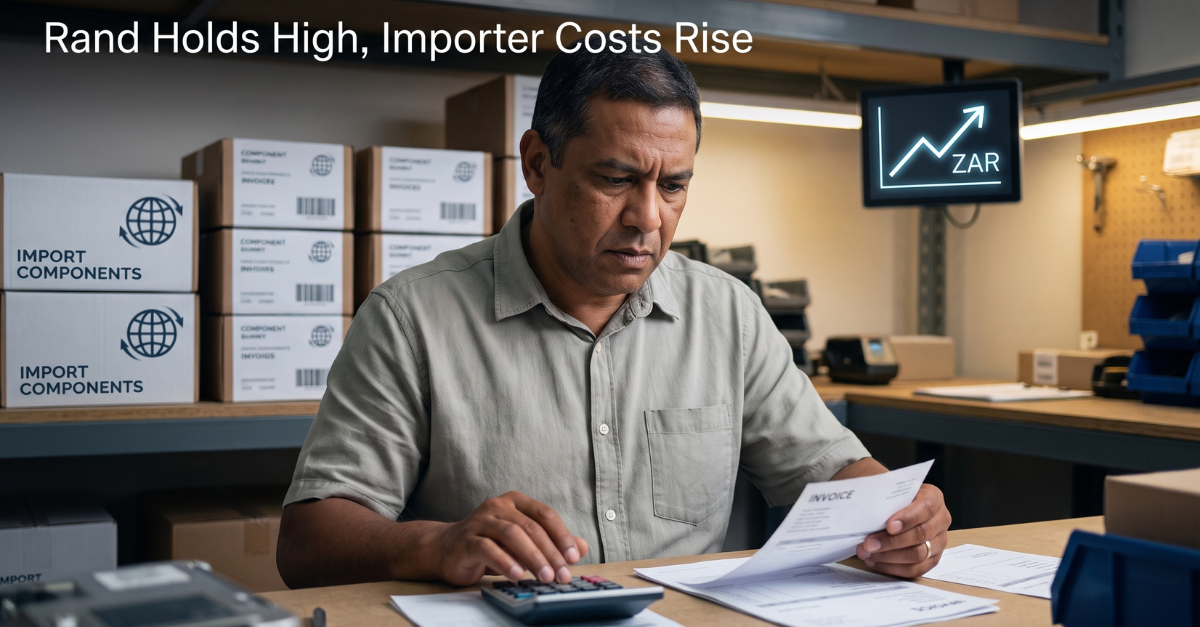
The rand has spent the past few weeks doing something South African currencies are not famous for: behaving. TradingView reports that the South African rand is hovering near its strongest level in six months, which in plain terms means it is trading close to the best exchange rate it has managed against major currencies like the US dollar in half a year. It is a good problem to have, mostly.
For small and medium enterprises that import raw materials, machinery or finished goods, a stronger rand means fewer rand are needed to buy the same amount of foreign currency. That eases purchase costs and helps cash flow. The flip side, and there is always a flip side with currencies, is that South African exports become relatively more expensive for overseas buyers, which can squeeze margins for exporters just as it relieves importers.
What is actually holding the rand up
The move sits against a backdrop of, appropriately, mixed signals. Global risk sentiment has been broadly favourable, which tends to support emerging-market currencies generally, the rand included. Domestically, the South African Reserve Bank’s repo rate has stayed unchanged, and inflation has been running within the central bank’s target band, both of which help maintain confidence in the currency without anyone needing to do anything dramatic.
Businesses with foreign-currency exposure, meaning anyone who pays or gets paid in dollars, euros or pounds, should treat this as a moment to review hedging strategy rather than assume the calm holds. A stronger rand can lower the cost of existing hedges, but any new contracts signed now may look expensive if the currency weakens again later, which currencies, being currencies, eventually do. Firms leaning on imported inputs get a short-term benefit; export-oriented competitors may be quietly watching demand from overseas soften instead.
It is worth being specific about what “strongest in six months” actually covers, since the rand has had a genuinely rough couple of years by that measure. A currency that has traded past R19 to the dollar at its weakest points in recent memory sitting closer to R18 is a real move, not a rounding error, and it changes the arithmetic on any dollar-denominated contract signed months ago at a worse rate. Businesses that locked in supplier pricing or loan terms during a weaker patch for the rand may find they are effectively paying a premium relative to today’s rate, a reminder that currency timing is rarely something a business fully controls, only something it can plan around.
None of this is a forecast. A six-month high is a snapshot, not a trend line, and the rand’s habit of swinging on domestic policy news, commodity prices and global risk appetite has not gone anywhere. What has changed, for now, is the cost side of the ledger for anyone bringing goods into the country. SMEs weighing pricing decisions, stock orders or new supplier contracts have a genuine, if temporary, tailwind. The sensible move is to use it, not to assume it as the new normal, and to keep half an eye on the same oil price and interest rate signals that could just as easily send the rand the other way.
It is also worth remembering how the rand fits into the wider basket of emerging-market currencies, since South Africa rarely moves entirely on its own steam. Global funds allocate to emerging markets as a category more than they pick individual countries, which means a wave of risk appetite lifting the Brazilian real or the Indonesian rupiah tends to lift the rand alongside it, and a wave of risk aversion tends to hit all of them together regardless of what is actually happening domestically. That is a large part of why currency forecasting is such an unreliable business: a South African business owner can get the local economics exactly right and still be wrong about the rand, because half the story is being written in trading rooms that have never heard of Midrand or the SARB’s repo statement.