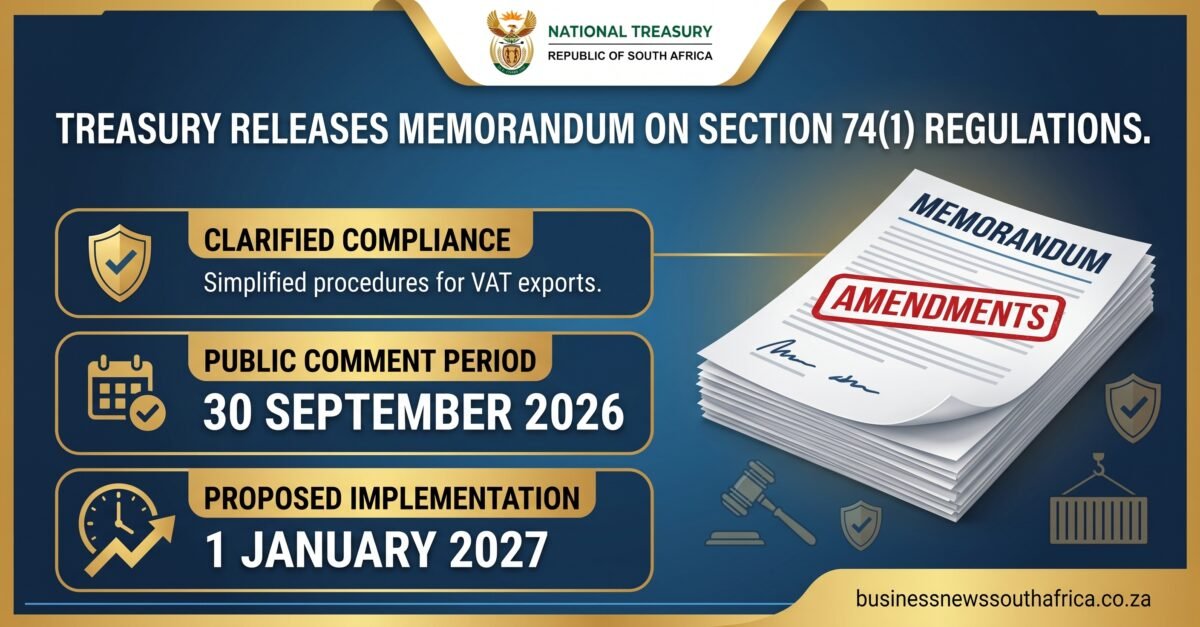
Somewhere in the Treasury building, a memo has been written whose sole purpose is to explain another document nobody outside a compliance department will ever read for pleasure. The Treasury has published an explanatory memorandum accompanying recent amendments to regulations issued under Section 74(1), read together with paragraph (d) of the DEFI. Treasury says the memo exists to clarify the purpose and expected effect of the changes, which is a polite way of saying the original wording needed a translator.
Section 74(1) sets out compliance obligations for entities that receive public funding: reporting, budgeting and audit requirements, the paperwork skeleton behind any organisation that touches state money. Paragraph (d) of the DEFI, the Department of Finance’s own provision, adds procedural detail on top of that. Together they form part of the rulebook governing how public funds get managed and accounted for, the sort of clause that means nothing until an audit season makes it mean everything.
Why an SME with a government contract should care
For any business that contracts with government, a state-owned enterprise, or an organisation reliant on public funds, a change to these rules can reshape how financial statements get prepared, how reports get submitted and when audit deadlines fall. Treasury’s own account of the amendments lists three aims: clearer definitions of key reporting terms, alignment with recent changes to the Public Finance Management Act, and a streamlined process for quarterly compliance reporting. Treasury describes the memo as a road map for entities to adjust their internal processes before the new rules take effect.
What the memo does not do is publish the full text of the amended regulations themselves. The exact wording, the date the changes become legally binding, and whether smaller entities get any transitional breathing room are all, at this stage, unknown. Treasury has indicated further guidance is coming, but has not committed to a detailed implementation timetable.
It helps to understand why regulations like this exist at all. Public Finance Management Act compliance is the mechanism that is supposed to stop public money disappearing into unexplained gaps, the audit trail that lets the Auditor-General, Parliament and, eventually, journalists trace a rand from budget to actual spend. Every tightening of definitions or reporting timelines is, underneath the dry language, an attempt to close a loophole that either caused a problem somewhere or could plausibly cause one. That is worth remembering when the amendments feel like bureaucratic noise: they are usually a response to a specific weakness someone found, even when the memo itself does not say which one.
This is not the first time South Africa’s public-sector financial rules have had a mid-life update. Recent years have brought similar revisions to procurement regulations and to reporting standards for state-owned enterprises, and those earlier rounds typically required affected organisations to upgrade accounting systems and retrain staff, a cost that lands harder on a small contractor than a large one with a compliance department to spare.
The practical advice for an SME owner holding a government contract is unglamorous but sound: watch for the detailed regulations rather than acting on the memo alone, and start a preliminary review of current reporting practices against the themes Treasury has flagged. A memo about clearer definitions and streamlined reporting is, at bottom, still just a claim about intended benefits until the actual regulation text lands. Treat it as an early warning rather than a finished instruction, and use the lead time it buys.
None of this is unique to South Africa’s public finance rules, either. Every jurisdiction with meaningful state procurement eventually runs into the same tension: rules written broadly enough to cover every possible entity end up vague enough that compliance officers argue about what they actually require, and rules written narrowly enough to be unambiguous end up needing constant amendment as new situations arise that the original drafters never anticipated. Treasury’s explanatory memorandum sits squarely in that second category, a narrow technical fix rather than a sweeping reform, which is exactly why it has attracted a memo rather than a press conference. For the SME owner reading this, that is oddly reassuring: a quiet clarification is generally easier to comply with than a genuine overhaul.