In an interview with the Truth Report, Efficient Group economist Dawie Roodt warned that the United States could take steps far beyond the current visa restrictions on a handful of South Africans. He said the American government is not limited to denying entry to individuals; it could also apply financial penalties and pressure other countries to join any future measures.
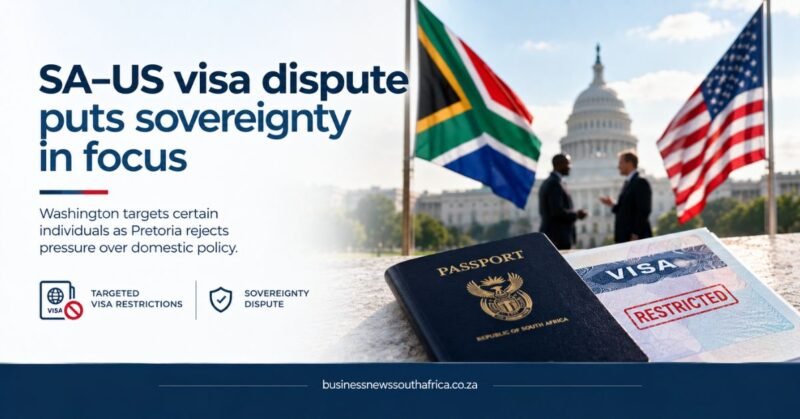
Visa restrictions, a ban on travel to the United States, were announced earlier this year for South Africans deemed responsible for policies such as Black Economic Empowerment (BEE) or land expropriation without compensation. The United States described the targeted individuals as complicit in “uncompensated land seizures, race-based discrimination and the incitement of imminent violence against minority groups”. The policy was announced by US Secretary of State Marco Rubio, who said the actions undermine peace, economic stability and the rule of law.
What the restrictions cover
The current measures affect only specific people, not the broader South African population. Roodt called this a “silver lining”, noting that the sanctions are “targeted” rather than country-wide. However, he cautioned that the United States has a range of tools at its disposal, including financial sanctions that could freeze assets, block transactions or restrict access to US financial markets.
Financial sanctions differ from visa bans in that they can directly affect companies, banks and investors that rely on US dollars or US-based partners. For South African firms that export to the United States, hold US-denominated debt, or depend on US-based venture capital, such measures could raise borrowing costs or cut off critical trade channels.
US Ambassador to South Africa Brent Bozell hinted that the visa policy is “only the first step in a series of escalatory measures”. In a tweet, he said America’s patience was limited and that stronger actions were being prepared.
South Africa’s response
South Africa’s Minister of International Relations and Cooperation, Ronald Lamola, told the SABC that the country will make its own policy decisions and will not surrender its sovereignty to external pressure. He rejected the notion that South Africa is “slow to respond” to US concerns, a point raised by Rubio during the announcement.
The political backdrop includes a declining vote share for the ruling African National Congress (ANC) and the prospect of coalition governments in upcoming local elections. While the visa bans do not affect most South Africans, the uncertainty around possible broader sanctions adds another layer of risk for businesses that operate in a politically volatile environment.
What this means for South African enterprises
For small and medium-size enterprises (SMEs) that rely on US customers or investors, the warning signals a need to review exposure to US-linked financial channels. Companies should assess whether any of their senior staff appear on the US watch list, as a visa denial could disrupt travel for negotiations, conferences or trade missions.
Enterprises can mitigate risk by diversifying funding sources away from US-centric banks, exploring local or regional financing options, and ensuring compliance with both South African and US anti-corruption regulations. The Department of Trade, Industry and Competition offers guidance on managing sanctions risk, and the Regulatory & Policy section of Business News South Africa provides tools for compliance documentation.
In short, the United States has signalled that the current visa bans are a foothold, not a final act. While the immediate impact is limited to a few individuals, the potential for broader financial sanctions means South African businesses should stay alert, review their exposure, and consider contingency plans.
BusinessTech reported that the United States previously revoked the visa of former International Relations Minister Naledi Pandor in November 2025 after she publicly criticised US policy and accused a lobby group of influencing the decision. The report also noted that US Ambassador Brent Bozell had outlined five specific “asks” of South Africa concerning BEE, land expropriation, and the country’s response to farm attacks in March 2026. These details add depth to the current restrictions, showing that the United States has a history of targeting high-profile officials and using a broader set of diplomatic pressures beyond the present visa bans.
BusinessTech also highlighted that Secretary of State Marco Rubio said the visa restrictions would apply to individuals but did not disclose the names of those affected. The source reiterated Rubio’s comment that South Africa had been “slow to respond” to earlier US concerns, a point that underpins the ambassador’s warning of further measures. By linking the visa bans to a pattern of escalating diplomatic demands, the report suggests that the United States may be preparing a coordinated strategy that could involve additional political or economic levers.
In practice, a visa restriction prevents the named person from entering the United States, while a financial sanction can freeze assets, block transactions and bar access to US-dollar markets. For South African owners, this means that any exposure to US banks, investors or supply chains could be abruptly cut off, raising the cost of borrowing and disrupting trade. Companies therefore need to map which senior staff appear on US watch lists and assess whether their operations rely on US-linked financing or contracts, because a sanction can cascade through partner networks.
Looking ahead, businesses should monitor statements from Brent Bozell and any updates from the US State Department, as well as the timing of South Africa’s upcoming local elections, which could influence the political climate. Keeping an eye on the Department of Trade, Industry and Competition’s guidance and any new entries on the US Treasury’s sanctions list will help firms anticipate further restrictions. Early detection of changes allows companies to adjust financing strategies, diversify markets and maintain compliance before any broader measures are implemented.