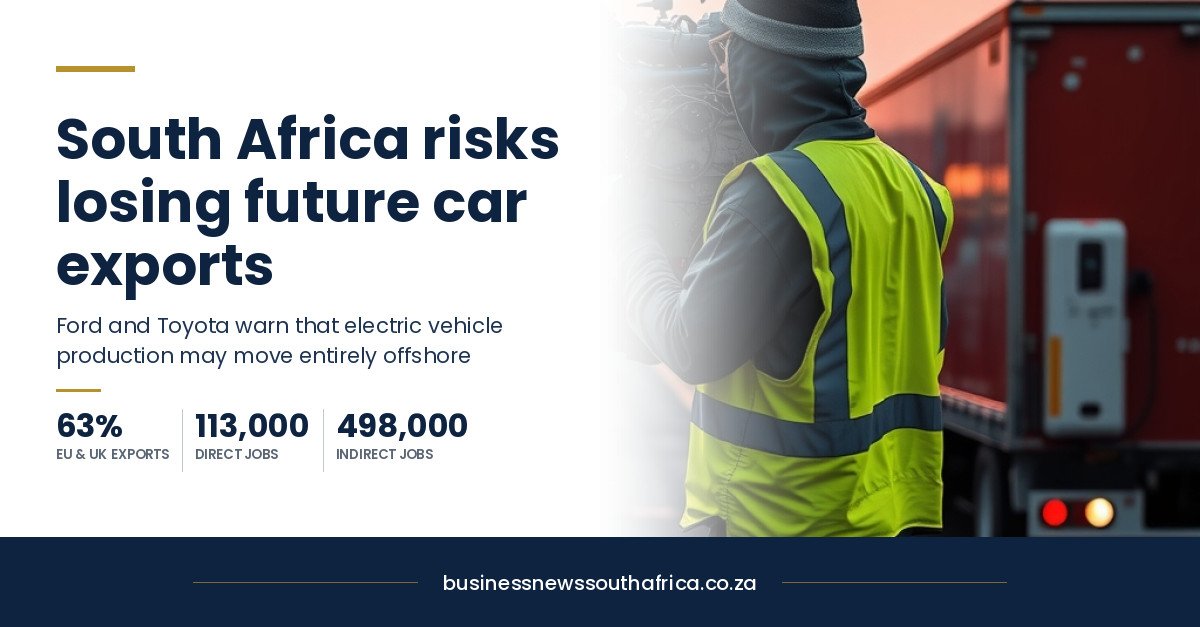
Two out of every three vehicles built in South Africa are exported, and 63% of those exports go to the European Union and the United Kingdom. Those are the two markets moving fastest to ban new petrol and diesel cars. Senior executives at Ford and Toyota have now said publicly what the industry has worried about privately for years: South Africa risks being left out of the next generation of vehicles.
In a Reuters report published by TechCentral on 25 September, Ford Motor Company Africa president Neale Hill described the competition for the company’s investment as “a competition between countries within Ford”, and warned that South Africa must not “get left behind because the global framework is moving so quickly”.
Why this is a bigger deal than it sounds
The motor industry is one of the few parts of South African manufacturing that works at scale. According to the Reuters figures, it contributed 23.8% of manufacturing output in 2025, employs about 113,000 people directly and supports about 498,000 more. Most of those 498,000 are not at the big assembly plants in Kariega, Gqeberha, East London, Pretoria and Durban. They work for the component makers, logistics firms, tool rooms, cleaning and catering contractors and small engineering shops that feed them.
These plants do not close overnight. The danger is quieter than that. De Wet Taljaard, a technical adviser at Investec Sustainable Solutions, put it plainly: “The risk is not that existing production disappears overnight. The risk is that the next generation of vehicle platforms, technologies and manufacturing investments goes elsewhere.”
That is already happening. Toyota chose Thailand, not South Africa, to build the electric version of the Hilux, a vehicle whose diesel version has been built in Durban for decades. Toyota South Africa Motors CEO Andrew Kirby said the country “used to rely on low energy costs, affordable labour, taxes and logistics. All of these have risen significantly,” and that production allocation is “moving towards Asia”.
The Rosslyn example
Nissan offers a concrete picture of what an exit looks like. The Japanese carmaker sold its Rosslyn plant to China’s Chery as part of its global restructuring, and Chery formally took it over on 3 July 2026. About 700 of the plant’s roughly 800 workers were offered jobs by Chery on similar terms, and Chery plans to start building its own SUVs there from 2027. The plant survived, but the brand, the model line-up and the supplier relationships all changed. Chinese brands are also climbing the local sales rankings, putting pressure on locally built models at home as well as abroad.
The incentive that exists, and why it may not be enough
South Africa does have an electric vehicle incentive. Section 12V of the Income Tax Act, in force since 1 March 2026, gives manufacturers a 150% deduction on new plant, machinery and buildings used mainly to produce battery electric or hydrogen-powered vehicles, for assets brought into use before 1 March 2036. SARS has published a draft interpretation note on how it works. Taljaard called it “one of South Africa’s strongest incentives for EV manufacturing”.
The carmakers’ objection is about timing and cash. A tax deduction only helps once a plant is profitable enough to have tax to deduct. Ford’s head of tax, Carla Terblanche, argued that grants work better: “Cash is immediate and helps fund your business.” Competing countries offer upfront grants.
There is also no local market to speak of. Electric vehicles make up just 2.8% of new vehicle sales in South Africa. There is no consumer purchase incentive, and import duties combined with the luxury tax can push the total levy on an electric car to around 30%, depending on its price. Manufacturers building EVs mainly for export have no home market to fall back on.
What to watch
The main policy lever is the review of the Automotive Production and Development Programme, the framework of duties and credits the industry has run on for a decade. President Cyril Ramaphosa committed in August to concluding it, and the industry wants EV-specific support in the next version. The industry body Naamsa, which appointed a new chief executive this month as US tariffs bit into exports, has been lobbying for exactly that. The uncertainty over AGOA adds another reason for Europe-bound production to matter more, not less.
For suppliers and the small businesses around the plants, the practical signal is the model allocation decisions carmakers make over the next two to three years. Each new platform awarded to a South African plant brings about a decade of orders with it. Each one that goes to Thailand or Morocco is a decade lost.