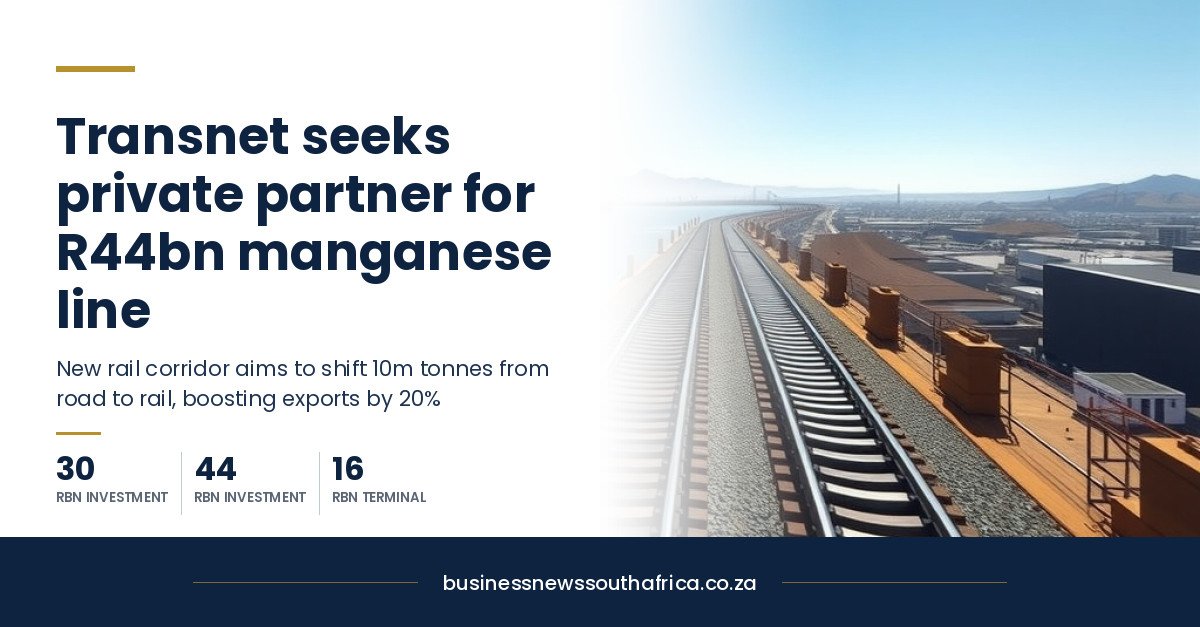
South Africa ships more manganese than any other country, and a large share of it still reaches the coast on the back of a truck. Transnet now wants a private partner to change that. The state logistics group has issued a request for qualification for a partner to fund, build and run a new manganese corridor from the mines around Hotazel in the Northern Cape to a new export terminal at the Port of Ngqura, near Gqeberha, for about 25 years.
The price tag is large. Transnet puts the total investment at R30 billion to R44 billion, Business Day reported: roughly R16 billion for the new terminal, R10 billion to R20 billion for rail infrastructure, and about R4 billion for train operations and rolling stock.
What the manganese corridor would change
South Africa exported about 26 million tonnes of manganese in 2025, according to the Minerals Council, Mining Weekly reported. Transnet’s rail system carries about 16 million tonnes of that a year. Roughly 10 million tonnes go by road, which is the volume the new line is meant to win back.
The corridor would initially handle about 12.6 million tonnes a year. The terminal at Ngqura is planned with an initial capacity of about 14.7 million tonnes, expandable to about 16 million tonnes if demand holds, according to The Herald. Transnet frames the goal as a 20% increase in manganese exports by rail, with commissioning pencilled in for 2030 to 2031.
The ore itself is a steel input first, used to harden and clean the metal, with a growing second market in batteries. Almost all of it heads east: about 95% of South Africa’s manganese exports go to Asia, with China taking nearly 68%, followed by India at 16% and smaller shares to Singapore, Malaysia and Japan.
How the deal is structured
This is not a simple concession. Transnet would keep 51% of the company that runs the terminal and corridor operations, with the private partner holding 49%. A separate rail infrastructure company would sit on the consortium’s side, while the underlying network stays with the Transnet Rail Infrastructure Manager, Freight News reported. The request for qualification is only the first stage: it tests whether bidders have the money and experience to deliver, after which those who qualify are invited to submit detailed proposals.
The model fits a pattern that has become Transnet’s default answer to its funding problem. Years of underinvestment left the group unable to pay for new capacity on its own, and private partners are now being invited in across rail and ports, from private operators running test trains on its network to the R26 billion its rail manager wants from Treasury to fix the tracks those operators will use.
What it means for Gqeberha
The move also settles a long local argument. The Port of Gqeberha currently accounts for about 65% of South Africa’s manganese export capacity, and its manganese and liquid bulk terminals have held back plans to redevelop the waterfront for years. Residents have long complained about ore dust and truck traffic, and municipal monitoring in 2026 found serious dust problems around the harbour and the Markman area, The Herald reported. Transnet says consolidating manganese handling at the new terminal would reduce road congestion, cargo handling movements and dust.
Who should pay attention
For miners in the Kalahari manganese field, the pitch is cheaper, more predictable export capacity, if the line is built on time. That is a real if: Transnet’s record on delivery is exactly why a partner is being sought. For road hauliers, the picture is the reverse. A corridor designed to pull about 10 million tonnes a year off the road is a direct threat to one of the largest bulk-haulage flows on South African roads, although it is years away and the ramp-up will be gradual.
And for suppliers in the Eastern Cape and Northern Cape, a R30 billion to R44 billion build is a procurement opportunity worth tracking from this first stage, before the contracts are handed out rather than after. The shortlist of consortia that qualify will be the first real sign of whether private capital believes Transnet can hold up its side of a 25-year bargain.