In a busy Johannesburg market, a shopkeeper pauses at a shelf of canned goods, noting that the price tags have barely moved in weeks. The relief she feels is not because the world has suddenly become cheaper, but because the South African Reserve Bank has signalled a clear path back to its 3% inflation goal.
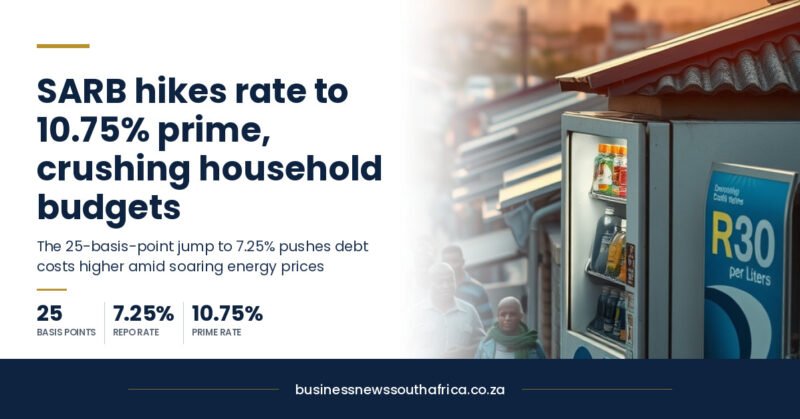
Governor Lesetja Kganyago told the Mistra Forum in Johannesburg that the central bank expects inflation to slow significantly next year and to be back at 3% by the end of 2027. He said the bank has increased the policy rate, the interest rate that guides all other rates in the economy, to 7.25% to make sure the target is met. The policy rate was lifted by 25 basis points, meaning a quarter of a percentage point, in a move that markets had already priced in.
Inflation has lingered above the target since March, driven largely by supply constraints that stem from the wars in Ukraine and the Middle East. Those conflicts have kept energy prices high, feeding through to transport costs and ultimately to the price of everyday goods.
For small and medium enterprises, the announcement carries mixed implications. Higher interest rates raise the cost of borrowing, which can squeeze cash-flow for businesses that rely on loans to fund inventory or expansion. At the same time, a credible path to lower inflation means that input costs, such as fuel, electricity and raw materials, are likely to ease, giving retailers and manufacturers some breathing room. Companies that are already servicing debt may want to review their financing arrangements using the commercial funding suite to see if a refinance is prudent before rates climb further.
Kganyago noted that it has been about six months since South Africa last hit the 3% target, a stark improvement over the 67-month interval the United States experienced before it returned to its own goal. The comparison underscores how quickly the SARB is moving to tighten monetary policy, a strategy that is less common in economies that have been able to keep inflation low for longer periods.
What remains uncertain
While the governor’s outlook is clear, the timing of price pass-through, when lower inflation actually shows up on shop shelves, can vary across sectors. Moreover, the central bank has not ruled out further rate adjustments if inflation proves more stubborn than expected. Small business owners should keep an eye on future SARB statements, which are published on the South African Reserve Bank website, and consider how any additional moves might affect their financing costs.
In the meantime, the signal that inflation is set to retreat offers a tentative optimism for entrepreneurs who have been wrestling with rising costs. As the SARB’s policy stance becomes clearer, the hope is that the price pressures that have haunted the retail floor for months will finally ease.
Moneyweb reported that Governor Kganyago’s Monday speech to the Mistra Forum highlighted a series of cascading shocks that are still reverberating through the global economy, from the Ukraine war to Middle-East tensions. He reiterated that the SARB’s decision to raise the policy rate by 25 basis points to 7.25% was a deliberate move to anchor expectations and prevent a relapse into the 67-month gap the United States experienced before it returned to its own target. The governor stressed that the tighter stance is designed to “cool inflation sharply” and that the central bank will monitor the pass-through of lower energy costs into retail prices, adjusting policy if the slowdown proves slower than projected.
Moneyweb explained that the SARB’s policy-rate mechanism works by influencing the cost of borrowing across the banking sector, which in turn affects loan pricing for businesses and consumers. When the central bank lifts the rate, commercial banks typically raise their prime rates, making new loans more expensive while also raising the cost of servicing existing variable-rate debt. For a small retailer, this can mean higher repayments on inventory financing, but it also signals a commitment to stabilise the price level, which can reduce the risk of sudden cost spikes in inputs such as fuel or electricity. Business owners should therefore watch the SARB’s quarterly monetary policy statements for clues on whether further adjustments are likely.
Moneyweb noted that the SARB’s forecast that inflation will return to 3% by the end of next year rests on the assumption that supply-side pressures will ease as energy markets stabilise. The governor warned that while the current trajectory is promising, the bank has not ruled out additional rate moves if price pressures prove more persistent. This forward-looking stance means that firms should keep an eye on the SARB’s published minutes and any commentary on the “cascading shocks” that could re-ignite inflationary pressures, especially in sectors heavily dependent on imported inputs.
Moneyweb added that the SARB’s approach reflects a broader view that investment, rather than regulation, will drive growth in South Africa. By maintaining a credible inflation target and a clear policy path, the central bank aims to create a stable macro-environment that encourages capital formation. For entrepreneurs, this translates into a more predictable cost base and the possibility of accessing longer-term financing at rates that reflect a lower inflation outlook. Monitoring the SARB’s future rate decisions and the timing of any further hikes will be essential for planning expansion, pricing strategies and debt-management initiatives.