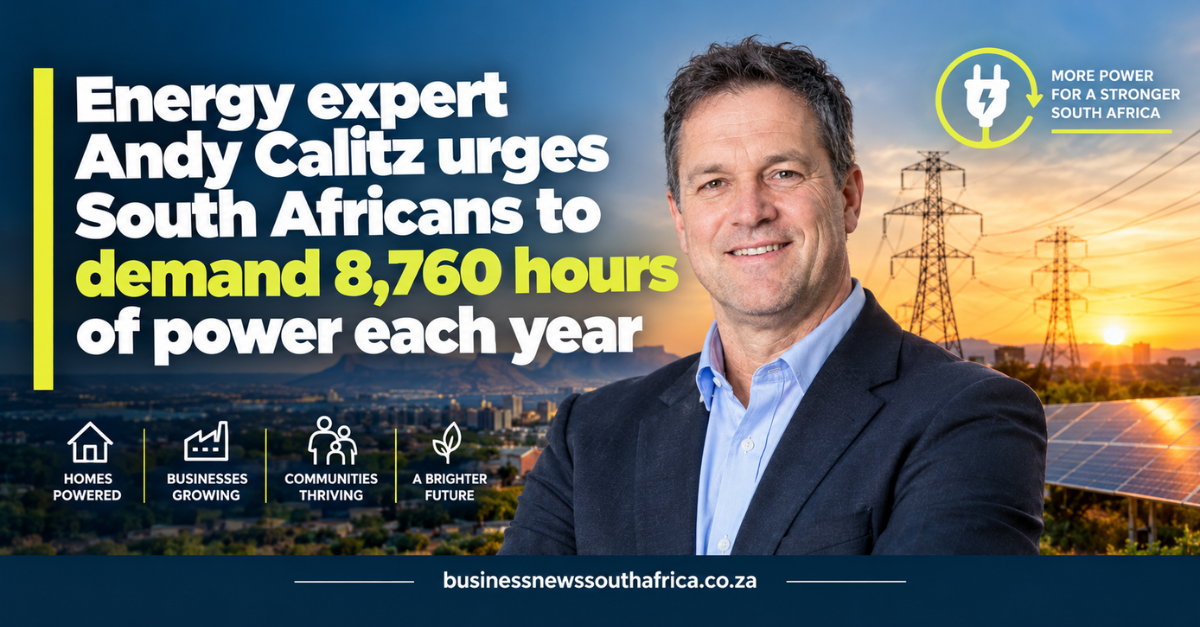
Andy Calitz, who once ran South Africa’s national transmission grid at Eskom, used a recent interview with BizNews to tell South Africans that reliable electricity should not be treated as a luxury. He says the country’s power system should deliver 8,760 hours of supply per year, the total number of hours in a calendar year, and that every farm, restaurant, school, university and business has a right to that level of service.
Calitz’s demand is more than a slogan. He argues that in a modern democratic economy, electricity is a basic requirement, not an optional extra. That is his own view of what citizens should expect, not a regulatory standard.
Why reliable power matters
South Africa has spent the last decade coping with load shedding, the planned, rolling blackouts that have become a familiar backdrop for households and enterprises. When power is cut, a restaurant loses customers, a farm cannot run irrigation pumps, a school cannot use computers, and a small manufacturer may have to halt production. Those interruptions translate directly into lost revenue and higher operating costs, which is why Calitz says the right to continuous power is a matter of economic survival for many SMEs.
Looking beyond the immediate pain, Calitz warns against framing the country’s energy future as a simple choice between one technology or another. South Africa enjoys abundant solar and wind resources, but he says a broader mix is needed to guarantee both security and affordability. He also stresses that no energy source is completely clean, coal mining, solar-panel production and wind-turbine manufacturing all have environmental footprints.
Another pillar of his argument is human capital. Calitz notes that South Africa and the wider continent need roughly ten times more engineers and technical specialists than are currently being trained. He stresses that universities, technikons and technical colleges must not only graduate more engineers, but also keep them employed locally, otherwise the country suffers a brain drain that weakens its ability to build and run power infrastructure.
The rapid growth of private-sector generation is, in Calitz’s view, a sign that citizens are taking the cost and reliability of electricity into their own hands. Rooftop solar installations and larger renewable projects have created a new class of “prosumers”, consumers who also produce electricity. This shift, he says, shows a growing willingness among South Africans to engage with the energy market and demand better service.
For the owner of a small business, Calitz’s message is a call to action: demand reliable supply, support policies that expand the skilled workforce, and consider how private generation could protect your operations from future load-shedding. In a noisy democracy, the electorate’s voice on electricity matters, and Calitz believes that voice should be louder than ever.
Calitz was one of the final candidates for Eskom’s chief executive role before the board appointed André de Ruyter, and his career since has taken him to energy markets across China, Russia, Canada and the Middle East, according to BusinessTech.