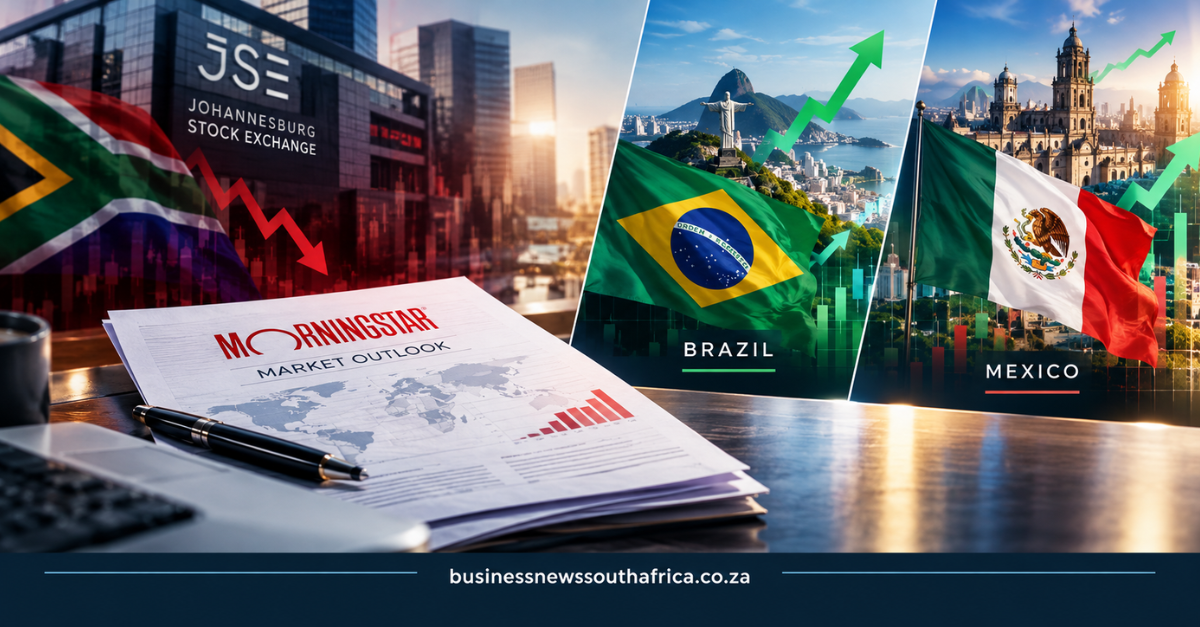
Morningstar is keeping South African shares out of its global portfolios because of the country’s weak growth, according to Sean Neethling, its South African investment head, who spoke to Bloomberg in a report carried by Moneyweb on 29 September 2026. The $375 billion asset manager is overweight emerging markets as a whole, but not South Africa.
The FTSE/JSE All Share Index had fallen more than 4% in dollar terms in 2026 by the time of the report, and is on course for its first annual drop since 2022. Over the same period the MSCI emerging-markets gauge rallied 21%, driven largely by Asian artificial-intelligence companies.
## Why Morningstar is looking elsewhere
Neethling oversees about R60 billion ($3.7 billion) in rand- and dollar-based portfolios. He said the problem is growth: “South Africa doesn’t have that growth factor that a lot of other emerging markets have right now.” The economy has expanded by less than 1% a year for more than a decade.
The technology gap is part of it too. “If you look at South Africa at a company-specific level, there’s not many companies that are at the forefront of what’s driving markets right now in artificial intelligence and tech,” Neethling said.
The money is going to Brazil and Mexico. Brazil offers diversified commodity exposure, through companies such as Petrobras and Vale, and well-capitalised banks. Mexico offers what Neethling called an “industrial-staples mix”, with companies such as Coca-Cola Femsa. China remains the firm’s strongest conviction, and South Korea looks attractively priced after a 24% decline.
An overweight position means a fund holds more of a market than its benchmark does. Underweight, the position Morningstar effectively takes on South African equities, means holding less.
## The Reserve Bank has made growth harder
The South African Reserve Bank’s Monetary Policy Committee raised the repo rate by 25 basis points to 7.25% on 23 September 2026, effective 25 September. The decision was unanimous. It was the second increase of the year, after a rise to 7.0% in May, according to a South African government news agency report on the decision.
Governor Lesetja Kganyago said the inflation outlook faced upside risks as fuel-price shocks intensified and global rates moved higher. Inflation was 4.4% at the time, against a target of 3%. The Bank cut its 2026 growth forecast to 1.2% from 1.4%, and its statement said growth risks remain tilted to the downside. It expects a rebound in the second half of the year after a contraction in the second quarter.
Higher rates raise the cost of debt for companies and households, which is the opposite of what a slow economy needs. It also makes the case for holding domestic equities harder for a global manager to argue.
## Bonds are the exception
Morningstar remains overweight South African government bonds. Neethling said “absolute yields and yields to maturity are among the most attractive in emerging markets, only second to Brazil.”
Foreign investors have been selling South African shares for years. A 2025 Reuters report, carried by CNBC Africa, cited Institute of International Finance figures showing non-residents had sold a net $5.9 billion of South African equities in the first part of that year, against $4.9 billion in the same period of 2024. It also noted that South Africa had seen annual equity outflows since 2022, even while the market posted strong dollar returns. Analysts quoted there blamed a decade of declining per-capita income and depressed growth, and concern about policy uncertainty.
For a small business, the practical link is borrowing costs. Banks usually pass repo rate changes on to prime lending rates, so the September increase is likely to reach overdrafts and term loans, while weaker foreign demand for shares matters mainly to companies planning a listing. The Markets & Finance section tracks rate and market moves, and Regulatory & Policy covers the decisions behind them.