South Africa’s podcast ad market is worth about R700 million a year and is still far from fully capitalised, according to iono.fm chief operating officer Francois Retief. Speaking on the How to Make a Podcast in South Africa show alongside South African Podcasters Guild managing director Jonathan Warncke, Retief said: “I saw a figure yesterday that the SA digital audio ad market is worth about 700 million a year, but it’s not nearly capitalised to its potential.”
Warncke framed how creators make money from a show: selling ads against listener attention, or selling something else entirely to that audience. Both models depend on data most local producers do not yet track closely, which the pair spent the conversation setting out.
Iono.fm itself is a case study in that growth. Retief said the platform was founded in Cape Town in 2018, born out of frustration with linear radio and the arrival of early smartphones, and now hosts about 2,500 podcasts. It carried more than 10 million unique South African listeners last year, hosting shows from radio groups, print-linked media houses and pay-TV broadcasters, as well as independent podcasters.
South Africa is catching up to the US, fast
Data compiled by Edison Research shows how quickly local listening habits have shifted. Retief said that when the research firm compared podcast listenership between South Africa and the United States in 2019, the country was roughly 11 years behind. By the time the same comparison ran in 2022, the gap had narrowed to about five years. “We’re definitely picking up and gaining on established markets like the US,” Retief said, though he noted the US audience is far larger in absolute terms.
What advertisers are paying, and who is buying
Major brands, including Standard Bank and Absa, now put meaningful budgets into local audio. Retief said financial institutions favour the medium because high customer lifetime value justifies the spend, a pattern that also shows up in how brands buy digital advertising more broadly, as we reported when BusinessTech drew South Africa’s biggest brands into digital advertising.
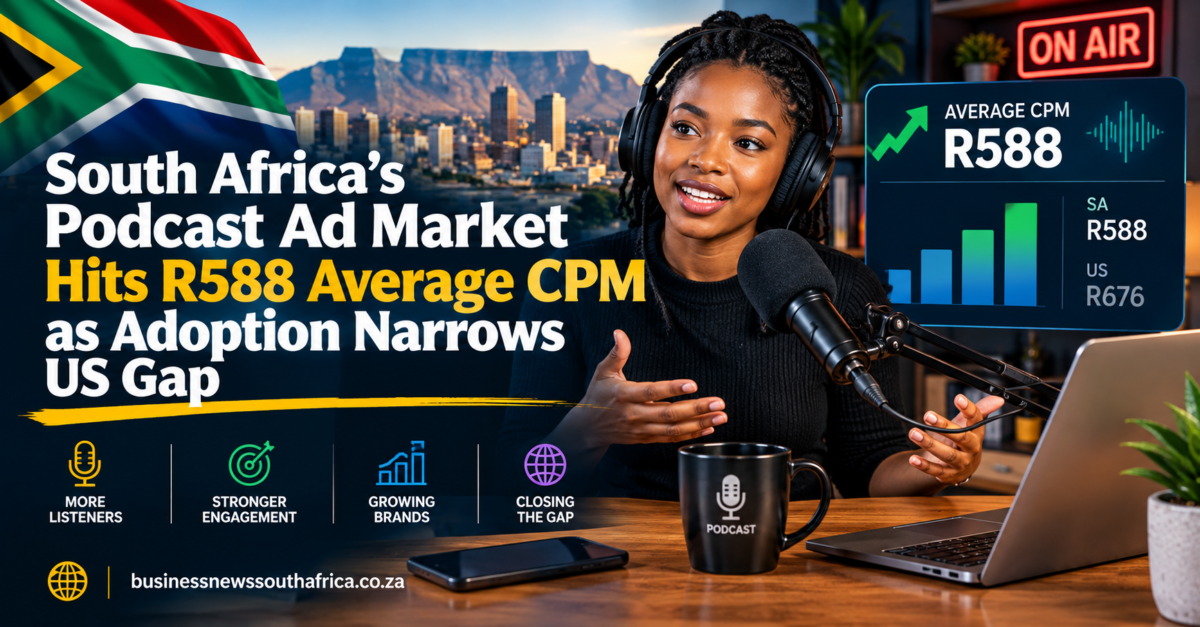
On pricing, Retief said: “In the last six months our average CPM, or cost per thousand ads delivered, was about R588 a thousand, which is very good; that’s a lot better than what you will get on YouTube.” Pre-roll ads, played before an episode starts, are the most sought-after slot. “The research that I’ve seen, and what we see on our platform as well, is your pre-roll ad is actually incredibly popular,” Retief said.
Retief cautioned independent producers against performance-based affiliate deals unless they control the advertiser’s sales funnel directly, favouring a straight cost-per-thousand structure instead. He pointed to one niche producer who built a profitable show focused entirely on tractor buyers: a small audience, but one where the value of a single sale made the advertising highly lucrative. On the technical side, dynamic ad insertion lets a publisher swap out expired campaigns and target ads by location without re-recording an episode. Retief gave an example: a campaign could run only in the Western Cape between 06:00 and 10:00, then be swapped for a different ad halfway through without touching the original recording. The same technology can split an audience across borders. Retief said iono.fm has served FNB ads to listeners inside South Africa and Standard Bank ads to the same show’s audience elsewhere in Africa. Building that capability in-house costs nothing extra once a producer owns the ad insertion, he said, but using a hosting platform’s version comes at a price: “If you run it through our platform, we ask 18% of the sales price to cover the costs of providing that technology.”
“You have to realise that the challenge with radio is you’re only as good as your last show, whereas with podcasting you’re as good as your best show ever.”
Francois Retief
That durability is what separates podcast archives from live radio. A back catalogue keeps earning long after the original air date, the same long-tail logic behind how Absa has built trust into its digital services over repeated customer interactions rather than a single transaction.
Data costs still shape how shows are made
Bandwidth remains a constraint for South African listeners, and it feeds directly into production choices. “On iono, at least, our compression at that stage used to be about seven megs per hour; we’ve increased it to 12,” Retief said, describing a constant trade-off between audio quality complaints and complaints about data size.
The platform’s own numbers show who is listening. Female listeners make up 61% of iono.fm’s audience over the past six months, spread fairly evenly across adult age groups. Genre performance runs against what traditional broadcasters might expect: business content outperforms sport, which sits at just 1.2% of total downloads on the platform. True crime and history draw a larger share, Retief said, which is a useful signal for any local brand deciding where its ad budget should sit next to a show’s content.
For advertisers, Retief said the trade-off is between reach and precision: narrow a campaign too far by targeting and it starts cutting out people who would still buy. “The more you target, the more of your audience you also lose, and you lose all of these guys that may be listening to something else but are still a pretty viable customer,” he said. It is the same tension retailers navigate when they fold advertising into loyalty schemes, such as the bank rewards added to Clicks’ ClubCard programme.