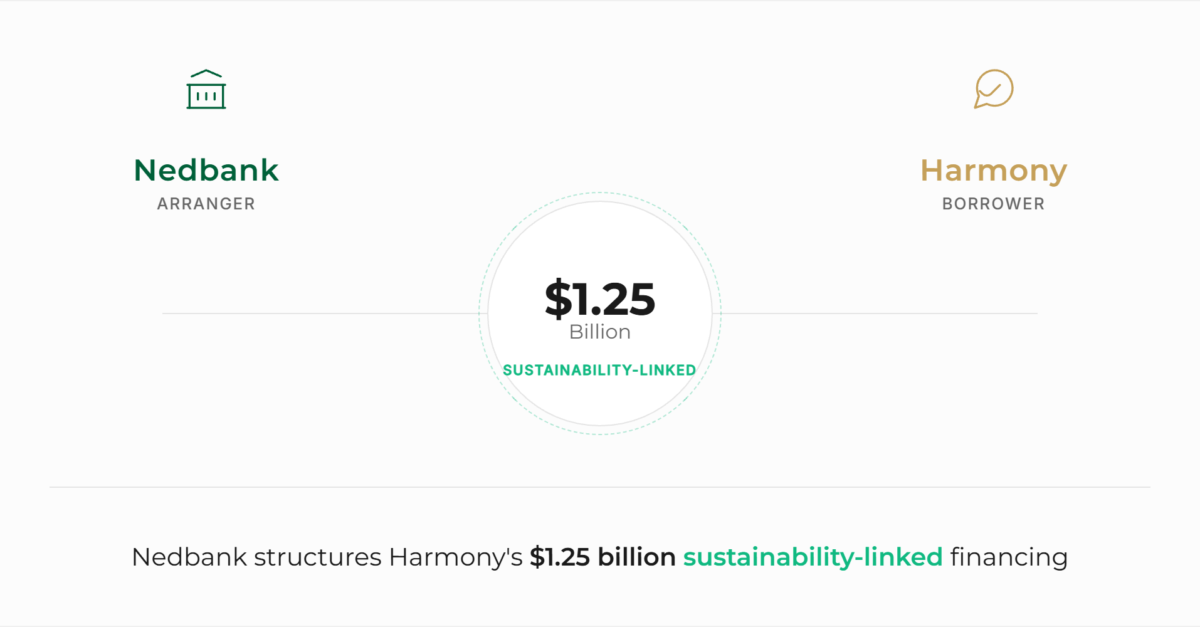
Harmony has closed a $1.25bn loan tied to sustainability targets, and the deal is a genuinely useful window into how South African miners are quietly reshaping themselves into companies that dig for more than one metal in more than one country. The South African miner, which now produces copper alongside gold, structured the financing with Nedbank and Citi, designed to replace bridge debt used to buy the CSA copper mine in Australia, fund further investment at the Eva Copper project, and support renewable-energy and other capital needs back home in South Africa.
A sustainability-linked financing is a loan whose interest rate or other terms shift depending on whether the borrower hits pre-agreed environmental goals, and this package includes a dedicated green tranche earmarked for renewable-energy projects, alongside broader targets covering energy use, water efficiency and community spending, terms that put real financial consequences behind sustainability commitments rather than leaving them as a separate reporting exercise.
A structure built for a company that no longer fits one country or one metal
The facilities split between two borrowing entities, one for Harmony’s South African operations and one for its Australian assets, drawn in more than one currency. That dual-entity, multi-currency structure means acquisition refinancing, growth capital and day-to-day funding are all managed in one coordinated arrangement rather than as separate, disconnected agreements, a genuinely more efficient setup for a company operating across two continents and two commodities at once.
Several banks from South Africa, Europe, North America, Asia and Australia joined the lending syndicate, and the loan was oversubscribed by more than three times the amount originally expected, effectively doubling the size of Harmony’s previous financing in the process, a strong signal of lender appetite for exactly this kind of diversified, sustainability-linked mining exposure. Nedbank contributed a large share of the debt and used its market relationships to bring other lenders on board, with Nivaash Singh, head of Mining and Critical Minerals at Nedbank Corporate and Investment Banking, describing the bank’s long-standing relationship with Harmony as central to shaping a solution that fit the miner’s actual strategy rather than forcing a standard, off-the-shelf product onto a genuinely non-standard company.
The deal reflects a broader trend among South African mining groups moving beyond a single metal and a single country in search of growth, seeking exposure across multiple commodities and jurisdictions rather than staying tied to gold and South Africa alone. Lenders are responding in kind, offering more complex cross-border structures and embedding sustainability performance directly into core loan terms rather than treating it as a bolt-on reporting requirement.
For owners of small and medium-sized enterprises, this specific transaction changes nothing about day-to-day borrowing options, Harmony’s $1.25bn facility operates in an entirely different world from an SME overdraft. But it does signal something genuinely relevant over time: as lenders grow more comfortable assessing multi-commodity, multi-region businesses at this scale, the criteria they apply, sustainability metrics very much included, tend to filter down gradually into how banks assess smaller borrowers too, a slow but real trickle-down effect from the top of the lending market to businesses that will never see a syndicate of this size in their lifetime.
South African mining more broadly has been navigating a genuine identity shift over the past decade, moving away from the gold-dominated single-country model that defined the industry for most of the twentieth century toward a more diversified, internationally spread portfolio approach that looks considerably more like a global mining major than a purely domestic operator. Harmony’s own trajectory, from a gold miner deeply rooted in South Africa’s historic goldfields to a company now running a copper operation in Australia, captures that broader industry pivot about as clearly as any single company’s story could, and financing deals structured this cleverly are as much evidence of that transformation as the underlying commodity mix itself.
For context: a sustainability-linked loan differs from a standard corporate facility in one key way: the interest rate moves with the borrower’s own performance against agreed environmental or social targets, so a miner that hits its emissions or water-use goals pays less over time. The JSE has been publishing guidance on exactly this kind of instrument as sustainable finance volumes grow locally. For related coverage of a different listed miner’s own regulatory-linked story, see this site’s report on Remgro’s headline earnings guidance.