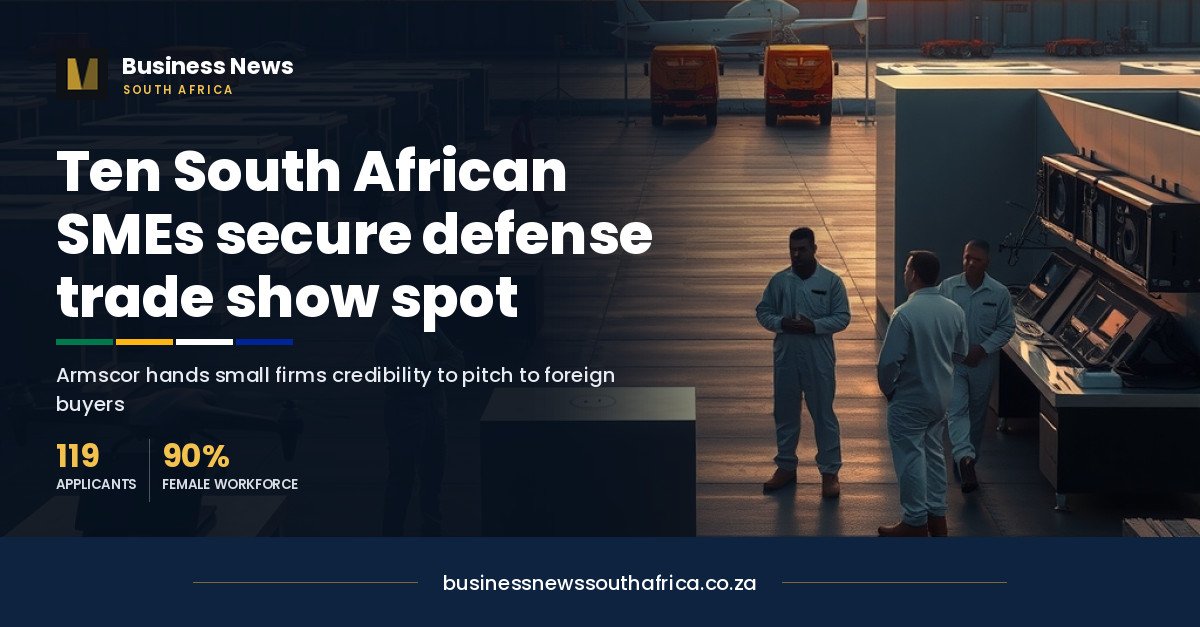
Ten small South African firms spent four days this September standing next to tanks and fighter jets, trying to convince foreign defence buyers that a company with a handful of staff in an industrial park outside Johannesburg can build something a government is willing to bet its soldiers’ lives on. That is, in miniature, the pitch the whole of South Africa’s defence-industrial sector has been making to the world for decades. This year, ten small businesses got state help to make it themselves.
The ten were selected from 119 applicants to Armscor’s Enterprise and Supplier Development programme and given exhibition space, a speaking slot at the accompanying conference, and introductions to buyers at Africa Aerospace and Defence 2026, the continent’s largest defence trade show. What they actually build is a useful map of where a small manufacturer can still find a gap in an industry usually associated with a handful of large, decades-old primes.
Some of it is hardware that would not look out of place at a consumer electronics fair with the branding changed: QP Drone Tech’s surveillance and disaster-risk drones, BattleCopter’s Air Drop Hunter, a vertical take-off drone its founder Darren Njela says is designed, developed and produced entirely in South Africa, and Sebakeng M Holdings’ ruggedised computers and tablets built to survive conditions that would kill an ordinary laptop in a week. Other entrants are quieter but just as specific: Lizwile Engineering supplies valves, steel fabrication and piping into armoured vehicles and defence infrastructure, the unglamorous plumbing that every weapons platform still needs. Mochochonono Group, a soft body armour and ballistic vest manufacturer with a workforce that is 90% female, makes the case that defence manufacturing in South Africa does not look like the industry’s own stereotype of itself.
The common thread in what each founder told DefenceWeb at the show was less about the technology than about the door Armscor’s backing opened. Nomagugu Mvelase of Lizwile Engineering said the state agency’s support let her company present its full range of capabilities rather than the fragment a small firm can usually afford to showcase alone. Kabelo Maithufi of SVM, which builds transportable waste systems and armoured bodies on an 8×8 chassis, put it more bluntly: local procurement, he said, is the only way defence-related jobs get secured in the country at all.
That is the real stake for an SME in this sector, and it is one most small businesses never have to think about. A defence buyer, whether the South African National Defence Force or a foreign government, cannot simply try a product and switch suppliers if it disappoints. Equipment gets locked into service for years, sometimes decades, and a government awarding a contract to an unproven ten-person firm is making a judgment about whether that company will still exist to support what it sold. Export sales compound the problem: Sujo Mulamattathil of Sparcx, which builds AI-assisted radar classification and runway-monitoring systems with the CSIR and Reutech, described this as government-to-government relationship-led business that takes time and has to be earned market by market, not a sales cycle a small business can shortcut with a good pitch deck.
Armscor’s Enterprise and Supplier Development programme exists precisely to absorb some of that credibility gap on a small firm’s behalf, lending its own standing to companies that cannot yet lend their own. Whether that model scales matters well beyond these ten names. South Africa’s defence-industrial base is already one of the more established on the continent, built on decades of state investment through Armscor and Denel, but much of that reputation sits with a small number of large, well-known manufacturers. A pipeline of credible small suppliers underneath them, in body armour, rugged computing, drones and the unglamorous fabrication work that keeps a vehicle fleet running, is what turns an industrial legacy into an industry that is still adding firms rather than only defending the ones it already has.
None of the ten companies at AAD 2026 disclosed contract values or confirmed export deals from the show, and a conference booth is a long way from a signed order. What the event did produce, on the evidence of what each founder was willing to say, is the one thing a small manufacturer in a sector built on long relationships actually needs first: a reason for a buyer to take the meeting.