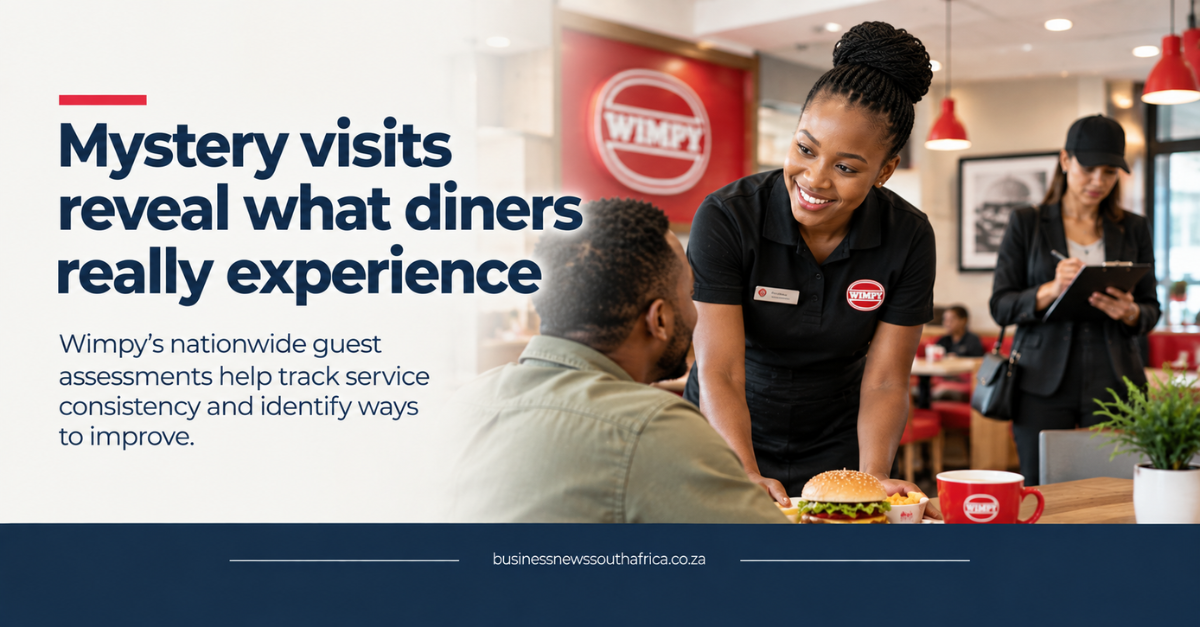
Wimpy, the South African restaurant chain, has expanded its Guest Experience Assessment programme to cover more than 400 outlets nationwide, using mystery shoppers to audit the in-store journey from entry to exit. The data, collected by BMi Research, gives the brand a regular, objective view of how staff interactions affect the customer experience.
The move follows a global consumer survey by the Qualtrics XM Institute that interviewed over 20,000 people in 2025. The study found that 34% of consumers who had a negative brand experience spent less money, translating to an estimated $2.1 trillion of reduced global spend and $865 billion in lost revenue for brands that deliver poor experiences. For South African restaurant owners, the implication is clear: inconsistent service can directly erode sales.
Why mystery shopping matters for restaurants
Unlike digital-only businesses, restaurants rely heavily on human interaction. Staff availability, attentiveness, a welcoming atmosphere and a simple thank-you at the end of a meal were all identified by the latest Wimpy research as behaviours that drive customer advocacy. Promoters, customers likely to recommend the brand, were far more likely to encounter these positive touchpoints than detractors.
According to Michele Daines, head of Research at BMi Research, “The longitudinal nature of this programme means that Wimpy can track performance over time rather than relying on a single snapshot.” By measuring the same criteria across multiple visits, the brand can spot trends, benchmark stores against each other and pinpoint whether operational changes, such as staff training or shifting service priorities, are delivering results.
For independent restaurant owners and franchisees, the insight offers a practical tool to protect revenue. If a single outlet consistently scores low on staff attentiveness, the brand can intervene before the issue spreads to other locations, potentially averting the spend-loss patterns highlighted by the Qualtrics survey.
The methodology is flexible. While the core of mystery shopping involves undercover shoppers observing real-world interactions, the framework can evolve. New measures can be added as customer expectations shift, ensuring that the research stays relevant in a market where diners are increasingly demanding and fickle.
In the broader South African hospitality sector, where competition is intense and labour costs are a constant pressure, the ability to quantify service quality provides a competitive edge. Brands that can demonstrate consistent, high-quality experiences are better positioned to retain customers and sustain spend, especially in an environment where a single negative encounter can lead to reduced patronage.
For SMEs considering a similar approach, the source article’s point is that mystery shopping does not require a large budget. It gives an objective view of where service breaks down and which training spend is justified.
Wimpy’s partnership with BMi Research shows how an ongoing assessment can replace a one-off exercise. Brands that measure the human side of the customer journey are better placed to avoid the spend-loss trends the global study identified.
Read more about practical steps for small businesses in the SME & Entrepreneurship section.
Hospitality mystery shopping provides an objective snapshot of what diners actually encounter, allowing brands to see operational strengths and weaknesses that might otherwise remain hidden, according to the Qualtrics XM Institute’s description of the approach. By sending undercover shoppers into restaurants, the audits capture real-time interactions, from greeting to farewell, and translate those observations into measurable data points. This evidence-based view helps managers pinpoint exact moments where service either enhances or erodes the customer experience, giving them a concrete basis for corrective action rather than relying on anecdotal feedback.
The Wimpy Guest Experience Assessment runs multiple research waves each year, each covering over 400 restaurants nationwide, and evaluates the entire customer journey from entry to exit. Every nuance, including the likelihood that a guest would recommend the brand, is recorded from the shopper’s perspective. Because the same criteria are applied in each wave, the programme builds a longitudinal dataset that reveals trends over time, enabling Wimpy to compare performance across locations and track the impact of any operational adjustments made between visits.
Flexibility is built into the methodology, allowing the programme to differentiate performance at the store and regional level and to isolate isolated issues from broader systemic problems. This capability means that if a particular outlet shows a dip in staff attentiveness, the brand can address that specific site without assuming the same problem exists elsewhere. Such granularity supports targeted interventions, whether through focused training sessions or shifts in service priorities, ensuring resources are directed where they are most needed.
Because the measurement framework evolves gradually, new service behaviours can be added as customer expectations shift, keeping the research relevant year after year. Daines explains that looking beyond a single satisfaction score or Net Promoter Score is essential, as deeper analysis reveals which specific touchpoints drive advocacy. By continuously updating the metrics, Wimpy can monitor whether emerging behaviours, such as a warm farewell or a personalized thank-you, are being delivered consistently and adjust its strategies accordingly.