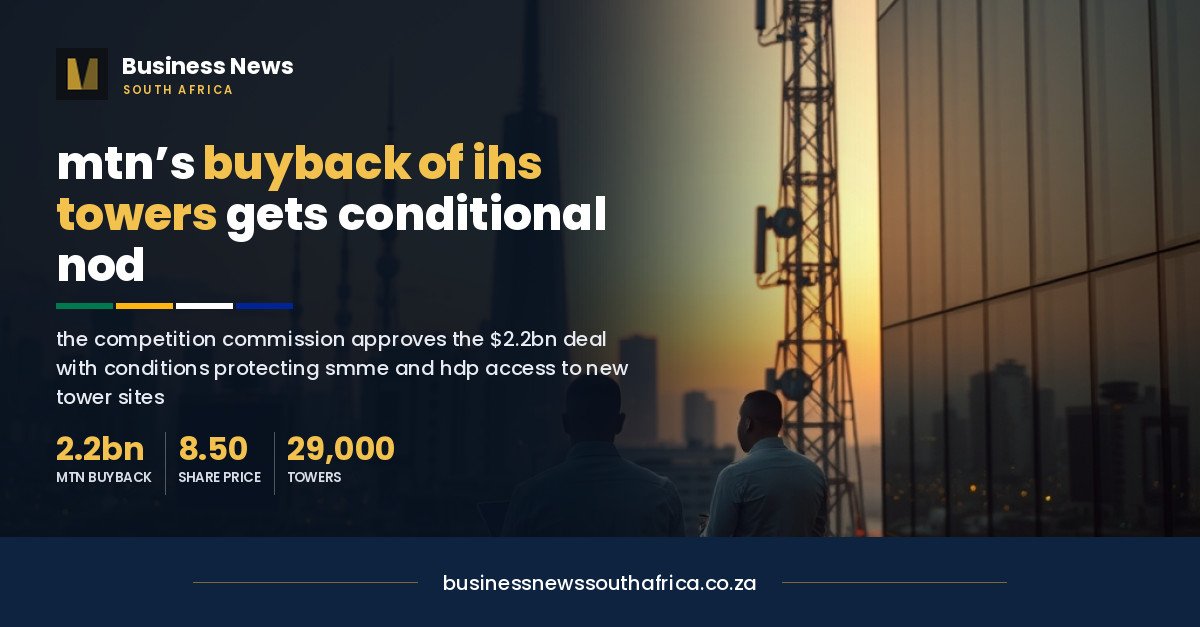
South Africa’s Competition Commission has recommended that the Competition Tribunal approve MTN’s buyback of IHS Towers, the company it sold 5,701 towers to in 2022, but only with conditions aimed at protecting small businesses and historically disadvantaged shareholders. “The conditions safeguard competitively sensitive customer information, support small, medium and micro enterprise (SMME) and HDP participation in new tower sites,” the Commission said, as reported by MyBroadband on 30 September. “The overlap is plain: MTN is a mobile operator, and IHS provides tower infrastructure to mobile operators,” TechAfricaNews quoted the Commission as saying, in a separate report confirming the same conditions and timeline.
MTN sold the towers to IHS in 2022 for R6.4 billion in cash, excluding an estimated R4.6 billion in lease liabilities, as part of the wider industry shift of selling tower networks to free up capital. MTN Group now wants to reverse that, buying out the roughly 75% of IHS it does not already own at $8.50 a share, a transaction worth about $2.2 billion, or R36.44 billion. MTN holds approximately 24.7% of IHS today and intends to take the whole company private through a cash merger once the deal closes, funded through roughly $1.1 billion of IHS’s own cash balance plus available liquidity and debt.
Why the regulator is attaching strings
“The Commission found that the proposed transaction raises competition and public interest concerns,” it said, and named the core issue plainly: MTN is a mobile network operator buying full control of the tower infrastructure other operators also rely on. IHS operates nearly 29,000 towers across Africa, serving multiple mobile network operators in the markets where MTN competes.
The recommended conditions require fair, equitable and non-discriminatory access to that infrastructure for other mobile operators, with no customer disadvantaged relative to MTN South Africa itself. Existing lease renewals must be negotiated fairly, non-MNO customers of IHS must not be disadvantaged either, and IHS must stay operationally independent rather than being absorbed into MTN’s own structures. The SMME and HDP participation condition applies specifically to new tower sites going forward, not the existing network MTN is buying back.
MTN Group chief sustainability and corporate affairs officer Nompilo Morafo welcomed the recommendation, calling the Competition Commission’s referral customary for a transaction of this size. “The parties believe the transaction will be beneficial to the entire industry,” she said, noting the conditions were ones MTN and IHS had themselves offered to address the concerns raised. The Competition Tribunal still has to make the final call, and no date has been set for that decision.
A deal that needs sign-off across several countries
South Africa is one of several jurisdictions where this transaction needs approval. Morafo said the deal already has in-principle approval from Nigeria’s Communications Commission, alongside approval from Zambia’s Information and Communications Technology Authority and the regional Common Market for Eastern and Southern Africa. Nigeria carries its own complication: Bloomberg has reported MTN needs a Nigerian investor prepared to put up R14.5 billion for a 30% stake in the local IHS entity, a separate ownership requirement tied to the Nigerian approval rather than anything South Africa’s regulator is asking for.
We reported in September on how MTN held its first Eurobond investor meetings in a decade as it prepared financing for this exact deal. The Competition Commission’s recommendation is the clearest sign yet that the regulatory path, not just the financing, is falling into place, though the SMME and HDP conditions mean MTN cannot simply reabsorb the towers on the terms it originally sold them under. Any tower company, telecoms supplier or small operator that leases space on IHS’s network in South Africa should watch the Tribunal’s eventual ruling closely, since the specific wording of the access and lease-renewal conditions will determine what changes for them once MTN is back in full control.
A pattern of conditions on big telecoms deals
This is not the first time South African competition authorities have attached public-interest conditions to a major telecoms transaction rather than blocking it outright. We reported in 2024 on how South Africa’s top mobile operators sought a competition law exemption to cooperate on shared infrastructure, a reminder that the regulator treats tower and network-sharing arrangements as public-interest territory precisely because smaller operators and SMMEs depend on fair access to infrastructure they cannot afford to build themselves.
That same SMME-access principle now sits behind the Commission’s conditions on the MTN-IHS deal, and it echoes a wider push to get smaller South African tech and telecoms-adjacent firms real access to capital and infrastructure rather than just a seat at the table. We reported last week on the JSE and TIA’s pilot to ready ten tech SMEs for capital markets, a separate initiative aimed at the same underlying problem: smaller firms in capital-intensive industries need deliberate conditions and support to compete with the scale of a company like MTN, not just the absence of an outright block on a dominant player’s deal.