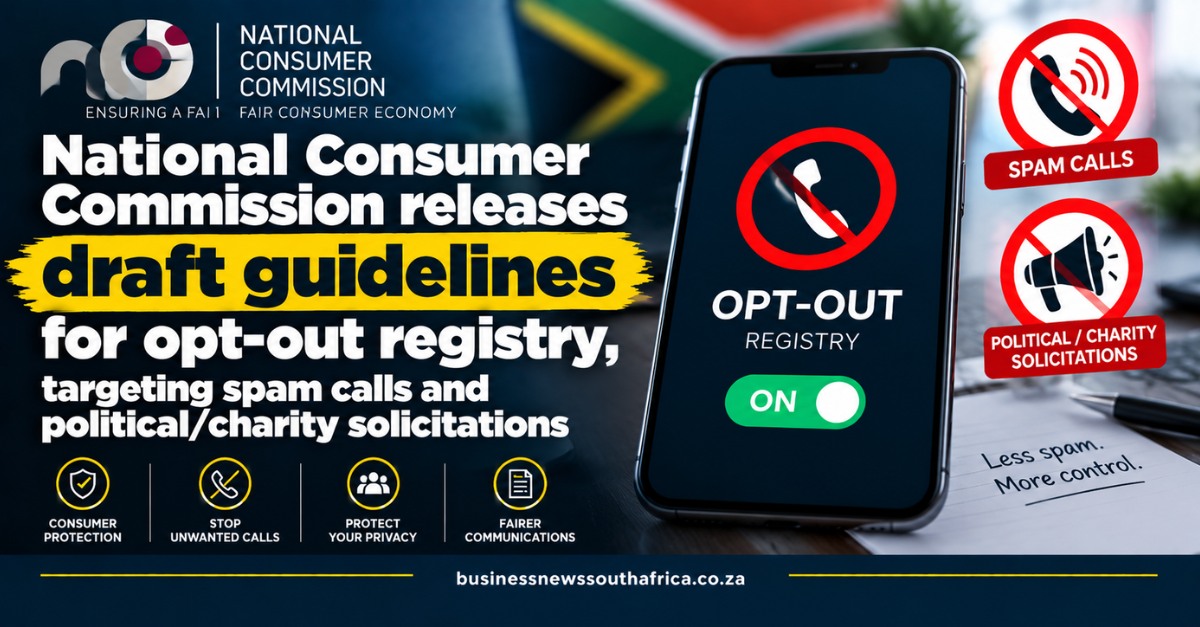
The National Consumer Commission (NCC) has gazetted draft guidelines for a new national consumer opt-out registry, inviting public comment for the next 15 days. The guidelines spell out how companies, political parties and charities must treat unsolicited marketing communications under the Consumer Protection Act (CPA).
In plain terms, an opt-out registry is a database where consumers can register a preference not to receive direct-marketing calls, SMS, emails or other outreach. Section 11 of the CPA guarantees every person the right to privacy and to block communications that are primarily for direct marketing. The 2026 amendments to the Opt-Out Regulations operationalise this right, adding requirements for direct-marketer registration, renewal, database cleansing, compliance with pre-emptive blocks, identification of direct marketers and prescribed fees.
According to the NCC, not every business call counts as direct marketing. Calls that simply administer an existing transaction, arrange delivery, resolve an account issue, provide support or fulfil a contractual obligation are exempt, unless the caller adds a sales pitch or upsell at the end. The commission gave an example: a call to resolve an account query is permissible, but if the same call ends with an unsolicited sales pitch it becomes direct marketing and must comply with the CPA, the Opt-Out Regulations and privacy law.
The draft also makes clear that using a third-party call centre or marketing agency does not shift compliance responsibility. The business that initiates the contact must ensure its service providers are registered, keep their databases clean and follow the same rules.
Political parties and charities
The NCC addressed a common question about cold-calling by political parties and non-profit organisations (NPOs). While campaigning for votes or informing the public does not automatically count as direct marketing, the moment money is solicited the communication may fall under the opt-out regime. For political parties, requesting donations is treated as direct marketing; the same applies to charities that ask for donations. However, the donation-solicitation rule only applies when the recipient’s annual turnover is less than R2 million.
In practice, an NPO that only sends educational or awareness messages is not a direct marketer, but if it follows up with a request for a donation it must register and comply with the same rules as commercial marketers.
Non-compliance can trigger a complaint to the NCC, leading to investigations, compliance notices, referrals to the National Consumer Tribunal and possible penalties. In serious cases, the CPA allows criminal prosecution with fines or up to 12 months imprisonment.
For small and medium-size enterprises, the guidelines mean an extra administrative step: registering as a direct marketer, paying prescribed fees and maintaining a clean contact database. Failure to do so could result in costly penalties or damage to reputation, especially for businesses that rely on call-centre outreach.
The draft guidelines are available on the NCC website. Stakeholders have 15 days to submit written comments, after which the commission will finalise the regulations and launch the registry.
For more background on how the opt-out system fits into South Africa’s consumer-protection framework, see our Regulatory & Policy coverage.
The draft makes clear that once a direct marketer is registered, the registration must be renewed periodically, with the NCC specifying that renewal fees are payable at the prescribed intervals. It also notes that the fee schedule is set out in the regulations, although exact amounts are not disclosed in the draft. Marketers are required to keep their registration details up to date, including any changes to corporate structure or contact information, to avoid lapses that could trigger enforcement action. Failure to renew on time could result in the marketer being treated as unregistered and therefore in breach of the CPA.
Database cleansing is a mandatory component of compliance, with the guidelines requiring marketers to regularly remove numbers that have opted out or are otherwise invalid. The NCC stresses that cleansing must occur before each campaign launch and that records of the cleansing process should be retained for audit purposes. In addition, the regulations introduce a pre-emptive block mechanism, meaning that once a consumer has opted out, any subsequent attempt to contact that number must be automatically blocked by the marketer’s dialing system, reinforcing the consumer’s right to privacy under section 11 of the CPA.
When a complaint is lodged, the NCC will first conduct an investigation to establish whether a breach has occurred before issuing a compliance notice. If the matter escalates, the commission may refer the case to the National Consumer Tribunal for a penalty hearing. The draft explicitly extends compliance responsibility to agencies, franchises and branch offices, so any subsidiary or partner acting on behalf of the principal marketer must also be registered and adhere to the same cleansing and block obligations.
The draft guidelines are hosted on the NCC’s website for download, and the 15-day comment window remains open for stakeholders to submit written observations. After the comment period closes, the commission will review the input, finalise the regulations and proceed with the operational launch of the opt-out registry, at which point the registration and cleansing requirements will become enforceable for all direct marketers.