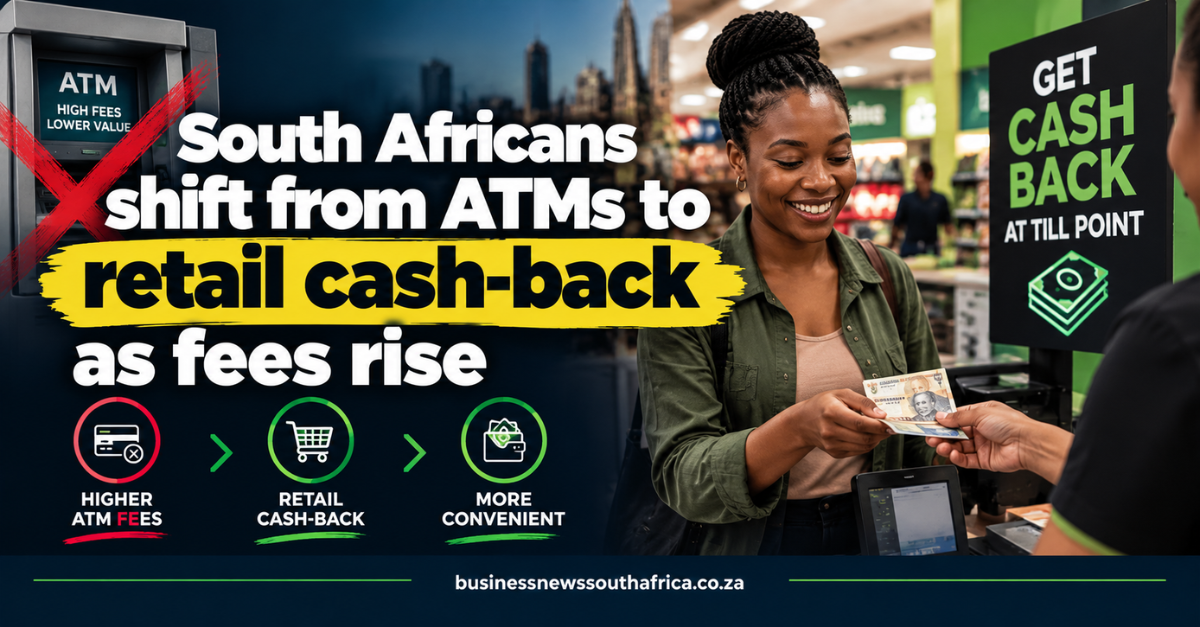
The South African Reserve Bank (SARB) said in its Cost of Cash Industry Report 2026 that South Africans are increasingly using supermarket tills for cash-back instead of traditional ATMs.
Cash-back at point-of-sale (POS) facilities means a shopper receives cash as part of a purchase, for example, buying bread and getting R100 back as change. The report found that POS cash-back accounts for about R326 billion of cash withdrawals each year, spread over 663 million transactions, with an average withdrawal of R492.
When the cost of handling cash is broken down, POS cash-back is the cheapest option: roughly 12 cents per R100 handled, versus 68 cents per R100 at an ATM and R1.53 per R100 at a bank branch. The SARB described POS cash-back as “the most cost-efficient channel due to leveraging existing retail infrastructure and high-transaction volumes.”
For consumers the savings are tangible. ATMs typically dispense only R100 and R200 notes and cannot provide coins, forcing shoppers to make extra purchases or travel to obtain smaller change. The report’s township field research noted that many people buy a loaf of bread or a soda simply to get back R10 notes and coins they need for taxi fares or informal trade.
Why the shift matters for small businesses
Retailers, including small grocery stores, can recycle cash generated through sales instead of sending it back through the banking system. This reduces both bank fees and the cost of cash-in-transit (CIT) services. For a small business that handles a lot of cash, partnering with a bank or fintech to offer POS cash-back could lower handling costs and improve customer service.
The report also highlighted the high cost of keeping ATMs running. South Africa has about 30,634 ATMs, with an average annual operating cost of roughly R307 590 per machine. While this is far less than the estimated R1.4 million needed to run a full bank branch, the total adds up across thousands of machines. Consumers collectively pay around R17.7 billion a year in cash-withdrawal fees, plus R13.3 billion in cash-deposit charges, a combined R31 billion in direct banking fees.
Beyond fees, South Africans spend an estimated R12.5 billion on taxi fares and fuel to reach ATMs or branches, another R19.5 billion is lost to queuing, and R8.3 billion is lost to travel time. Cash-related crime adds roughly R12 billion in annual losses. All of these hidden costs make the low unit cost of POS cash-back attractive to regulators, banks and merchants alike.
From a policy perspective, the SARB sees wider POS adoption, especially among informal traders through partnerships with banks and fintechs, as a way to cut handling costs and improve cash access in underserved areas where installing an ATM is not economically viable.
For small-business owners, the trend signals both an opportunity and a risk. On the one hand, offering cash-back can draw foot traffic and reduce the need to pay expensive bank fees. On the other, a continued decline in ATM usage could lead banks to withdraw machines from less-profitable locations, potentially limiting cash access for customers who rely on ATMs.
As the cash ecosystem evolves, the SARB’s recommendation is clear: regulators and industry players should incentivise and expand POS cash-back services to keep cash affordable and accessible across the country.
Read more about the broader implications for the banking sector in our Markets & Finance coverage.
The SARB’s data show that of the roughly 30,634 ATMs in the country, 21,443 are run by commercial banks while about 9,200 are operated by independent ATM deployers. Each machine carries an average annual operating cost of around R307,590, a figure that adds up quickly when multiplied across the network. Although this per-machine cost is far lower than the R1.4 million needed to keep a full bank branch open, the sheer volume of ATMs means the total expense is substantial. The split between bank-owned and independent units also influences where new machines are placed, with independent operators often targeting high-traffic retail zones.
The report highlights the practical problem of obtaining small change from ATMs, noting that “it is difficult to conjure up a R10 note from an ATM (banks favour high-value notes) and impossible to withdraw coins.” This limitation drives shoppers to purchase low-cost items such as bread or Coke, presenting a R100 or R200 note to receive the desired coins and R10 notes as change. The township field research confirms that many consumers deliberately structure purchases to solve the change shortage, turning everyday retail trips into informal cash-access points.
When a retailer offers POS cash-back, the transaction is processed through the same payment network that handles the sale. The customer’s card is authorised for the purchase amount plus the cash request, and the retailer’s acquiring bank releases the cash from its vault or a linked cash-in-transit service. After the sale, the retailer settles the combined amount with the bank, effectively recycling cash that would otherwise be sent back to the banking system. This recycling reduces the need for costly cash-in-transit pickups and lowers the retailer’s exposure to bank fees, while the bank benefits from higher transaction volumes without additional ATM infrastructure.
To encourage broader adoption, the SARB recommends that regulators create incentives for banks and fintech firms to partner with informal traders and small retailers. Such partnerships could involve reduced licensing fees for POS cash-back terminals or shared revenue models that make the service financially attractive. The central bank expects these measures to be rolled out over the next fiscal year, aiming to extend cash-access points into underserved townships where installing a new ATM is not economically viable. By expanding the network of eligible merchants, the SARB hopes to sustain the low-cost cash-handling advantage of POS cash-back across the country.