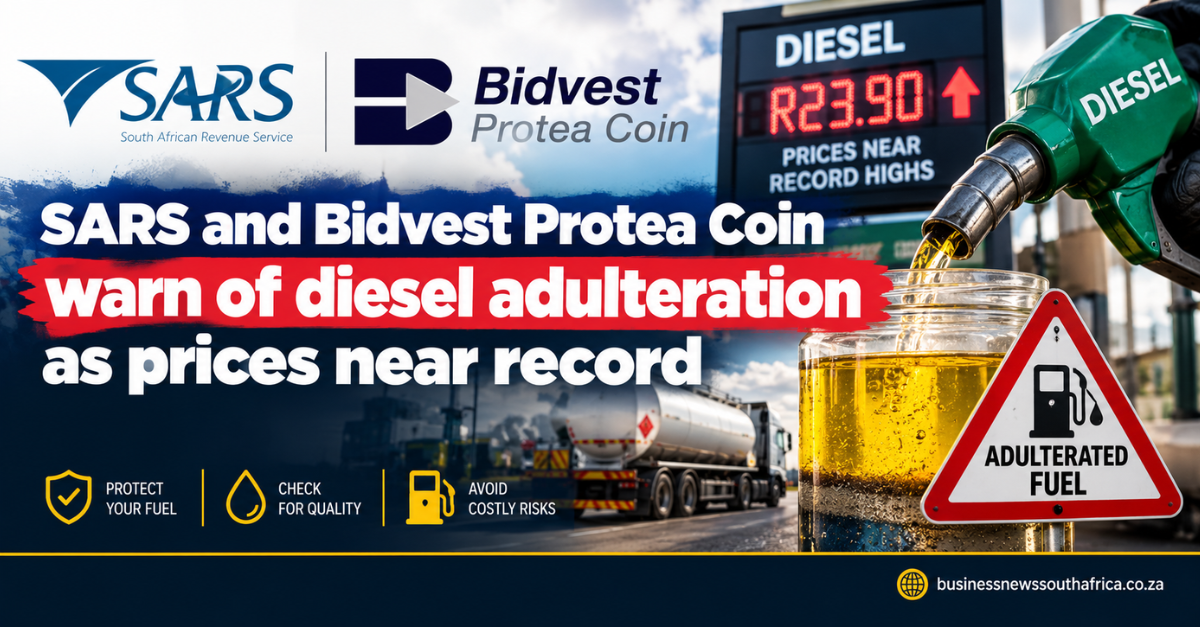
South African Revenue Service (SARS) and Bidvest Protea Coin warned on 4 October that a suspected illicit fuel operation near Potchefstroom is fueling a surge in diesel adulteration as pump prices head toward record levels.
Bidvest Protea Coin chief operating officer Waal de Waal said investigators uncovered a crude “wash plant”, a facility used to strip chemical markers from illuminating paraffin, and that the plant was intended to hide the paraffin before it was blended with diesel for sale.
Illuminating paraffin is taxed at a lower rate than diesel, creating a profit incentive for criminals who mix the cheaper substance with diesel. De Waal noted that while small-scale mixing has existed for years, the practice is now “getting out of hand”.
In a joint 2025 operation, SARS and law-enforcement seized about 2 million litres of contaminated fuel, with some storage tanks holding up to 68 % paraffin. The raid also resulted in the detention of 953 515 litres of fuel and the seizure of assets worth R367.3 million.
According to the International Trade Administration Commission (ITAC), fuel adulteration costs the fiscus roughly R3.6 billion a year. Central Energy Fund data shows current under-recoveries of between R2.73 and R3.13 per litre for diesel, adding pressure to already rising pump prices.
Motorists, transport companies and small businesses that rely on diesel face higher operating costs, while retailers risk losing market share if they sell adulterated fuel. The government’s ability to collect fuel taxes is also eroded.
Mineral and Petroleum Resources Minister Gwede Mantashe said the government cannot tackle the illicit trade alone and urged greater industry cooperation to identify offenders and strengthen compliance across the value chain.
For more coverage of fuel market developments, see the Energy & Infrastructure section.
More than 100 suspected illicit fuel depots have been flagged by Bidvest Protea Coin across several provinces, a tally that includes sites identified through the company’s helicopter surveillance team in recent months, according to de Waal. The aerial monitoring has allowed investigators to pinpoint remote locations that would otherwise escape detection, and the data gathered fed directly into the joint SARS operation that culminated in the October raid. By cross-referencing flight logs with intelligence reports, the team was able to map a network of storage points, many of which were later found to contain paraffin-diesel blends well above the 68 % threshold observed in the seized tanks.
An earlier 2023 probe uncovered around 70 service stations selling diesel tainted with paraffin, highlighting the long-standing nature of the problem before the recent surge. Those stations were identified through routine compliance checks and fuel sampling, which revealed the presence of the cheaper substance despite its lack of mandated markers. The findings demonstrated that adulteration was not confined to isolated depots but had already permeated the retail market, setting a precedent for the larger scale interdiction now underway.
The operation also exposed two mobile “washrooms”, one of which was a truck-mounted unit designed to strip chemical markers from illuminating paraffin before it entered the supply chain. Investigators described the equipment as a makeshift laboratory that allowed criminals to process paraffin on the move, thereby evading static detection points. This mobility complicated enforcement efforts, as the unit could be relocated quickly after each use, necessitating the deployment of real-time intelligence to track its movements.
Law-enforcement traced twelve fuel-transport trucks to the illicit network, linking them to false import declarations that understated volumes by up to 20 000 litres per shipment. While some importers declared 40 000 litres or less, investigations suggest actual deliveries reached 60 000 litres, a discrepancy that inflates the volume of untaxed paraffin entering the market. The trucks were seized alongside the contaminated fuel, and their documentation is now being examined for patterns that could reveal further hidden routes.
Thirteen criminal cases have been lodged with the South African Police Service as a direct result of the joint operation, each case focusing on different facets of the illicit trade, from false declarations to the operation of the washrooms. The prosecutions aim to establish legal precedents that deter future violations, and they will proceed through the courts over the coming months. While the outcomes are pending, the sheer number of cases underscores the scale of the coordinated effort required to combat fuel adulteration.
Beyond diesel, petrol has also felt the impact of under-recoveries, with Central Energy Fund data indicating shortfalls of R3.12 per litre for 95 octane and R2.93 per litre for 93 octane. These figures, alongside the diesel under-recoveries of R2.73 to R3.13 per litre, illustrate a broader fiscal strain caused by adulterated fuels across fuel types. The parallel losses reinforce the government’s call for industry cooperation, as the financial erosion extends beyond a single product and threatens the overall stability of fuel tax revenues.