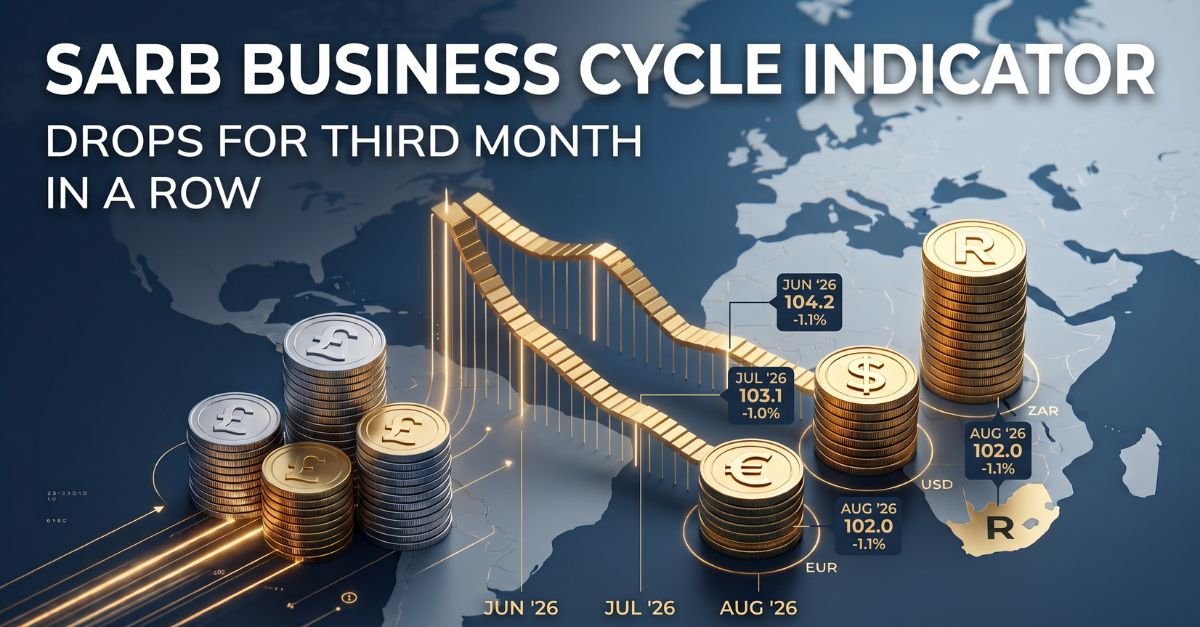
A line on the South African Reserve Bank’s monthly chart has been heading the wrong way for three months running, and business owners with an eye on the broader economy would do well to notice. The Reserve Bank’s composite leading business cycle indicator fell 1.4% in June 2026, its third consecutive monthly decline, according to the bank’s release of 25 August 2026 as reported by EWN.
The leading indicator exists specifically to flag shifts in economic activity before they show up in official statistics. It is a composite of several economic series, and its changes are reported as percentage movements month on month rather than against a fixed expansion or contraction threshold.
What drove the decline
The Reserve Bank said the fall mainly reflected lower dollar prices for South Africa’s main export commodities and slower growth in the money supply. Five of the seven available component series decreased. A rise in the number of building plans approved and faster growth in job advertisements partly offset those declines.
The Reserve Bank’s other two indicators moved differently. The coincident indicator, which measures current activity, slipped 0.2% in May, with weaker wholesale, retail and motor trade sales and lower industrial production behind the decline. The lagging indicator, which reflects trends already established in the economy, rose 0.9% over the same period.
The Reserve Bank did not tie this specific trend to any policy decision. A falling leading indicator has traditionally pointed to weaker demand ahead, but a single index cannot confirm which pressures are responsible, and the statistics reported here do not by themselves show the economy has entered a contraction.
Without further data, firms are left to monitor upcoming releases for sharper insight, especially if the indicator keeps trending downward into a fourth or fifth month. The next release was scheduled for 22 September.
Composite business cycle indicators like this one are deliberately built to lead rather than confirm, because hard data such as GDP or retail sales figures only arrive weeks or months after the fact, by which point a business has already lived through whatever shift the indicator was trying to flag. Three consecutive monthly declines is the kind of sustained signal these indices are designed to catch early, which is why a business owner tracking cash flow and hiring plans may want to treat this release as a prompt to review their own outlook.
The Reserve Bank’s own business cycle indicator series is published monthly and is the primary source for tracking whether this is a genuine trend or a short-lived dip. For related coverage of the broader growth picture this indicator feeds into, see this site’s report on South Africa’s stalled growth.