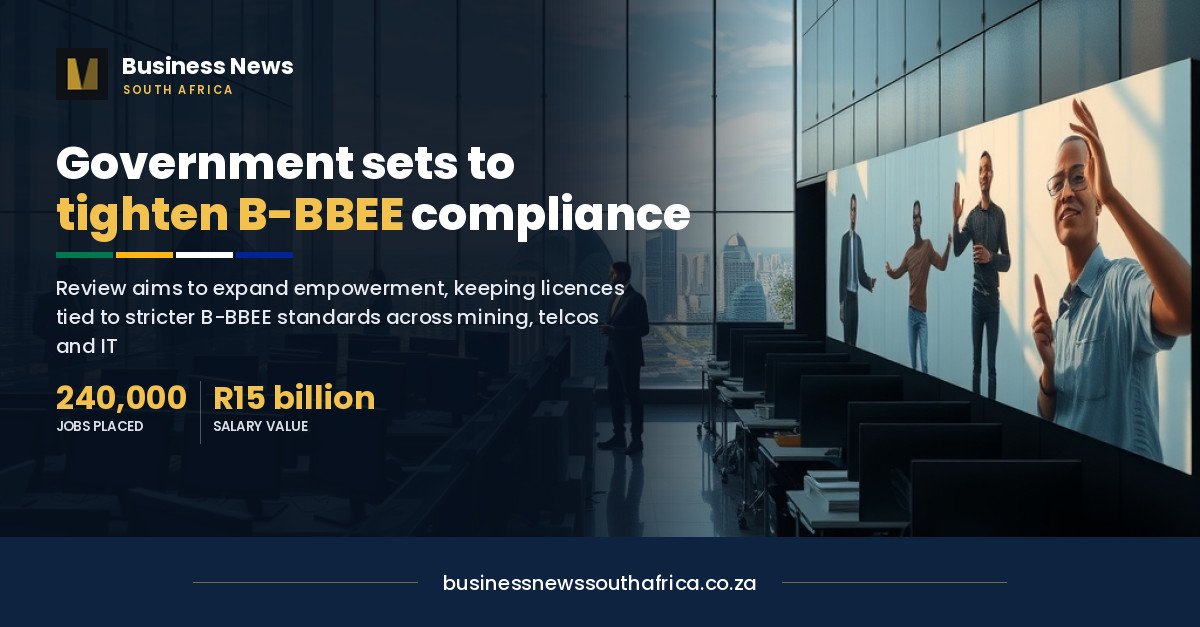
Minister in the Presidency Khumbudzo Ntshavheni told IOL that the government will support a review of South Africa’s Broad-Based Black Economic Empowerment (B-BBEE) laws to expand and strengthen the framework. The statement, published on 5 October 2026, makes clear that the policy is a constitutional obligation, not a bargaining chip, and that the administration intends to double down on redress.
For companies that need a state licence, for example in mining, telecommunications or information-technology, the announcement signals that compliance requirements will stay in place and may become more demanding. Multinationals that cannot sell equity in local subsidiaries can still meet their B-BBEE targets through Equity Equivalent Investment Programmes (EEIPs), a route the minister highlighted as already being used by firms such as Dell, Microsoft and HP.
Key elements of the current B-BBEE landscape
B-BBEE is defined in the Broad-Based Black Economic Empowerment Amendment Act as the viable economic empowerment of all black people, including women, youth, people with disabilities and rural residents. The policy is delivered through a mix of strategies, increasing black ownership and control of enterprises, developing skills, and supporting black-owned businesses.
The Youth Employment Service, created under the B-BBEE framework, has placed about 240,000 young South Africans in a full year of paid work, generating roughly R15 billion in salaries. EEIPs have helped global companies create more than 2 000 jobs, back 87 black-owned businesses (almost half owned by black women) and train over 2 500 people.
Ntshavheni stressed that these gains have not come at the expense of white South Africans, who continue to prosper. She noted the stark income gap, a typical black worker earns around R5 200 a month versus R25 000 for a typical white worker, and warned that abandoning redress would betray the promise of 1994.
In practical terms, the minister said the Department of Trade, Industry and Competition (DTIC) is already guiding investors through the policy’s flexibilities. Each sector has its own set of codes negotiated by a charter council, allowing tailored approaches while maintaining the overall empowerment goal.
For businesses, the key take-aways are:
- Compliance with B-BBEE remains a condition for licences in strategic sectors.
- EEIPs provide a viable alternative to equity sales for multinationals with restrictive global policies.
- The upcoming review may tighten measurement and reporting, so companies should audit their current scores.
- Opportunities exist to partner with black-owned enterprises and tap into government-supported programmes such as the Youth Employment Service.
While the government welcomes foreign capital, Ntshavheni reiterated that investment must build processing, beneficiation and manufacturing capacity on South African soil. “That is investment with development, not investment at the expense of development,” she said.
Stakeholders who rely on state licences or who source from local suppliers should monitor the review process closely. The minister’s message is clear: B-BBEE is here to stay, and the next phase will aim to make transformation more robust and aligned with growth objectives.
Read the full statement on BusinessTech. For more on the regulatory environment, see the Department of Trade, Industry and Competition. Related coverage can be found in our Regulatory & Policy section.