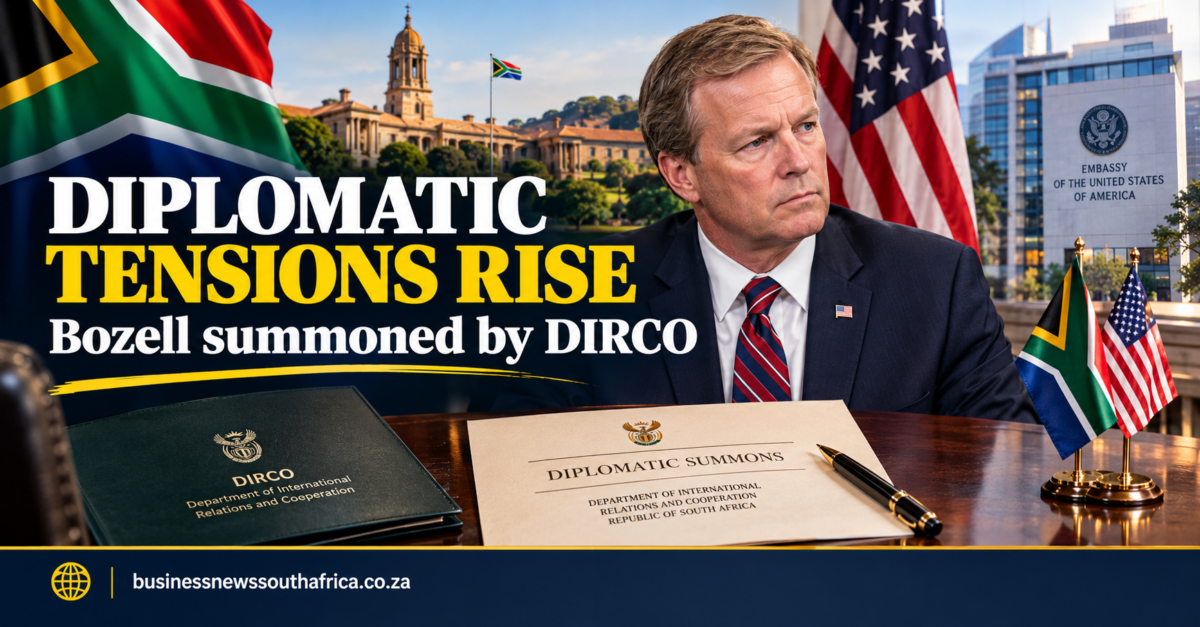
The Department of International Relations and Cooperation (DIRCO) has summoned United States Ambassador to South Africa Leo Brent Bozell to explain what it calls “undiplomatic conduct”. DIRCO confirmed to the South African Broadcasting Corporation that it issued a demarche this week, the second one this year.
A demarche is a formal diplomatic protest used by one government to register a grievance with another. In this case the grievance centres on Bozell’s recent op-ed and public statements that criticised President Cyril Ramaphosa and described South Africa’s response to US diplomatic demands as “spin” and untruthful.
In the op-ed Bozell outlined five “asks” that Washington presented to Pretoria in November 2025, saying his arrival in February 2026 had accelerated the discussion. He claims the South African response, delivered by Ramaphosa in September after nine months, failed to address the United States’ concerns. The United States Secretary of State Marco Rubio then imposed visa sanctions on targeted South Africans.
South African officials have pushed back, saying the response to the United States was comprehensive and characterising the US statements as an attempt to undermine South Africa’s sovereignty. The government’s position is that the visa sanctions are a disproportionate reaction to a diplomatic dispute.
Bozell was previously demarched in March 2026 after he described the “kill the boer” chant as hate speech, later back-tracking to say it was a personal view and that the US respects South Africa’s judiciary. The issue resurfaces as the Constitutional Court is set to rule on the Expropriation Act, a matter that could further test diplomatic sensitivities.
While the immediate impact is diplomatic, the visa sanctions could affect South African professionals, students and business travellers who rely on US entry permits. Companies with US links may need to monitor the situation for any operational or compliance implications.
What Washington asked for, and what business should watch
Bozell’s op-ed set out five specific asks the US presented to Pretoria in November 2025, with his own account of how far each has been addressed. Two are directly relevant to business: Washington asked South Africa to create alternatives to Broad-Based Black Economic Empowerment ownership rules, such as equity equivalent investment programmes (EEIP), across all sectors. South Africa already allows EEIP in some sectors but has refused to extend it to telecoms or mining, which Bozell lists as unaddressed. The other three asks cover the processing of Afrikaner refugees in the US (which both sides agree has been addressed), the Expropriation Act (now before the Constitutional Court), and whether government officials condemn the singing of a contested political chant.
For a business with US ties, the asks matter less than the consequence: Secretary of State Marco Rubio’s visa sanctions on named South Africans, imposed after Ramaphosa’s September response. Companies with staff who travel to the US for work, or who need US visas for shareholders, directors or technical specialists, should treat the diplomatic dispute as a live compliance risk rather than a political sideshow, and confirm the travel status of anyone who might be affected before booking US trips tied to a deal or a conference.
This is the second demarche Bozell has faced in 2026. The first came in March, after he initially described the chant “kill the boer” as hate speech regardless of court rulings on the matter, then said days later that it was a personal view and that the US respects the independence of South Africa’s judiciary. That back-and-forth is the pattern businesses should expect to continue: a public statement from the ambassador, a diplomatic protest from Pretoria, and no change yet to the underlying visa sanctions or trade relationship.
The broader US-South Africa trade relationship, including the future of duty-free access under AGOA, has already been a live risk for exporters. This diplomatic dispute runs alongside that trade question rather than replacing it, and a business exporting to the US or relying on US-linked finance should track both.