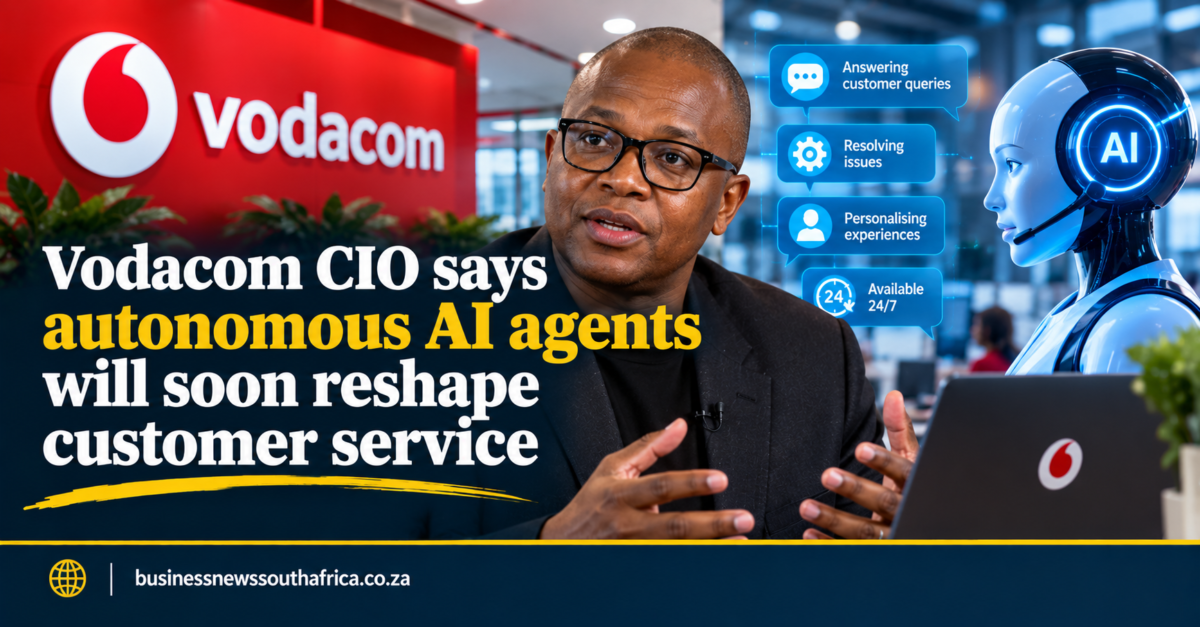
Group Chief Information Officer Mohamed Sami told TechCentral on its Meet the CIO podcast that autonomous AI agents, software that can resolve a customer problem from start to finish without handing the case to a human, are arriving very soon.
Autonomous AI agents differ from the chatbots and voice bots that already answer routine questions. An autonomous agent can understand the context of a request, pull data from multiple back-end systems, and complete the transaction or troubleshooting step without a live operator.
According to Sami, Vodacom’s existing chatbots and voice bots already handle a considerable share of inbound calls. In addition, AI-powered tools now sit behind human agents, surfacing the right information across disparate systems so that agents do not have to jump between screens.
The degree of autonomy, he added, will depend on how much intelligence, such as natural-language understanding and decision-making, and orchestration, the ability to coordinate multiple services, are built into the platform.
This push mirrors a broader trend in the telecom sector, where operators are using artificial intelligence to cut contact-centre costs, improve first-call resolution rates, and deliver faster service to both retail and business customers. For small businesses that rely on Vodacom for mobile and data services, quicker problem resolution could mean less downtime and fewer interruptions to daily operations.
While the statements describe Vodacom’s roadmap, the timeline remains a company claim until the technology is rolled out at scale. The next few months should reveal pilot projects or limited-release features that test the promised “very soon” rollout.
For more analysis of how AI is reshaping South African telecoms, see our Tech & Telco coverage.
During the interview, Sami emphasized that the shift to autonomous agents will not take years to materialise, stating, “When I say it is the next big thing, it is not something that is happening in years. It’s something that is happening very soon.” This comment adds a concrete sense of urgency to the roadmap, suggesting that the pilot phases could move into broader deployment within the next quarter rather than remaining a distant ambition. The phrasing also signals confidence that the underlying technology stack is already mature enough to support a rapid transition from experimental trials to operational use across Vodafone’s service channels.
The Meet the CIO podcast series, which hosted Sami’s discussion, is produced in partnership with NTT DATA. This collaboration brings together Vodacom’s strategic vision and NTT DATA’s expertise in systems integration, potentially accelerating the development of the orchestration layer that links multiple back-end services. By leveraging NTT DATA’s experience in large-scale AI deployments, Vodacom can tap into proven methodologies for testing, security validation and performance monitoring, thereby reducing the time required to move from proof-of-concept to a production-ready autonomous agent environment.
In addition to the technical partnership, the podcast platform itself uses cookie technology to personalise the listener experience. Users who consent to these cookies receive enhanced features such as episode recommendations and seamless playback across devices. While the consent mechanism is a routine part of the website’s operation, it also illustrates how Vodacom and its media partners are already employing data-driven approaches to optimise user engagement, a practice that mirrors the broader aim of using AI to streamline customer interactions.
Vodacom’s existing AI tools already surface relevant information for human agents, reducing the need to toggle between disparate applications. The next phase will involve embedding decision-making logic directly into the autonomous agents, allowing them to execute end-to-end transactions without human oversight. This evolution requires a robust governance framework to ensure that the agents adhere to regulatory standards and maintain data privacy, particularly when accessing sensitive customer records across multiple systems.
Regulatory compliance will be overseen by Vodacom’s internal audit function, which will conduct periodic reviews of the agents’ decision logs. These logs capture each step the AI takes, providing a traceable record that can be examined for accuracy and bias. The audit schedule is expected to align with the company’s quarterly reporting cycle, ensuring that any deviations are identified and corrected before the agents are rolled out to the full customer base.
Looking ahead, the rollout plan includes a staged expansion that begins with high-volume, low-complexity queries such as balance checks and data top-ups. Once stability is demonstrated, more intricate issues like device provisioning and fault diagnosis will be added. Each stage will be measured against predefined service-level targets, and successful completion will trigger the next release window, creating a predictable cadence for bringing autonomous AI capabilities to all Vodacom customers.