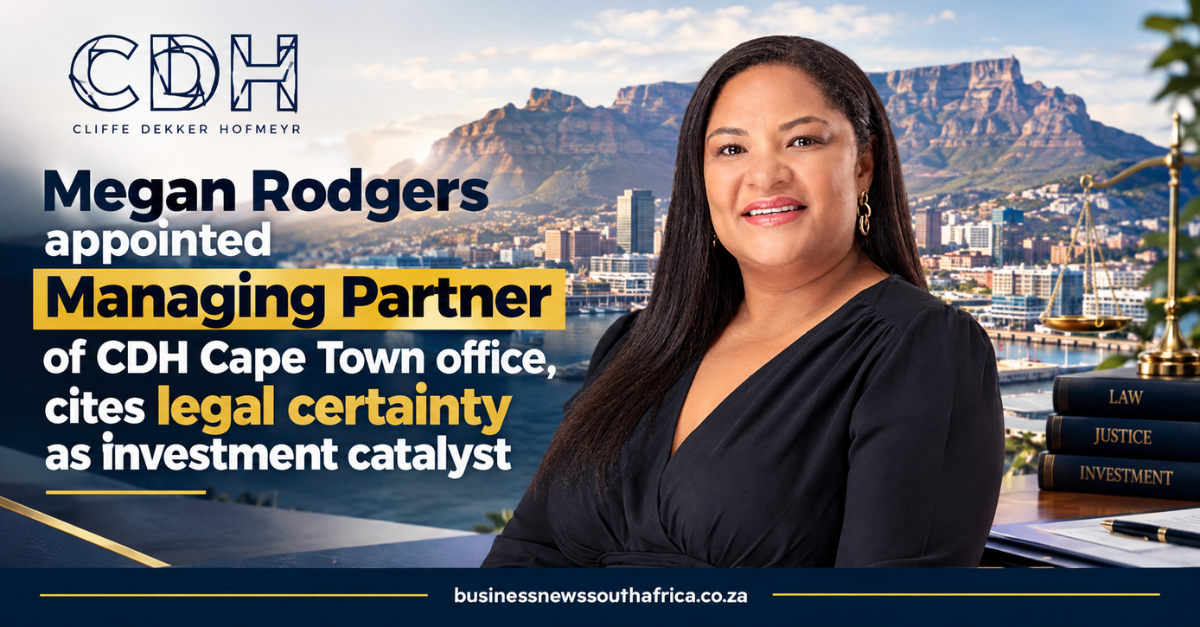
Cliffe Dekker Hofmeyr (CDH) announced that Megan Rodgers will serve as Managing Partner of its Cape Town office, a move that could affect companies seeking legal guidance on energy projects across Africa. The appointment was disclosed in a Business Talk interview hosted by Michael Avery.
According to the interview, Rodgers brings dual qualification as a South African attorney and a solicitor of England and Wales, and she is a member of the Association of International Petroleum Negotiators and Women in Oil and Energy South Africa. Her résumé includes former roles as Director at BBP Law and Associate at Bowman Gilfillan, and she has been with CDH for nearly 12 years.
Rodgers said her priority as Managing Partner will be to strengthen legal certainty, the predictability and stability of laws and regulations, to make the Cape Town office a reliable partner for long-term projects. She framed legal certainty as a prerequisite for investors who need confidence that contracts will be enforced and that regulatory changes will be transparent.
When asked about recent fuel-sector trends, Rodgers highlighted increased interest in renewable-fuel projects and the continued importance of traditional oil and gas supply chains. She argued that without clear legal frameworks, even well-funded projects can stall, limiting the sector’s growth potential.
Rodgers distinguished between merely passing legislation and taking the steps needed to create an investment-friendly environment. She warned that laws on paper do not automatically translate into a favourable climate for capital if enforcement mechanisms and dispute-resolution processes remain ambiguous.
Looking ahead, Rodgers believes Africa can unlock more investment by improving the consistency of its legal systems. She positioned CDH as a conduit that helps clients navigate complex regulatory landscapes, thereby reducing risk and encouraging capital inflows.
Read the full interview on Business Talk. For more stories on regulatory developments, visit our Regulatory & Policy section.
Beyond her new Managing Partner role, Rodgers also serves as Director in the Corporate and Commercial Practice and as Sector Head of Oil and Gas for CDH, giving her oversight of both transactional work and industry-specific counsel. She earned a Bachelor of Laws and a Master of Laws from the University of the Western Cape, credentials that complement her dual qualification as a South African attorney and a solicitor of England and Wales. Membership of the Association of International Petroleum Negotiators and Women in Oil and Energy South Africa further embeds her in networks that shape cross-border energy deals, a fact she highlighted when discussing the breadth of CDH’s client base.
Rodgers said her agenda for the Cape Town office will centre on building a pipeline of long-term projects by tightening contract enforcement and streamlining regulatory approvals, a focus she described as essential for “sustained success” of the practice. She plans to embed risk-assessment frameworks into early project stages, ensuring that any amendment to legislation is captured in client advisories. By aligning the office’s service model with the expectations of multinational investors, she hopes to reduce the time between deal conception and execution, thereby enhancing the office’s reputation as a dependable partner.
In the interview, Rodgers identified a shift toward renewable-fuel initiatives, noting that developers are increasingly seeking clarity on feed-stock definitions and carbon-credit mechanisms. She also observed that traditional oil and gas supply chains remain vital, but that investors now demand transparent frameworks for de-risking legacy assets. These observations stem from recent tender rounds where bidders asked for explicit guidance on tariff structures and environmental compliance, signalling a market that values predictability as much as price.
The process of achieving legal certainty, according to Rodgers, begins with drafting legislation that incorporates stakeholder input, followed by the publication of detailed implementation guidelines. Once the rules are codified, enforcement agencies must establish clear inspection protocols and penalties, while courts develop precedent through consistent rulings. Dispute-resolution mechanisms, such as arbitration clauses tailored to the energy sector, are then embedded in contracts to provide parties with a reliable avenue for conflict management, reducing reliance on protracted litigation.
CDH’s role, as Rodgers explained, is to translate these procedural steps into actionable advice for clients, drawing on the firm’s expertise in both corporate law and sector-specific regulation. By coordinating between the Corporate and Commercial Practice and the Oil and Gas sector team, the firm can offer integrated solutions that address financing structures, joint-venture arrangements, and compliance audits in a single workflow. This holistic approach allows clients to anticipate regulatory shifts and adjust their strategies before formal changes take effect.
Looking ahead, Rodgers believes that Africa’s investment potential will expand as more jurisdictions adopt the same systematic approach to lawmaking that she described. She expects that, over the next few years, the accumulation of consistent enforcement records and transparent amendment processes will create a virtuous cycle, attracting larger capital flows into both renewable and conventional energy projects. CDH intends to monitor these developments closely, positioning its Cape Town office to advise on emerging opportunities as they arise.