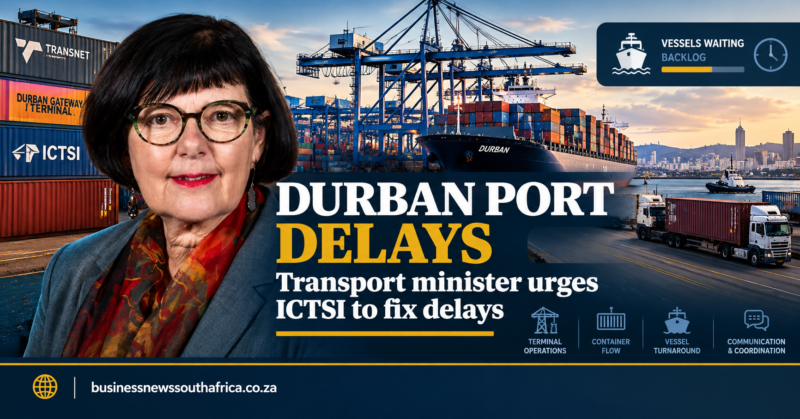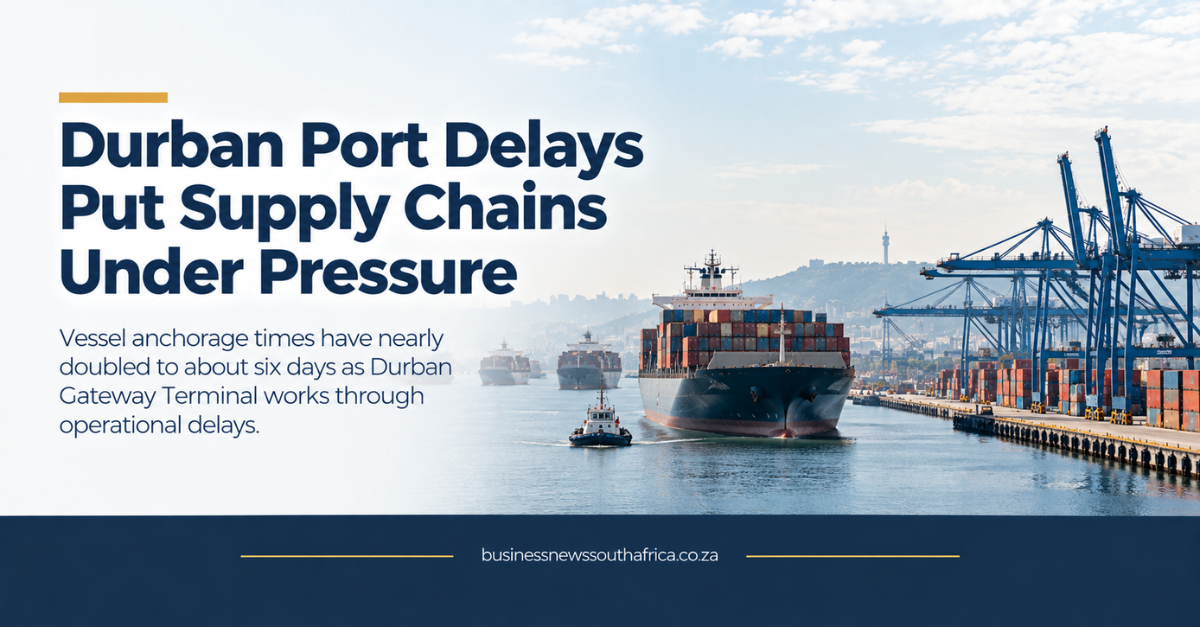
South Africa’s Minister of Transport Barbara Creecy told reporters that the average time vessels spend anchored at the Durban Gateway Terminal has roughly doubled to six days since the terminal changed hands.
Durban Gateway, the country’s busiest container terminal and the gateway for almost half of South Africa’s container traffic, is operated jointly by International Container Terminal Services (ICTSI) and state-owned Transnet (Transnet). The contract that gave ICTSI a 30-year concession was delayed after A.P. Moller-Maersk filed a lawsuit challenging the bidding process.
Creecy said the slowdown is linked to two main factors. First, ICTSI introduced a new Navis terminal operating system, a command-and-control software that coordinates vessel movements, crane assignments and yard storage. Second, the terminal is still refurbishing or replacing key loading equipment, which has created bottlenecks in the loading and unloading cycle.
The minister urged ICTSI to improve its public communication and to present a clear plan for clearing the backlog. “In the long term, this is what will give us the volumes we want,” she said, adding that the immediate concern is how the operator responds to its customers during the teething period.
Impact on other ports and exporters
The Cape Chamber of Commerce reported that the Durban delays are forcing ships to bypass the port, putting pressure on the Port of Cape Town. Exporters Western Cape Chairman Terry Gale noted that vessels are now queuing alongside both the Cape Town Container Terminal and the Cape Town Multi-Purpose Terminal, reducing berth availability and stretching equipment allocation.
Gale said the Transnet National Ports Authority is aware of the situation, and the Cape Chamber will continue to raise the issue through the Cape Town Port Liaison Forum. The chamber also warned that the prolonged delays are damaging the reputation of South Africa’s ports in global shipping rankings.
For businesses that rely on timely container deliveries, from manufacturers to retailers, the longer anchorage times translate into higher freight costs, inventory shortages and tighter cash flow. Small and medium-size enterprises that import raw materials or export finished goods may see order fulfilment timelines stretched, potentially eroding customer confidence.
In response, ICTSI has announced an investment of R737 million to upgrade equipment and increase terminal capacity by 40 percent, aiming for a handling volume of 2.8 million twenty-foot equivalent units (TEUs) by 2030. The upgrade is expected to include new ship-to-shore cranes, automated guided vehicles and expanded yard space.
While the investment signals a commitment to long-term growth, the short-term challenge remains: clearing the current backlog without further disrupting the supply chain. Industry observers note that similar transitions to new terminal operating systems have caused temporary slowdowns elsewhere, but the speed of recovery often depends on how quickly equipment can be brought online and how effectively the operator communicates with shipping lines.
For now, exporters are advised to monitor berth availability, consider alternative routing through other South African ports, and engage with logistics partners to mitigate the risk of delayed shipments.
During a phone interview from Durban, Creecy highlighted that the average anchorage time has risen to nearly six days, a figure that mirrors the six-day estimate reported earlier this week. She stressed that the surge is tied to the rollout of the Navis system and the lag in refurbishing key loading gear, echoing earlier remarks about the “teething problems” faced by ICTSI. The minister also urged the operator to publish a detailed recovery timetable, noting that transparent communication will help shippers adjust schedules and reduce uncertainty across the supply chain.
The legal challenge lodged by A.P. Moller-Maersk questioned the original bidding process, which delayed the concession award to ICTSI and Transnet. Because the lawsuit postponed the finalisation of the 30-year contract, the new operator began its tenure later than planned, compressing the window for equipment upgrades. This sequence of events illustrates how procurement disputes can cascade into operational bottlenecks, especially when a terminal simultaneously introduces a new operating platform and undertakes major asset renewal.
ICTSI’s commitment of R737 million to modernise the terminal includes the acquisition of additional ship-to-shore cranes, automated guided vehicles and expanded yard space, all aimed at lifting capacity by 40 percent to 2.8 million TEUs by 2030. The funding allocation will be phased, with the first tranche earmarked for crane procurement and yard reconfiguration, followed by the rollout of automation technology. Once the equipment is commissioned, the Navis system can fully synchronise vessel berthing, crane deployment and yard movements, which should shorten turnaround times and restore berth availability.
According to the Cape Chamber of Commerce, the Transnet National Ports Authority is fully aware of the knock-on effects that Durban’s delays are having on Cape Town’s berth schedule and equipment utilisation. The chamber plans to keep raising the issue through the weekly Port Liaison Forum, seeking coordinated adjustments to regional shipping timetables. By aligning slot allocations and sharing real-time yard data between ports, the network can mitigate congestion and prevent further diversion of vessels, thereby protecting the reputations of both Durban and Cape Town within global shipping rankings.