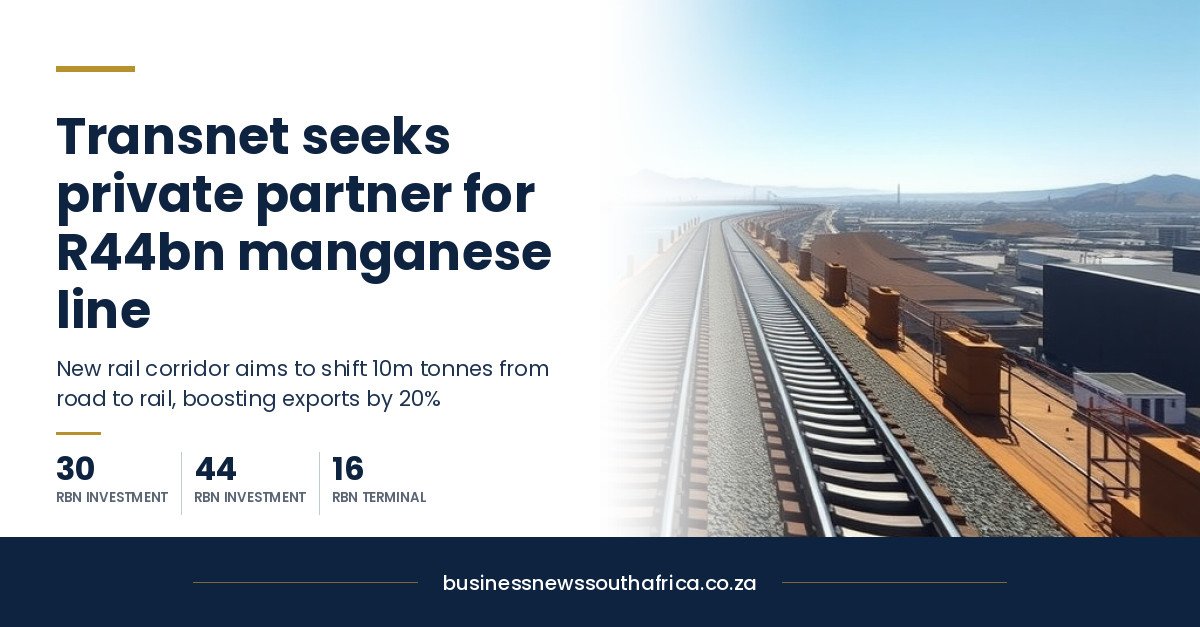
Transnet has issued a request for qualification (RFQ) for a private partner to fund, build and run a manganese export corridor from the Hotazel area in the Northern Cape to a new terminal at the Port of Ngqura, near Gqeberha, for about 25 years. According to Freight News, which cited Transnet’s RFQ, it was issued on 23 September 2026. The corridor covers about 1,100 km of rail.
Transnet puts the indicative investment at R30 billion to R44 billion: about R16 billion for the new terminal, R10 billion to R20 billion for rail infrastructure and about R4 billion for train operations and rolling stock. Freight News said these amounts remain indicative and will be confirmed at the proposal stage. The Herald and Business Day reported the same range. Miningmx reported that applications close on 26 February.
What the corridor would change
South Africa exported about 26 million tonnes of manganese in 2025, according to the Minerals Council, Mining Weekly reported. Transnet’s rail system carries about 16 million tonnes of that a year, and roughly 10 million tonnes reach the ports by road. The new terminal is expected to reduce that road volume, according to the same report.
The corridor would initially target about 12.6 million tonnes a year, The Herald reported, while the terminal would have an initial capacity of about 14.7 million tonnes, expandable to about 16 million tonnes if demand warrants it. Transnet forecast a 20% expansion in manganese exports by rail. The Herald reported in April that Transnet National Ports Authority had given councillors a commissioning date of 2030 to 2031 for the Ngqura terminal, and noted that the new RFQ does not set a revised date for the move.
How the deal is structured
The partnership would use two companies, according to Freight News. In the first, which would develop and operate the terminal and manage rail freight services, Transnet would hold 51% and the private consortium 49%. The second would be wholly owned by the consortium’s holding company, would finance, repair and maintain the rail infrastructure, and would be paid under an agreement with the Transnet Rail Infrastructure Manager, which keeps ownership of the rail infrastructure. The ownership arrangements, investment requirements and term may still be refined during procurement, the RFQ states.
The RFQ is the first stage. Applicants must show financial capacity and technical and operating experience, and set out how they would deliver benefits to communities along the corridor, The Herald reported. Those that qualify will be invited to submit detailed proposals. No partner has been chosen.
It fits a wider pattern of Transnet inviting private partners into rail, including private operators running test trains on its network, alongside the R26 billion its rail manager is asking Treasury for to refurbish the network.
What it means for Gqeberha
The delayed closure of the manganese and liquid bulk terminals has held back plans for a waterfront at the Gqeberha harbour, The Herald reported. Residents and businesses have long complained about ore dust and manganese trucks on city roads, and municipal monitoring presented this year found serious dust problems around the harbour and Markman, although Transnet disputed the metro’s assessment of harbour air quality. Transnet says gradually consolidating manganese handling at the new facility would reduce road congestion, cargo handling movements and dust.
Correction, 1 November 2026: an earlier version of this article gave export destination percentages and a share of export capacity for the Port of Gqeberha that we could not confirm, and added commentary on who should pay attention that was our own opinion. These have been removed, and the sourcing has been corrected.