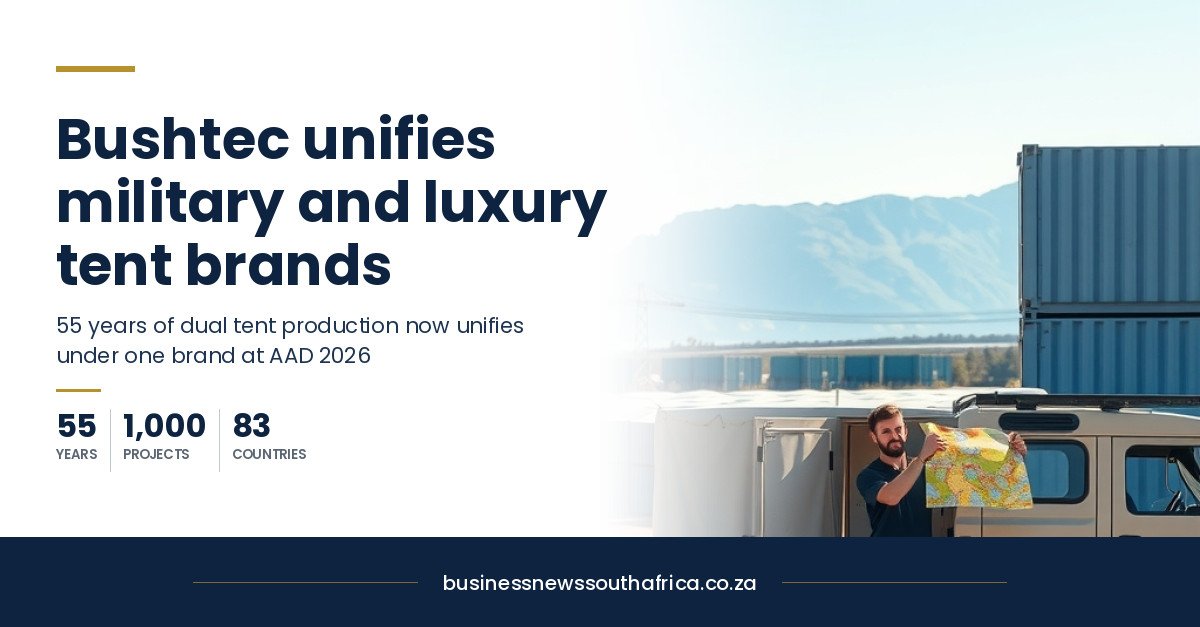
Bushtec spent 55 years being two things at once without ever quite saying so out loud. One version of the company built tents for the military: rapidly deployable shelters, power systems and sanitation for a camp of a handful of people or a couple of thousand, designed for conditions where nothing can be assumed to already exist on site. The other version built luxury tented camps for safari lodges, the kind of canvas suite a guest pays a premium nightly rate to sleep in without ever thinking about how it got there. At Africa Aerospace and Defence 2026, the company finally picked one name for both halves and explained why.
The group’s manufacturing arm, Canvas and Tent, based in Ladysmith in KwaZulu-Natal, has delivered more than 1,000 projects in 83 countries across six continents over its history. Going forward, Bushtec becomes the master brand for everything client-facing, while Canvas and Tent stays on as the name of the factory that actually makes the product. CEO Hans Hillebrand framed the unification around what he called “the value of remarkable experience,” a phrase doing more work than it first appears to: the pitch is that the discipline of building a shelter that has to work when nothing else on site does, which is what military deployment demands, is the same discipline that makes a luxury tented suite feel effortless to a paying guest who never sees the engineering underneath it.
That argument gets a genuine test in the products the company actually showed at the exhibition. A solar-powered water purification system drew river, lake or borehole water and produced drinking water for groups from 30 people up to brigade-level deployments, housed in a transportable shipping container so it can be dropped into a remote site with no existing infrastructure. Electrical power generation and distribution systems range from 20 to over 400 kVA, with auto-synchronising generators, plug-and-play wiring that needs no on-site electrician, and solar, wind, battery and hybrid configurations aimed at cutting fuel dependency over the life of a deployment. A new tented ablution facility serves up to 60 people per unit with showers, toilets, hand basins, water heating and lighting built in, and a containerised version of the same thing packs the identical functions into a standard ISO shipping container for 20 to 40 people.
Sanitation sounds like the least glamorous item on that list, and the company’s own framing leaned into exactly that. “Sanitation can be underestimated when a camp is being planned,” Bushtec said. “Get it wrong and you can affect health, morale and operational effectiveness across the whole site.” It is not a line written for a brochure about safari lodges, but it applies to one just as directly as it applies to a military base: a lodge with plumbing problems loses guests and reviews the same way a camp with sanitation problems loses operational readiness.
The new Bushtec logo, a stylised letter B built from what Hillebrand described as a taut stretched canvas shape, is meant to carry the same dual meaning: tensile, flexible materials as a metaphor for a company that can flex between a ten-person fly camp and a 2,000-person base. Whether a single brand actually helps Bushtec win business in either market is a separate question from whether the metaphor is a good one. A defence procurement officer evaluating a water purification contract and a lodge developer sourcing a luxury tent supplier are not reading the same trade publications or attending the same conferences, and a rebrand does not automatically put the company in front of both audiences at once. What the unification does more concretely is let Bushtec point a defence buyer at its decades of hospitality-grade finishing and point a lodge developer at its decades of surviving conditions no hospitality brand alone has ever had to plan for, using one brand’s track record to vouch for the other’s.