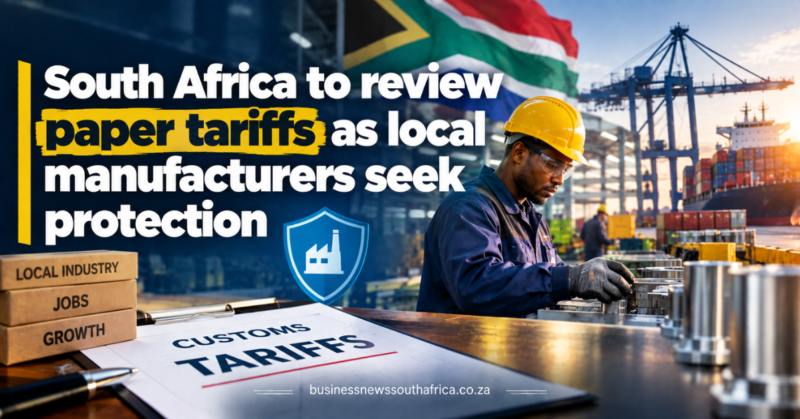
The International Trade Administration Commission (ITAC) has decided not to raise the customs duty on imported paper products by the 20% that had been proposed. The decision, announced in a recent gazette, follows an investigation that was triggered by local manufacturers who feared that cheap imports were eroding their margins.
Mondi, a major paper producer in South Africa, lodged the initial complaint, arguing that the domestic pulp and paper sector was under threat from lower-priced foreign goods. Sappi, another large player, supported the call after reporting a loss of R2.77 billion in its last financial year. Sappi’s chief executive, Steve Binnie, said that “imported paper products continue to create challenges for local manufacturers and deserve greater policy attention.”
Minister of Trade, Industry and Competition Parks Tau asked ITAC to look into the matter. In its recommendation, the commission said it could not find sufficient proof that the industry’s difficulties were caused by imported paper. It also noted that most imports come from the European Union, which enjoys preferential trade agreements with South Africa, and that any increase in the general customs rate would have to respect World Trade Organization (WTO) bound rates.
What the decision means for local manufacturers
By keeping the tariff unchanged, ITAC avoided adding a new cost layer for domestic producers. The commission warned that a higher duty could have pushed up prices for downstream users, such as printers, packaging firms and tissue manufacturers, and ultimately for consumers. However, manufacturers will still face the same structural pressures that prompted the original request: high electricity and transport costs, a market that is shrinking because of digitisation, and weak overall demand.
ITAC suggested that, if future evidence shows “injurious import competition,” trade-remedy tools such as anti-dumping or safeguard duties could be considered. For now, the sector must look to other ways of improving profitability, such as energy efficiency measures or product diversification.
Minister Tau approved the commission’s recommendation but also asked ITAC to conduct a broader investigation of the domestic paper market. The goal is to identify “appropriate trade policy instruments that can drive the industry towards sustainability and resilience.” This signals that the government may still intervene, but through mechanisms other than a blanket tariff increase.
The paper industry remains a significant part of the South African economy. The Department of Trade, Industry and Competition estimates that R33 billion has been invested in the sector over the past seven years. Yet the industry is in a long-term decline linked to the shift from print to digital media, changing consumer habits and a sluggish economy.
For small and medium-size enterprises that rely on paper, from local printers to packaging start-ups, the decision offers short-term price stability but does not remove the underlying challenges. Companies will need to monitor electricity tariffs, transport costs and any future trade-remedy actions that could affect import levels.
Overall, the ITAC ruling reflects a balancing act: protecting a struggling domestic industry without imposing higher costs on the broader economy. The next phase of the minister’s request will likely shape whether additional policy tools are introduced to help the sector adapt to a digital future.
The minister’s brief to the commission highlighted that “the South African pulp and paper industry is under tremendous strain, particularly in the uncoated paper, newsprint, packaging, and tissue segments.” This observation adds nuance to the earlier discussion of overall industry pressure, pointing to specific product lines where import penetration is felt most acutely. By singling out these categories, the request underscores that any future trade-policy response may need to be calibrated to the distinct dynamics of each segment, rather than applying a uniform tariff across all paper goods.
In the same request, officials warned that “increasing input costs, particularly electricity and transportation expenses, are placing significant pressure on local manufacturers and squeezing local producers’ profit margins.” The emphasis on electricity and transport aligns with broader concerns about South Africa’s energy reliability and logistics bottlenecks, suggesting that even without a tariff hike, cost structures remain volatile. This framing indicates that any remedial measures will likely have to address these input-cost challenges alongside import competition.
ITAC’s assessment process involved weighing stakeholder comments, market analysis and the constraints of World Trade Organization bound rates before reaching a decision. The commission noted that an increase to the general customs rate would not effectively target the source of competition and could breach WTO obligations. It also signalled that, should credible evidence of injurious import competition emerge, anti-dumping or safeguard duties could be deployed as more precise trade-remedy tools, reflecting a preference for targeted measures over blanket tariffs.
Following the ruling, the commission has been tasked with a broader domestic market inquiry, with a mandate to recommend “appropriate trade policy instruments that can drive the industry towards sustainability and resilience.” This secondary investigation will examine structural issues such as digitisation trends and cost pressures, and is expected to produce a report within the next few months. The outcome will shape whether future policy levers, potentially including the trade-remedy instruments mentioned, will be activated to support the sector.