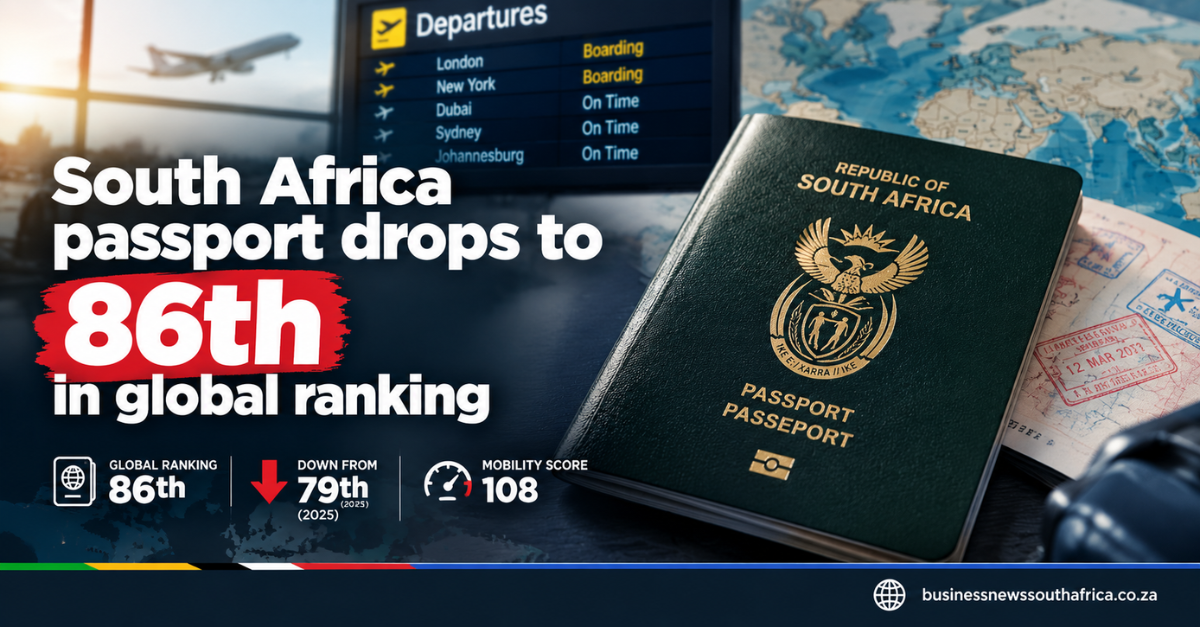
South Africa has slipped to 86th out of 199 countries in the latest Passport Reports index, down from 79th in 2025, BusinessTech reports. The country’s Mobility Score, the number of destinations a passport holder can enter without a traditional visa, is 108, down from 110 a year ago.
For anyone who travels for business, the practical meaning is simple: fewer doors open without paperwork, which can add time and cost to meetings, trade shows and sourcing trips.
How the score is built
The 108 destinations break down into 59 that are visa-free, 42 where a visa is issued on arrival at the airport, and 7 that require an Electronic Travel Authorisation (ETA), an online permit that must be obtained before departure but is not a full visa. Passport Reports ranks passports by total Mobility Score. Where two passports tie, it compares visa-free destinations first, then ETAs, then visa-on-arrival. If all three match, the passports share a rank. The index also cautions that other passport rankings can produce different results because they count and weight entry types differently.
Where South Africa still stands
South Africa ranks third among 54 African passports and fourth among 11 BRICS countries. It is 15th among the 19 G20 countries, 26th among 56 Commonwealth countries and 38th among 132 G77 countries. Passport Reports puts South Africa’s total access across Africa at 71.7%, counting visa-free, simplified-entry and ETA access together.
Entry rules worth knowing
Having access does not always mean showing up with just a passport. The report lists arrival-card requirements in Malaysia, Singapore and Thailand, pre-registration for Côte d’Ivoire, tourist registration for the Seychelles, and Cabo Verde’s EASE system, an online pre-registration platform whose name stands for Efficient, Automatic and Safe Entry of Travellers. Maximum stays vary: 360 days in Georgia, 180 days in Antigua and Barbuda, Barbados and Peru, and 90 days in numerous other destinations.
The source does not say which destination or destinations caused the two-point fall. For more on how travel and trade rules affect business, see our Regulatory & Policy section.