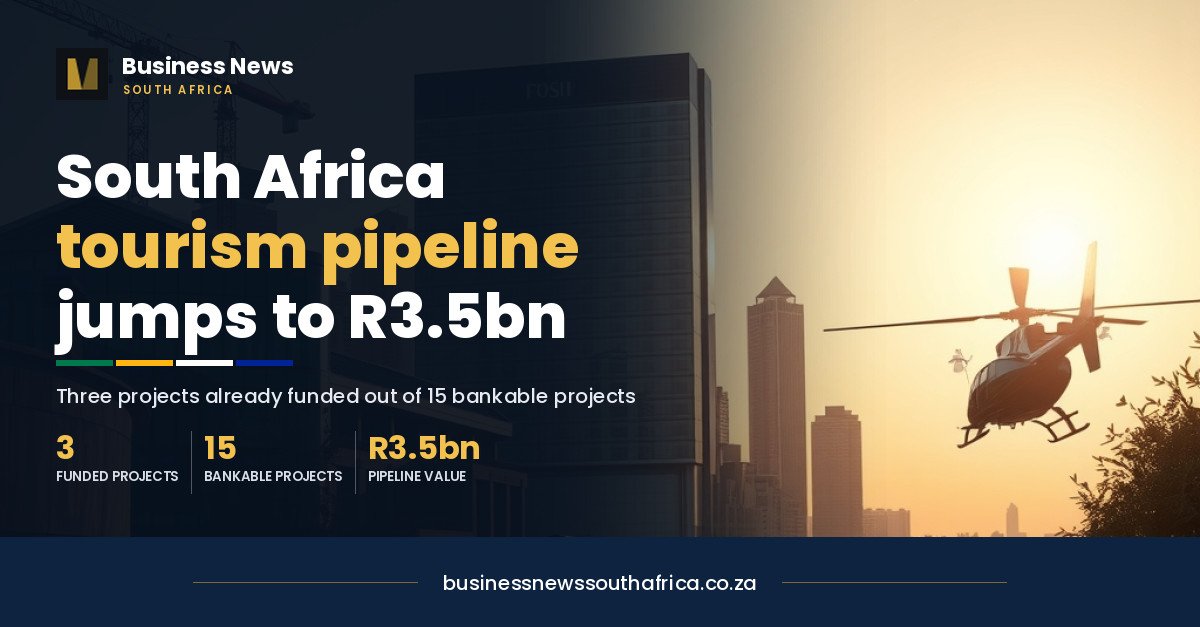
Tourism Minister Patricia de Lille told investors at the second Tourism Infrastructure Investment Summit (SATIS) in Johannesburg on 1 October that South Africa’s pipeline of investable tourism projects has more than tripled in a year, and that three projects have already secured funding commitments. “We started with eight bankable projects valued at R1 billion and the pipeline has now grown to 15 projects valued at R3.5 billion, three projects already secured funding commitments,” she said, in a speech published on the government’s own website.
The 15 projects span the public and private sectors and cover accommodation, tourist attractions, heritage spaces, entertainment facilities and infrastructure. The North West was the single largest provincial contributor, with MEC for Economic Development, Conservation, Environment and Tourism Bitsa Lenkopane submitting 11 projects valued at R1.2 billion on its own, according to Bizcommunity’s coverage of the summit. Those projects, like the rest of the pipeline, still need to clear a screening process before being included in an investment booklet that is put in front of financiers.
Government names tourism as a priority growth sector
De Lille used the summit to press a wider argument about how government treats tourism as an economic sector. “Tourism policy is Economic policy,” she said, pointing to her recent role as co-chair of the inaugural Beyond Tourism Day at the World Economic Forum in Geneva, where the World Bank identified tourism among five sectors with the greatest potential to generate jobs at scale. She noted that President Cyril Ramaphosa named tourism alongside mining, infrastructure and agriculture and agro-processing as one of four priority sectors under Phase Three of the Government-Business Partnership in August.
The numbers she cited to back the sector’s weight were specific: Stats SA figures put tourism’s direct employment at 953,981 people in 2024, equivalent to 5.7% of total employment, with a direct GDP contribution of 4.9%, ahead of agriculture, utilities and construction. On a broader measure that includes indirect and induced effects, the World Travel and Tourism Council puts tourism’s contribution to South Africa’s GDP at 10%.
That growth is already showing up in the arrivals data. South Africa recorded 44.7 million domestic overnight trips in 2025, worth R111.6 billion in spending, and a record 10.5 million international arrivals worth R102.2 billion. Between January and August this year, international arrivals reached more than 7.5 million, up 11.7% on the same period in 2025, and August alone brought in more than a million international tourists, a milestone we reported on last week.
Why a bankable pipeline matters more than a demand story
Juan Gomez Garcia, senior investment specialist at UN Tourism, told the summit that strong demand alone does not attract capital. “Tourism Infrastructure investments must go beyond assets and empower communities by creating economic opportunities,” he said, arguing that bankable tourism investments depend on bankable destinations, and that demand has to be matched by a pipeline of properly screened, investment-ready projects rather than a list of ambitions.
That is the gap SATIS is explicitly trying to close. De Lille pointed to the Electronic Travel Authorisation digital visa system, launched in August and now live in more than 30 countries, as one piece of the access side of the equation, alongside a Cabinet-approved Tourism Route Development Marketing Plan backed by R6.5 million in government funding to coordinate route development between national government, provinces and the private sector. Easier entry for visitors is only half the picture; South Africa’s own passport dropped to 86th in the global ranking last week, a reminder that travel-document friction cuts both ways even as inbound arrivals grow.
For businesses in construction, hospitality operations, and tourism-linked services, the practical signal from SATIS is less about the headline R3.5 billion figure and more about the screening pipeline behind it: a project that clears that process and lands in the investment booklet moves from a provincial wish list to something financiers can actually underwrite. Whether the remaining 12 projects can match the three that have already found funding, within a sector competing for capital against mining and infrastructure under the same government growth partnership, is the detail worth watching as the pipeline moves from announcement to construction.