According to a BusinessTech report on data from the Pietermaritzburg Economic Justice and Dignity (PMBEJD) group, Mtubatuba in KwaZulu-Natal posted the lowest grocery basket price among South Africa’s major metros and towns at the end of September 2026.
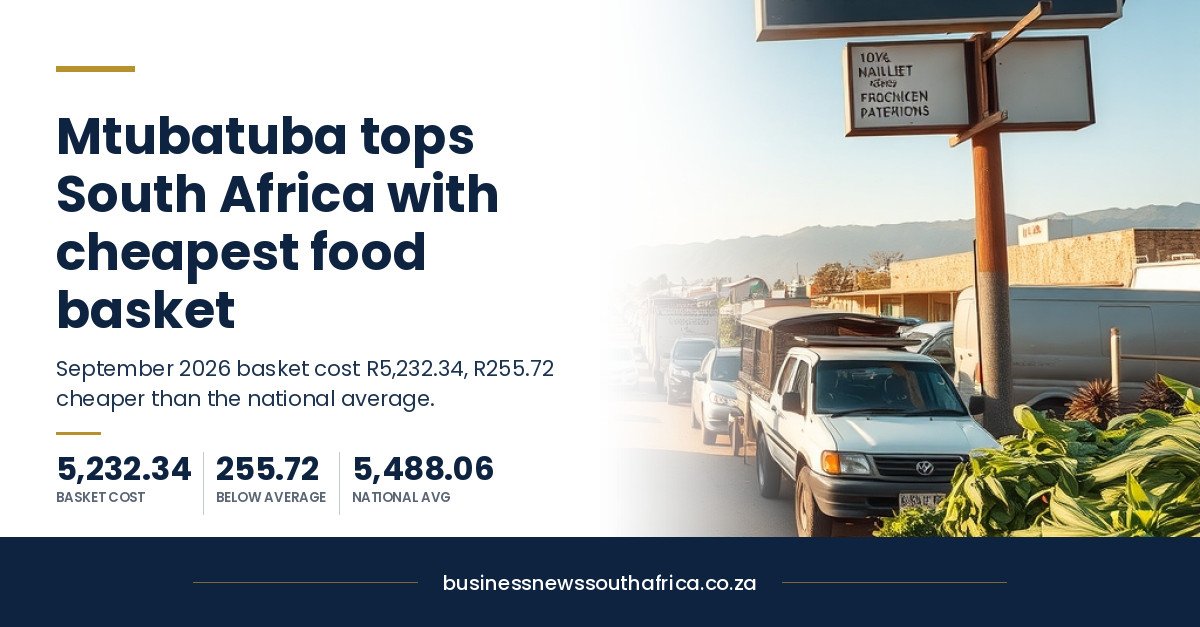
The basket, a collection of 44 essential food items that reflects typical household purchasing patterns, cost R5,232.34 in Mtubatuba, which is R255.72 below the weighted national average. It also recorded the largest month-on-month reduction, R76.85.
Why Mtubatuba’s basket is cheaper
The group noted that 24 of the 44 items either fell in price or held steady, while the remaining 20 rose, eight of them with double-digit inflation. Nationally, grain-related products, fruits and vegetables were in deflation, keeping consumer food price inflation low.
Producer prices, the price that farmers receive for their output, lag consumer prices by roughly a month. In July 2026, grain mill products, starches and animal feeds fell 9.6% year-on-year, helped by a record 2025/26 summer grain and oilseed harvest of 21.6 million tonnes. In Mtubatuba, a 30 kg bag of maize meal cost R259.97, well under the R300-plus price tags seen in Cape Town, Springbok and Pietermaritzburg.
Frozen chicken portions (10 kg) were priced at R379.98, and bulk protein alternatives like beef tripe (2 kg) cost R74.98. Fresh spinach was available for R95.92. These lower inputs help keep the aggregate basket cost down, even as other items, fish and seafood, milk, dairy and eggs, posted modest increases in August.
Nationally, consumer price inflation for food and non-alcoholic beverages rose 0.7% year-on-year in August 2026, according to Stats SA. The overall consumer price index edged up to 4.4% from 4.3% in July.
Comparatively, Durban and Cape Town posted almost identical basket costs, R5,364.64 and R5,364.98 respectively, a difference of just 34 cents. Springbok in the Northern Cape recorded the highest cost at R5,891.18, while Johannesburg was the second most expensive at R5,679.
BusinessTech describes Mtubatuba as having a two-tiered economy: widespread poverty and subsistence farming across much of its footprint, alongside a concentrated, formally employed middle class. It reports that retailers there price staple carbohydrates and frozen chicken portions aggressively to capture the buying power of the surrounding rural population.
Readers interested in broader trends can follow the Retail & Consumer coverage for updates on food price dynamics and their impact on South African small businesses.
The average South African basket stood at R5,488.06, reflecting a 2.9% rise year-on-year, or R82.07, compared with September 2025, and an increase of R36.30 on August 2026.
In August, fish and seafood inflation accelerated to 7.5%, with hake up 12% and frozen fish fingers up 11.3%. Pork prices were up 6.6% and ham and bacon 8.6%. These products have lower weightings, so they do not materially raise headline food price inflation, which Stats SA put at 0.7% year-on-year.