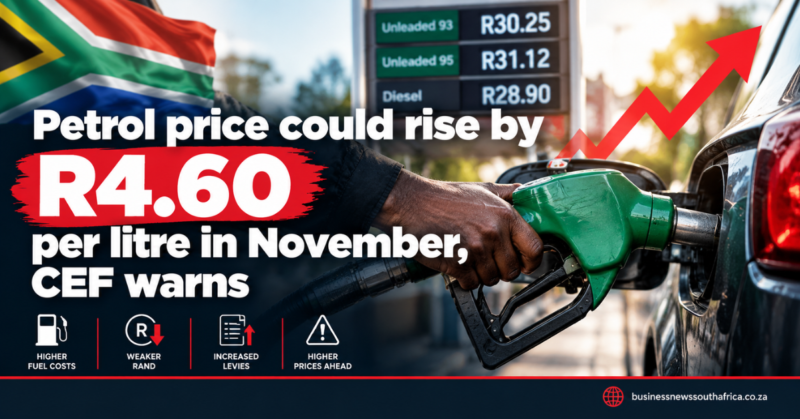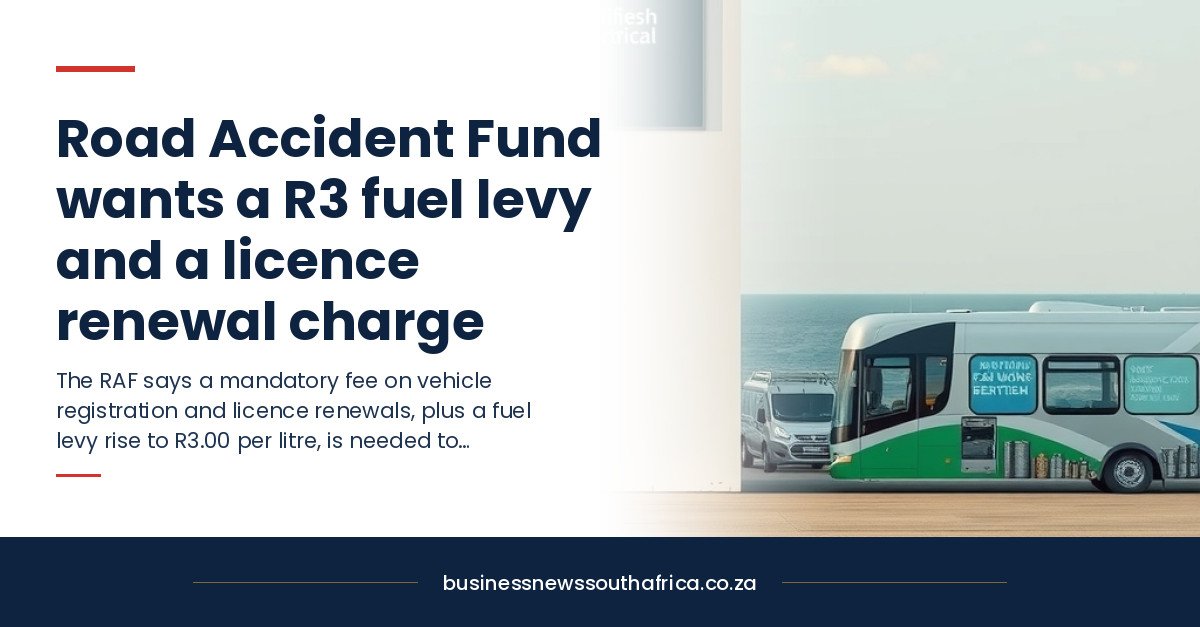
The Road Accident Fund (RAF) wants the government to lift the fuel levy to as much as R3.00 a litre and to add a compulsory charge to every vehicle registration and licence disc renewal. If the proposal is approved, every business that runs vehicles or buys fuel in bulk would pay more.
Why the fund says it needs the money
The RAF’s total revenue fell 5% to R48.1 billion in the 2025/26 financial year, according to its annual report. Net fuel levies make up 99.40% of that income, so the fund depends almost entirely on how many litres South Africans buy. The levy has been frozen at R2.18 a litre since 2021/22. Inflation has eroded what the money is worth, and fuel sales have fallen. The fund says it is under pressure to “fund an unlimited claims trajectory” and calls itself “historically insolvent”.
The increase already in place
National Treasury broke the freeze in 2026 and raised the levy by 7 cents a litre, from R2.18 to R2.25. The RAF welcomed the increase but said it was not enough. It blames higher pump prices, linked to the Middle Eastern war and other inflation, for cutting fuel volumes and so reducing the extra income.
What the fund is asking for
Through the Medium Term Expenditure Framework, the government’s multi-year budget process, the RAF has asked Treasury for a levy of “up to R3.00 per litre”, along with capital support to protect its solvency. This is a request, not a decision. It will be weighed against other fiscal priorities before any change is written into law.
The fund is also investigating three other sources of revenue:
- extending the levy to foreign-registered vehicles that enter South Africa;
- attaching a separate charge to vehicle registration and licence renewals; and
- a charge aimed at electric and hybrid vehicles, which pay no fuel levy but use the same roads and receive the same benefits.
What it would mean for a business that runs vehicles
The fuel levy is charged per litre, so its effect grows with fuel use. A rise from R2.25 to R3.00 adds 75 cents a litre. As an illustration only: a business that buys 10,000 litres a month would pay R7,500 more in levy each month at R3.00 than at R2.25. The fixed amount of any licence-renewal charge has not been set, so it cannot yet be costed.
Electric and hybrid vehicles are the other cost to watch. Transport Minister Barbara Creecy confirmed in July that the government was looking at a separate mandatory fee tied to registrations and licence disc renewals. The Department of Transport argues that a vehicle-linked levy is needed to capture revenue from all road users. For a company that leases electric vehicles for staff, that would narrow the running-cost gap with petrol and diesel cars.
What is confirmed and what is not
Confirmed: the fall in RAF revenue, the 7-cent rise to R2.25 and the R3.00 request lodged with Treasury. Not yet known: whether Treasury will approve R3.00, the size and start date of any licence-renewal charge, and whether foreign-registered vehicles will be charged. The Department of Transport will assess the fiscal impact before making a recommendation to Treasury, and any change would apply in a later fiscal cycle after the legislative process.
What to do now
Budgets and price lists should carry a fuel scenario at R3.00 a litre, not only today’s price. Anyone who runs a fleet should record litres bought each month, so the effect of any change can be measured within days rather than at year end. The cash flow simulator can test a higher fuel line against the rest of a monthly budget, and the break-even calculator shows how much extra revenue a higher cost base needs. Licence and registration renewals already carry deadlines, so the compliance calendar is worth keeping current alongside them.
Sources: BusinessTech, 7 October 2026; National Treasury; Department of Transport.