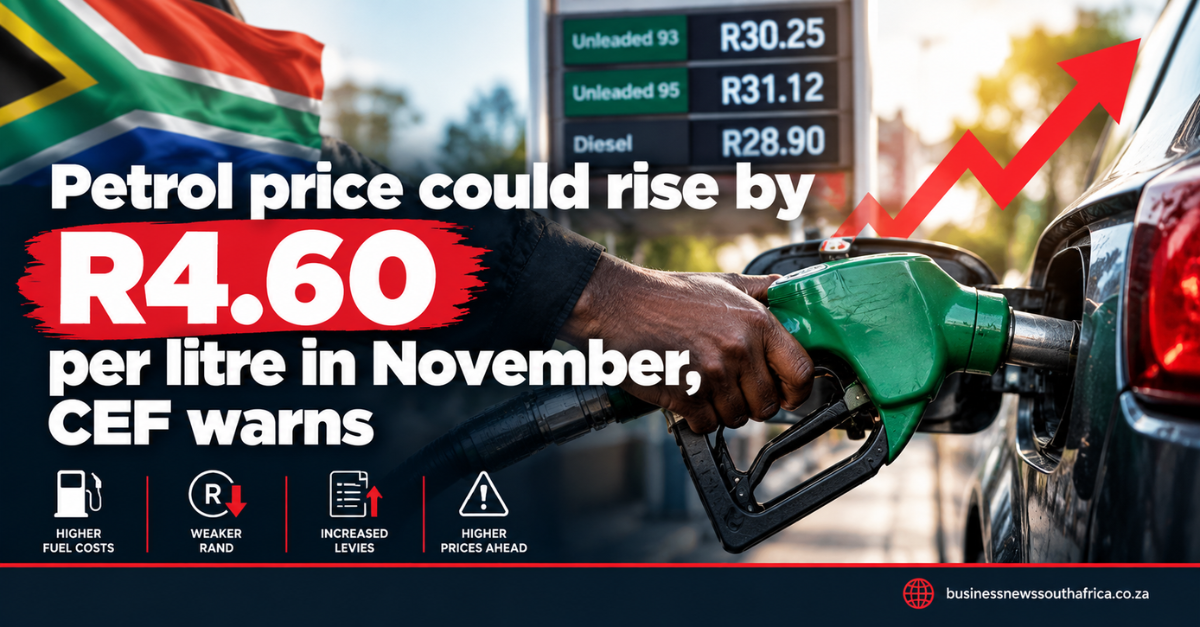
Investec Chief Economist Annabel Bishop has warned that South Africa faces a R4.60 per litre petrol price increase in November, based on early under-recovery data from the Central Energy Fund (CEF), BusinessTech reported. The figure compares what fuel retailers have collected against the cost of imported petroleum products, and points to the largest single monthly petrol increase of the year.
The under-recovery is split between more than R4.00 per litre caused by international oil prices still above $100 a barrel, well off the $65 a barrel level that prevailed before the Iran war, and roughly 50c per litre linked to rand depreciation. “Combined with rand weakness, this heralds further large fuel price increases for South Africa in November,” Bishop said. Diesel is tracking a similar increase of R2.60 per litre.
The CEF’s early projections, by fuel grade, are an increase of R4.29 per litre for petrol 93, R4.58 per litre for petrol 95, R2.56 per litre for wholesale diesel at 0.05% sulphur, R2.91 per litre for diesel at 0.005% sulphur, and R5.00 per litre for illuminating paraffin.
Diesel has already doubled this year
For small manufacturers, transport firms and farmers, diesel is a key cost driver, and the agriculture and freight industries have already flagged higher production costs from the fuel price rise that took effect on 7 October. Bishop noted that diesel has doubled in 2026, climbing from around R17.00 per litre in January to over R34.00 per litre now, which she called an unprecedented annual jump with “a very heavy burden on producers, with no renewed government support yet.”
Petrol has risen by about a third since January and is now on track to double for the year if the projected near-R5.00 per litre November increase goes ahead, which Bishop said would be larger than any petrol price rise so far in 2026. That scale of increase is expected to push consumer price inflation above 5.0% year-on-year and add direct pressure on commuters.
Treasury has not ruled out another levy cut
Bishop said a further cut to the general fuel levy is warranted given the added consumer stress, echoing calls that have been building since the petrol price passed R30 per litre in September. National Treasury cut the levy by R3.00 per litre in April 2026 to ease the impact on households, a move Finance Minister Enoch Godongwana said cost over R17 billion, partly recovered from stronger commodity export earnings at the time. Those export conditions are not currently repeating, meaning any further levy cut would have to be funded through lower spending elsewhere or higher borrowing.
Bishop cautioned that the November figures are still provisional. “It is still early in October, and as such, the petrol and diesel price changes in November may not prove to be as large as currently being signalled by the CEF, as they are recalculated daily,” she said. “However, the risk is clear. For South Africa, currently, very large transport cost increases are being signalled down the line again, with the price increases in October already having taken domestic fuel prices to historic highs.”
For small business owners, the potential hike means higher operating costs for delivery fleets, increased freight charges for imported goods, and tighter margins on anything that relies on diesel-powered machinery or transport. Unless the rand stabilises or global oil prices retreat before the end of October, when the CEF finalises its recovery calculation for the Department of Mineral Resources and Energy, consumers and businesses should expect the increase to be reflected in November’s pump prices.
The warning follows October’s own increase, which took petrol to about R30.25 a litre as the rand weakened and levies climbed, and comes as diesel prices already sit at record highs. We reported last month on SARS and Bidvest Protea Coin warning that rising diesel prices are driving a spike in fuel adulteration, as some operators try to cut costs by blending in cheaper, untaxed substitutes. A further R2.60 per litre increase in November would add to that pressure, giving transport operators and farmers an even stronger incentive to shop on price, exactly the condition the adulteration warning flagged as a risk.
For a small business running a delivery fleet or relying on imported stock, the compounding effect matters more than any single month’s increase. Diesel has already doubled since January, petrol is close to doubling for the year, and a further round of increases in November would land before most businesses have had time to adjust pricing for the current month’s rise.