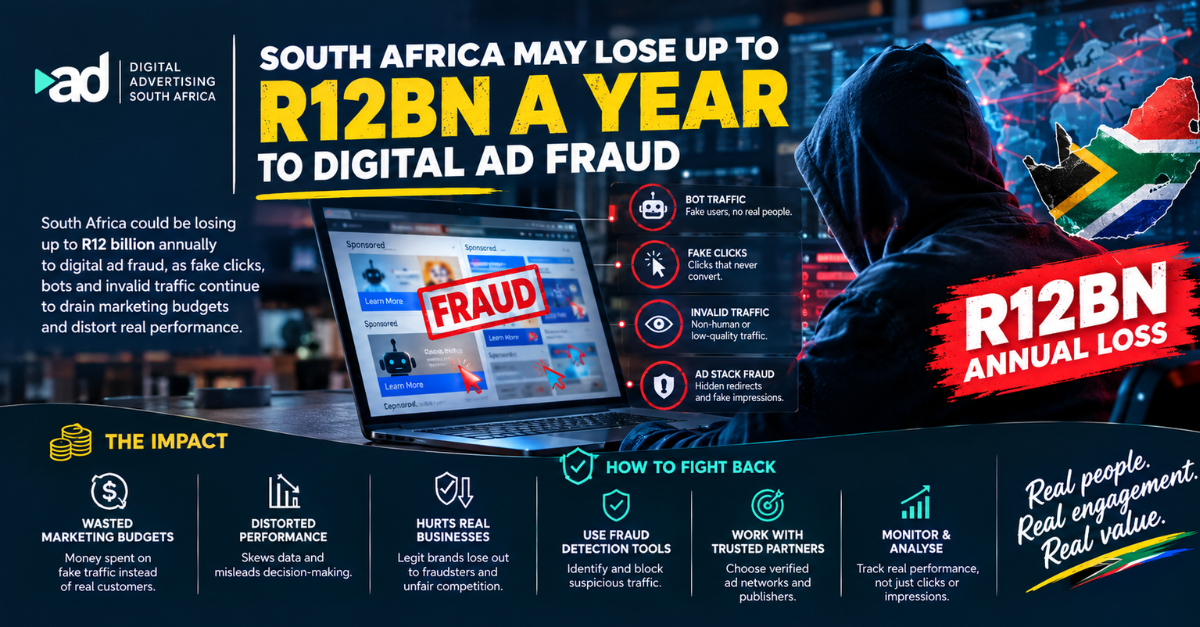
According to a Bizcommunity article, South Africa’s digital advertising market, valued at roughly R35bn to R40bn a year, could be bleeding between R2.8bn and R12bn annually because of ad fraud.
Programmatic buying, which accounts for an estimated 40% to 50% of that market, is where most of the waste occurs. The author’s own analysis of local campaigns found programmatic wastage ranging from 20% to 60%. When those percentages are applied to the total market size, the resulting loss falls within the R2.8bn to R12bn range.
Independent data backs up the claim that South Africa is lagging behind the world. Fraudlogix’s 2026 analysis of 105.7 billion impressions recorded an invalid-traffic rate of 22.94%, compared with a global average of 20.64%.
In a live forensic audit of a global advertiser’s campaign, 41% of the impressions were confirmed fraudulent and 12% confirmed legitimate. The remaining impressions were left unclassified because they did not trigger the three-warning-sign threshold used by the auditor. After optimisation, the fraud rate in the most recent 20,000 impressions fell to 27%, showing that the leak can be identified and reduced.
Ad fraud is not just a technical glitch; it is a human problem driven by incentives. Agencies under pressure to spend client budgets often meet volume targets by accepting low-quality inventory. When fraudulent impressions are removed, the reported volume drops and revenue for the agency falls.
Mitigation tools can dramatically lower fraud rates. Integral Ad Science’s 2025 research showed that campaigns without mitigation suffered a 10.9% fraud rate, while those with mitigation recorded only 0.7% fraud.
For small and medium-size enterprises that rely on digital ads to reach customers, the financial impact can be significant. A retailer spending R1 million on programmatic ads could be losing anywhere from R20 000 to R600 000 to fraudulent impressions, depending on the fraud rate applied.
Auditors are about to face new pressure. ISA 240 (Revised), the auditing standard on fraud in financial statements, applies to periods beginning on or after 15 December 2026. The standard expects auditors to challenge management’s assumptions about digital ad spend and to weigh contradictory evidence. Because digital media is often a large discretionary line in a listed company’s accounts, audit committees will soon have to ask how companies verify that their ad impressions reached real people.
SMEs can take practical steps now. First, request detailed supply-chain reports from agencies and demand transparency on the tools used to filter bots. Second, consider third-party verification services that flag suspicious traffic. Third, incorporate fraud-mitigation clauses into agency contracts, tying payment to verified human impressions.
While the exact national loss figure cannot be confirmed without industry-wide data, the range presented by the article reflects the typical experience of large advertisers and suggests that many smaller advertisers are likely facing a similar, albeit less visible, drain.
What this means for South African SMEs
Small businesses that allocate a modest portion of their budget to digital advertising should treat ad fraud as a cost of doing business that can be managed. By auditing their own media spend, using reputable verification tools, and demanding accountability from agencies, they can protect a larger share of their marketing dollars and improve the return on investment.
For more coverage of how digital trends affect small businesses, see our SME & Entrepreneurship section.
ITWeb counted more than 2,200 website-traffic services on Fiverr, with some promising thousands of visitors for as little as $5, illustrating how cheap the raw material for fraudulent impressions can be. The ease of buying such traffic fuels the “stacked-ads” and “zero-pixel” tricks that generate billable impressions without any chance of reaching a human. US Senator Mark Warner warned the Federal Trade Commission a decade ago that bots were already distorting ad markets, a caution that still rings true in South Africa’s programme-driven ecosystem. This low-cost supply chain keeps the problem alive, as agencies can source fake traffic faster than they can detect it.
Mitigation tools operate by flagging impressions that trigger multiple warning signs, typically requiring at least three independent indicators before labeling an impression as fraudulent. Once flagged, the impression is excluded from billing and the campaign is re-optimised, as seen when the most recent 20,000 impressions fell from 41% confirmed fraud to 27% after adjustments. Vendors that apply these filters can push fraud rates from the 10.9% baseline down to under 1%, mirroring Integral Ad Science’s 2025 findings. The process relies on continuous data feeds from both supply-side platforms and third-party verification services to keep the detection thresholds current.
Under ISA 240 (Revised), which takes effect for periods beginning on or after 15 December 2026, auditors must now obtain direct evidence that advertised impressions were delivered to real users. This involves requesting the underlying logs from ad-tech providers, cross-checking them against independent verification reports, and challenging any management assumptions that rely solely on internal dashboards. Auditors will also assess whether the three-warning-sign methodology used by agencies meets the standard’s requirement for reasonable assurance, and they must document any unresolved discrepancies for the audit committee’s review.
Adalytics’ 2024 research revealed that a widely used filtration product classified declared bots as valid human traffic 17% of the time and undeclared bots 77% of the time, underscoring the difficulty of accurate detection. Matt Sanders, formerly a senior PHD executive, argued that fear has drained courage from agency life, allowing fraud to persist unchecked. When verification tools misclassify traffic, agencies may inadvertently continue to bill for non-human impressions, perpetuating the revenue leak. Recognising these misclassification rates is the first step toward demanding higher-quality filters and more transparent reporting from technology partners.