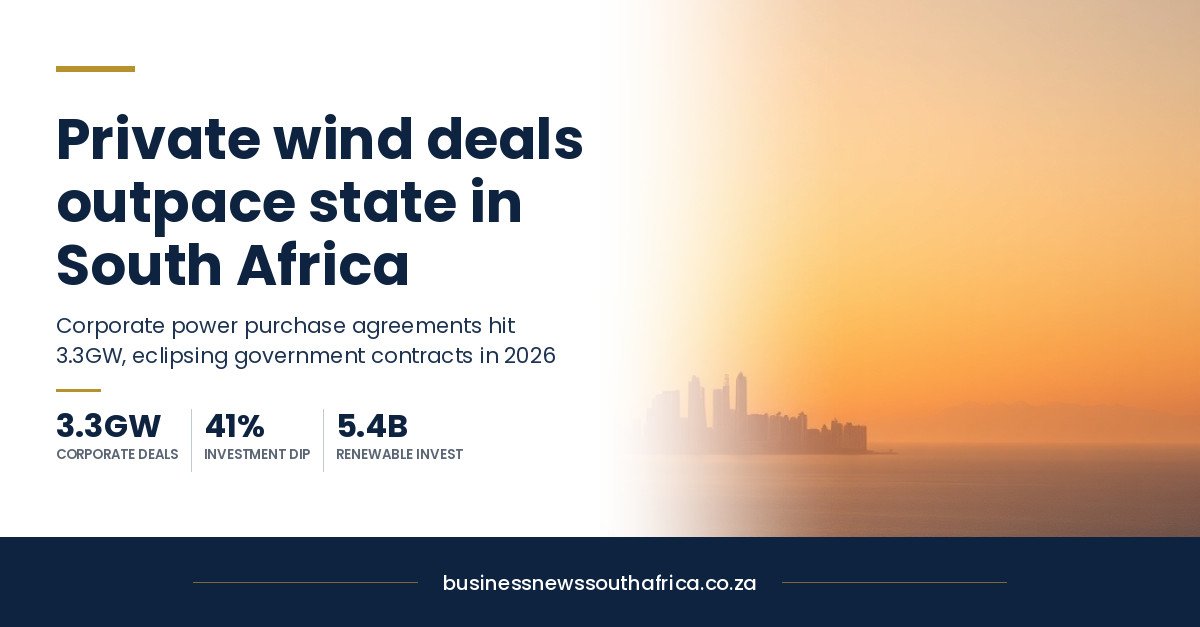
Private wind investment in South Africa now outpaces the state, delegates heard at Windaba 2026 in Cape Town on 7 October, according to Farmer’s Weekly. The report said more than 3.3GW of corporate power purchase agreements, which are contracts under which a company buys electricity directly from a generator, reached financial close in under three years.
Regulatory changes now let mining and industrial companies buy renewable electricity directly. The data from the first half of 2026 shows how far that shift has gone.
What the private money has built
The University of Cape Town’s Power Futures Lab found that 17 independent power producer (IPP) projects, totalling 1 920 MW, began commercial operation in the first six months of 2026, according to a briefing reported by the Cape Chamber of Commerce. That is the highest capacity ever added in a single half-year. The previous record was 1 472 MW, set in 2016.
Ten of the 17 projects, with a combined 1 046 MW, supply mining operations and industrial consumers directly. Seven projects, with 874 MW, came from government programmes: bid windows 5 and 6 of the Renewable Energy IPP Procurement Programme (the state’s competitive auction for private power) and the Risk Mitigation programme. Those figures cover all technologies. Wind contributed seven new farms and 815 MW.
The same briefing expects a further 28 projects, totalling 2 202 MW, to start operating in the second half, which would take 2026 to a projected 4 123 MW. It also notes that most of the projects entering service this year reached financial close in 2024, so this year’s output reflects deals signed two years ago.
Bloomberg New Energy Finance (BNEF) reaches a similar conclusion in its South Africa Transition Factbook 2026, as TaiyangNews reports. Corporate buyers back 73% of the 2.3GW of new solar and wind expected in 2026. BNEF says corporate agreements are, for the first time, delivering “more utility-scale renewable additions than government auctions”. Since 2020, corporate clean-power deals total 5GW, of which standalone projects account for 3.1GW: 1.5GW of wind and 1.6GW of solar.
Prices, and a dip in total investment
BNEF puts the average wind power purchase price at R1 102 per megawatt-hour in 2024 and 2025, forecast to edge up to R1 104 in 2026. Industrial electricity in South Africa cost R1 652 per megawatt-hour in 2025, against R964 in mainland China, according to the same factbook.
The investment numbers complicate the headline. BNEF reports that South Africa’s total renewable investment fell 41% in 2025 to US$5.4 billion, from US$8.6 billion in 2024. Onshore wind investment fell 30% to US$2.1 billion, while small-scale solar rose 35% to US$1.8 billion. Private buyers leading the market therefore does not mean the market itself grew last year. The BNEF figures are for 2025, while the Windaba claim concerns where new deals are coming from.
The continental picture is brighter. Farmer’s Weekly reports that Africa had installed 11.1GW of wind by December 2025, after a record 1.53GW added during that year. The continent has a planned pipeline of 186GW across 260 projects. South Africa, Morocco and Egypt hold 85% of Africa’s installed capacity but under 10% of its technical potential.
The grid is the limit
Delegates were told that transmission capacity is now holding back projects in strong markets, including South Africa’s Cape provinces, where grid infrastructure has not kept pace with new generation. Juliana Kainga, Africa WindPower director at the Global Wind Energy Council, whose Status of Wind in Africa Report 2026 was launched at the event, argued that strong wind resources alone do not attract investment. Credible buyers, bankable contracts, grid access and financing do.
The state grid company has said as much before. Segomoco Scheppers, chief executive of the National Transmission Company South Africa (NTCSA), told an Energy Outlook 2025 webinar, as Energize reported in February 2025: “Every grid, by design, does not have unlimited capacity.” At that point NTCSA planned 14 000 km of new transmission over a decade, with about 950 km in procurement or construction. Those figures are 20 months old and may have moved.
BNEF’s Africa research lead, Nelson Nsitem, called the transition a “critical inflection point” and said “the next phase will depend on whether infrastructure can keep pace with investment”.
What comes next
The industry body, the South African Wind Energy Association (SAWEA), shifted this year’s Windaba, its flagship conference, to a two-day programme under the theme “Implementing Watt Matters: Policy. Power. People.” SAWEA chief communications officer Morongoa Ramaboa said in a Farmer’s Weekly preview that “successful implementation will depend on practical reforms, particularly procurement certainty, stronger grid coordination”.
Forecasts in the Africa report put South Africa above 15GW of wind by 2035. BNEF expects wind capacity to grow from 4.4GW to 10GW by 2030, under the Integrated Resource Plan 2025 framework. Whether either number is reached depends less on wind speeds than on whether new lines are built in step with new turbines. For the corporate buyers signing the agreements, a contract without a grid connection is only a promise.
The Windaba claims come from delegates and industry bodies, and SAWEA’s own post-conference figures were not available at the time of writing.