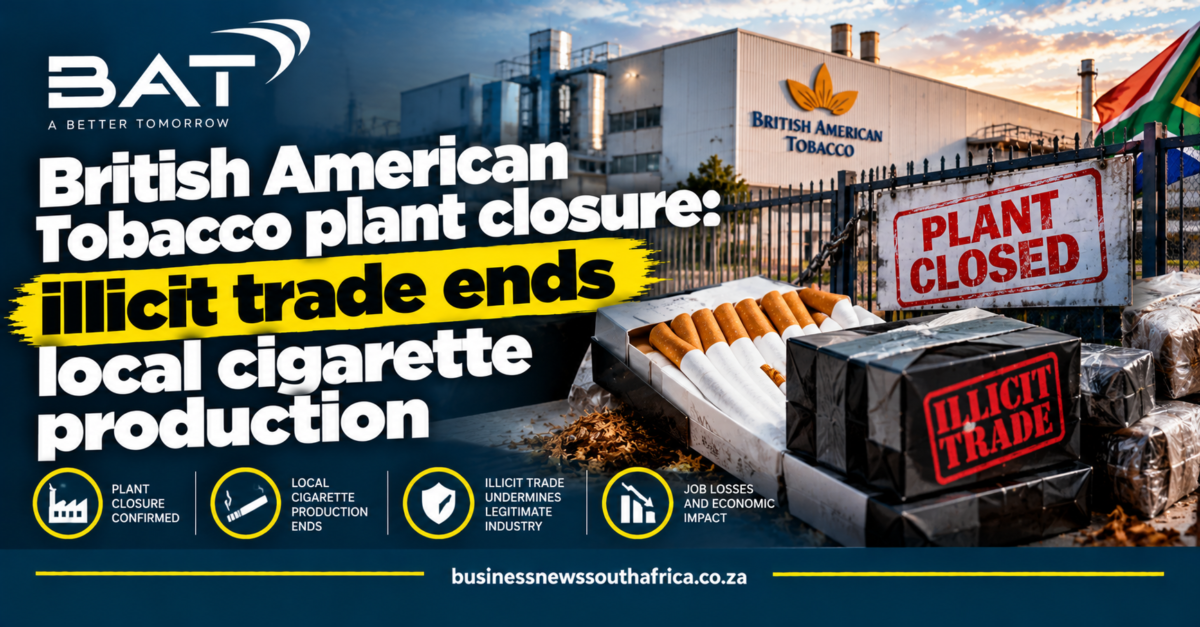
British American Tobacco is winding down its only South African cigarette factory. The British American Tobacco plant closure in Heidelberg, Gauteng, is due to be complete by the end of 2026, and the company says illicit cigarettes have made local production unviable. BAT South Africa (BATSA) first announced the decision in January. Its head of corporate and regulatory affairs, Johnny Moloto, has since argued that illegal trade is pushing legal manufacturers out of the market altogether.
A plant running at 35% of capacity
The Heidelberg plant has operated since 1975 and sits in the Lesedi Local Municipality. In a letter to the municipality, BAT said the factory was “operating at just 35% of total capacity”, which it described as operationally unsustainable. According to BusinessTech, the plant was once the eighth-largest in BAT’s global manufacturing network. The closure process began on 15 January after consultations with employees and unions. Farmers Weekly reports that about 230 jobs in Lesedi are directly at risk.
BAT says it will keep serving South African smokers through imported products. The company has also said its decision to close the facility “is final”. BusinessTech describes the result plainly: retailers will still source cigarettes from overseas, but the domestic jobs linked to production will shrink.
What the illicit market figures show
BAT’s central figure is that illegal cigarettes now account for roughly 75% of total sales in South Africa. Research commissioned by BAT and released on 13 October 2026 found cigarettes priced below the minimum collectable tax in about three-quarters of stores, and packs selling for under R20 in almost two-thirds of outlets, according to BusinessTech. A separate Ipsos study from 2025 also found below-threshold cigarettes widely on sale, as Farmers Weekly reported in January. Business Day carried BAT’s January account of the closure.
Moloto also pointed to a long decline in legal volumes. Volumes declared by local manufacturers to the South African Revenue Service fell from roughly 22 billion cigarettes in 2014 to about eight billion in 2024, based on National Treasury figures, Farmers Weekly reports.
The revenue cost is estimated differently by each report. In January, BATSA said the fiscus loses around R28 billion in excise tax every year. BusinessTech, reporting on the October research, puts the cost of the illegal market at around R30 billion a year in lost excise revenue. BAT also cites Oxford Economics data showing excise revenue fell sharply after the 2020 tobacco sales ban. Moloto argues that legal sales never recovered from that policy decision, which he says the Western Cape High Court declared unconstitutional.
Government response and BAT’s proposals
President Cyril Ramaphosa launched the National Illicit Economy Disruption Programme, also known as Operation Ukubusa, to tackle organised crime and illegal trade. BusinessTech’s reporting says the latest crackdown has done little to curb the illegal trade. Moloto said the research showed that illicit manufacturers “continue to operate with impunity” despite the president’s acknowledgement of the threat.
BAT wants the South African Revenue Service to enforce consequences for businesses profiting from the illegal trade. It also proposes a minimum retail price, which it put at R38 per pack in October and at R37 in January. The company argues that a price floor would make non-compliant products easier for law enforcement to spot. BAT further wants customs officials placed at cigarette factories, and licences revoked for manufacturers that consistently under-declare production or evade tax.
SARS has taken a different view of the policy options. According to Business Day, the revenue service told the portfolio committee on health that proposed tobacco legislation would worsen the illicit trade. Business Day’s January report did not record a government response to the closure itself.
Moloto’s conclusion is blunt. “The only conclusion from these results is that South Africa is losing the battle against illicit tobacco and on the current trajectory will end up with an entirely illicit tobacco market, with no legal industry left,” he said. He added: “The government has the means to turn this situation around. The time for action is now.”
What the closure means for workers and suppliers
Farmers Weekly quotes Moloto on the local impact: “The devastating reality of this decision is that unemployment in Lesedi is extremely high at 43%.” BAT also says its supply chain runs through agricultural suppliers, logistics providers and contractors, and that its workers “don’t deserve this”.
For suppliers, the practical effect is a move from local production to imports. BAT says that move keeps its brands on shelves, but the jobs and output that depended on the Heidelberg plant will not return. The figures above are BAT’s own estimates and have not been independently audited, so readers should weigh them as the company’s position.
Readers following the wider policy debate can find related reporting in our Regulatory and Policy section.