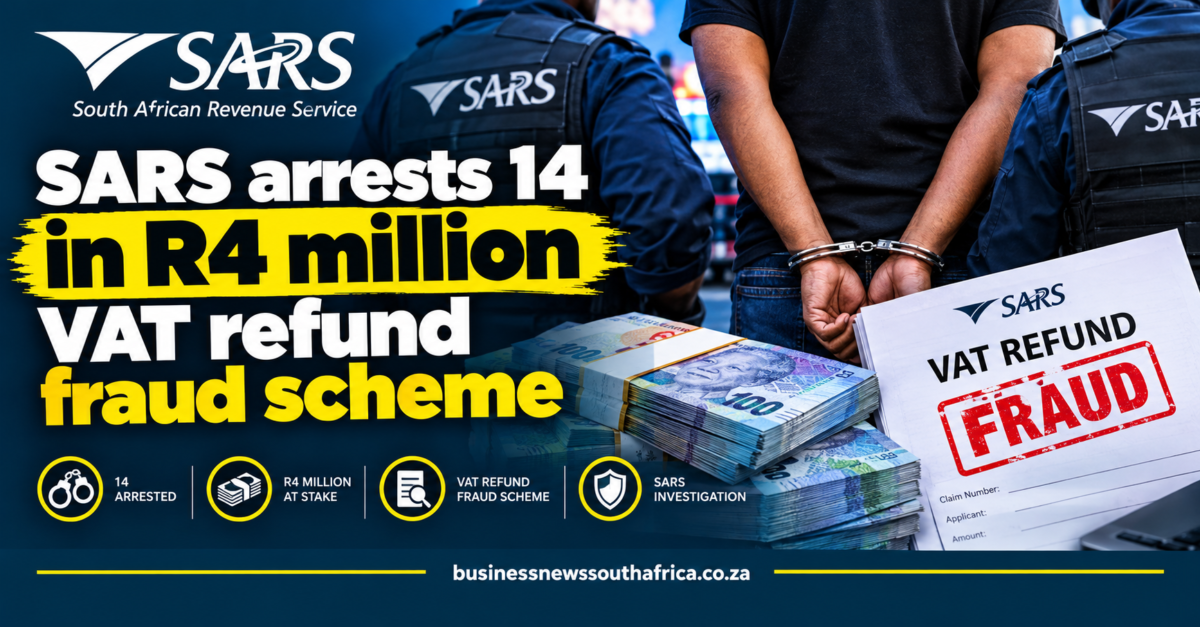
Fourteen accused, five entities and nine individuals, have begun appearing in the Siyabuswa Magistrates’ Court after coordinated arrests over alleged value-added tax (VAT) refund fraud of about R3.99 million, according to a joint statement from the South African Revenue Service (SARS) and the National Prosecuting Authority (NPA), as reported by BusinessTech. The accused first appeared on 6 October 2026 and bail proceedings are continuing. The allegations have not been tested in court, and none of the accused has been convicted.
What SARS alleges
VAT refunds are paid to businesses that have paid more VAT on their purchases than they collected on their sales. SARS says its criminal investigation began with fraudulent VAT refund claims that were submitted through its eFiling system, the online portal used to lodge returns and claim refunds, in the name of an entity.
The SARS media release, issued on 7 October 2026, says it is alleged that false VAT returns were submitted between June 2016 and June 2020. The alleged prejudice to SARS, meaning the amount the revenue service says it was cheated of, is about R3.99 million. BusinessTech rounds that to R4 million in its headline.
The statement does not list the specific charges, name the accused or give the next court date. SAnews, the government news agency, also reports only that bail proceedings of the accused continue.
A coordinated operation across three provinces
Warrants of arrest were executed in a coordinated operation across Mpumalanga, Gauteng and North West. The Directorate for Priority Crime Investigation, known as the Hawks, and other law-enforcement stakeholders supported the operation, according to SARS.
SARS says the case is part of a wider national investigation called Project Jan Vas. In that investigation, an alleged organised criminal syndicate made up of South African and foreign nationals is suspected of targeting SARS with large-scale tax fraud schemes. The syndicate is alleged to operate in Mpumalanga, Limpopo, North West and Gauteng. The statement does not say how many of the 14 accused are linked to the syndicate, or whether other arrests are planned.
What SARS says it is doing about it
Commissioner Dr Johnstone Makhubu said in the statement: “Every rand stolen through VAT fraud is a rand taken away from building a capable state and delivering services to South Africans.” He added that “those who seek to undermine the integrity of our tax system will be detected, investigated and prosecuted.”
SARS described VAT fraud as one of the most serious threats to the integrity of the tax system, and said fraudulent refund claims divert resources from essential public services, distort fair competition and fuel illicit economic activity. It said it is working with the NPA, the Hawks and other agencies to detect complex commercial crimes.
The revenue service also pointed to its growing use of data analytics, the analysis of large volumes of tax data to spot suspicious patterns, as a reason it can detect risk earlier. These tools, it says, also make compliance simpler for legitimate taxpayers. SARS said it will keep investing in advanced technologies that detect risk and suspicious transactions earlier. Those are SARS’s own claims about its systems, not an independent assessment.
A September court case
BusinessTech linked the arrests to a separate case from September in which the proceeds of a fraudulent VAT refund scheme were spread across several bank accounts. The transfers were detected with the help of the banks, the accounts frozen and money taken directly out of them, a process supported by a court ruling on its legality. The SARS release does not mention that case.
In that High Court ruling, BusinessTech reported, the judge held that SARS was entitled to freeze and recover a R900,000 payment made into a taxpayer’s Bidvest Bank account by a company that had received a VAT refund it was not entitled to. The court rejected his argument that SARS should first have sent him a final demand. The company’s alleged suppliers said in affidavits that the invoices were not authentic, and its registered business address was a daycare centre.
What it means for business
The September ruling shows that money paid on from a fraudulent VAT refund can be frozen and recovered from a third party’s bank account: the account holder in that case was not the company that claimed the refund. SARS is also moving towards near real time VAT reporting, set out in its Digital VAT Model proposal, and fraudsters are copying SARS itself: see our report on eFiling scams.