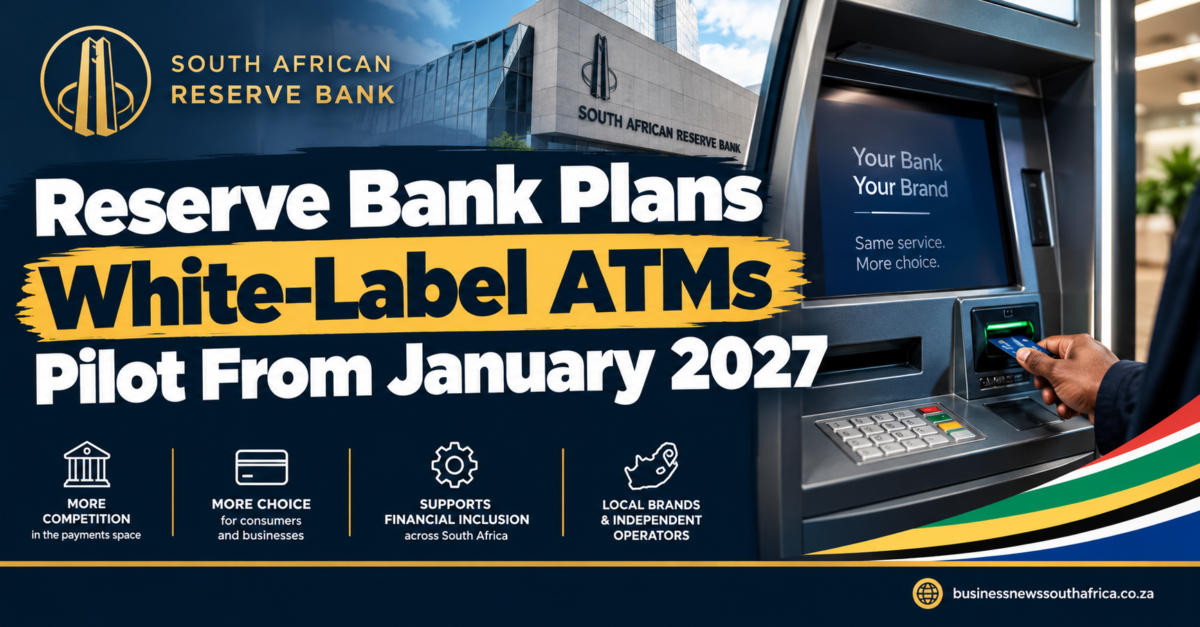
The South African Reserve Bank (SARB) plans to start piloting white-label ATMs in January 2027 as the first step in turning the country’s ATM network into a shared, unbranded system where transactions below a set amount are free, according to TechCentral. The bank also intends to set up a national cash utility by March 2027. The details were set out by Pradeep Maharaj, executive director of the SARB’s Payments Ecosystem Modernisation (PEM) programme, and Arif Ismail, head of its national payment system department.
What the SARB wants from ATMs
TechCentral reports that the SARB wants all of the country’s 30,000-plus ATMs to be unbranded and part of one shared network. Banks are being asked to white-label every machine. Maharaj said all ATMs should support deposits, withdrawals and balance enquiries, and that transactions below a certain amount must be free. He also criticised the “disloyalty fee” charged when a customer’s own bank ATM is out of order.
The idea is not new. A MyBroadband report from 24 June 2026 described a SARB position paper proposing independently owned ATMs not tied to any bank, so that customers of any bank can transact. MyBroadband noted that the paper is not binding and that the SARB said it would set up a regulatory framework covering deployment, funding and operations.
The cost-of-cash study, which used 2024 data, found that about 9,200 of roughly 30,600 ATMs are run by independent deployers that do not accept cash deposits. It also found that cash accounts for 56% of consumer transactions by volume. Maharaj pointed to Sandton City having more ATMs than the Alexandra township.
The national cash utility
The utility would pool cash centres onto one shared platform with a single cash management system, reducing repeated handling of notes, TechCentral reports. It would also place shared, unbranded ATMs where access is needed. The SARB sees the current arrangement, in which wholesale cash handling is dominated by a few providers, as a resilience risk. Firms such as SBV and Fidelity currently run cash centres.
In an earlier Moneyweb radio interview published on 15 December 2025, Maharaj said there are 112 to 113 cash centres nationally, all privately owned, and that the SARB wants to bring them under a utility function. In that interview he also said the interchange fee, which the SARB sets, would be removed for white-label ATMs.
Unlike PayInc, formerly BankservAfrica, in which TechCentral says the SARB took a 50% stake last November, the cash utility would be wholly owned by the central bank. A presentation in May suggested industry participants could gain governance roles or ownership interests.
The cost of cash
Ismail said about R180 billion in cash is in the system and costs about R90 billion a year to manage. The cost-of-cash study puts the annual economic cost at R88.5 billion, about 1.2% of GDP. Consumers earning up to R1,250 a month spend about 5% of their income on cash-related costs, against 1% for those earning R20,000 or more.
The SARB’s argument is that as digital payments grow, the fixed costs of vaults, vehicles and ATMs are spread over fewer transactions. Rural and low-income branches and ATMs close first, creating what TechCentral calls “cash deserts.” Maharaj said the cost of cash would need to fall by at least 30% just for the system to stand still.
Timeline and open questions
TechCentral lays out the sequence as follows. In November 2026 the SARB responds to alternative models proposed by banks, and a standardised QR+ payment code is due. The white-label pilot starts in January 2027, the cash utility is established in March 2027, and cash centres run by firms such as SBV and Fidelity begin moving into the SARB around mid-2027. The first batch of white-label ATMs is to be deployed in a phased rollout by the end of 2027.
Much is still undecided. Banks have put forward their own models, and Maharaj described the talks with them as a “robust conversation,” so the final design may change. The reports we reviewed do not give the free-transaction threshold, the pilot sites or who would own the white-label machines.
The reforms reach beyond cash. The SARB wants PayInc to operate as a national payments utility with equal access for all. PayShap handles about 60 million transactions a month, against a target of 500 million a month by 2029. The National Payment System Bill, released for comment in September 2026, would let non-banks perform seven payment activities on their own from mid-2027. Maharaj said banks are not the target and that the aim is to open access for entrepreneurs serving underserved parts of the economy. For related coverage, see our Tech and Telco section.