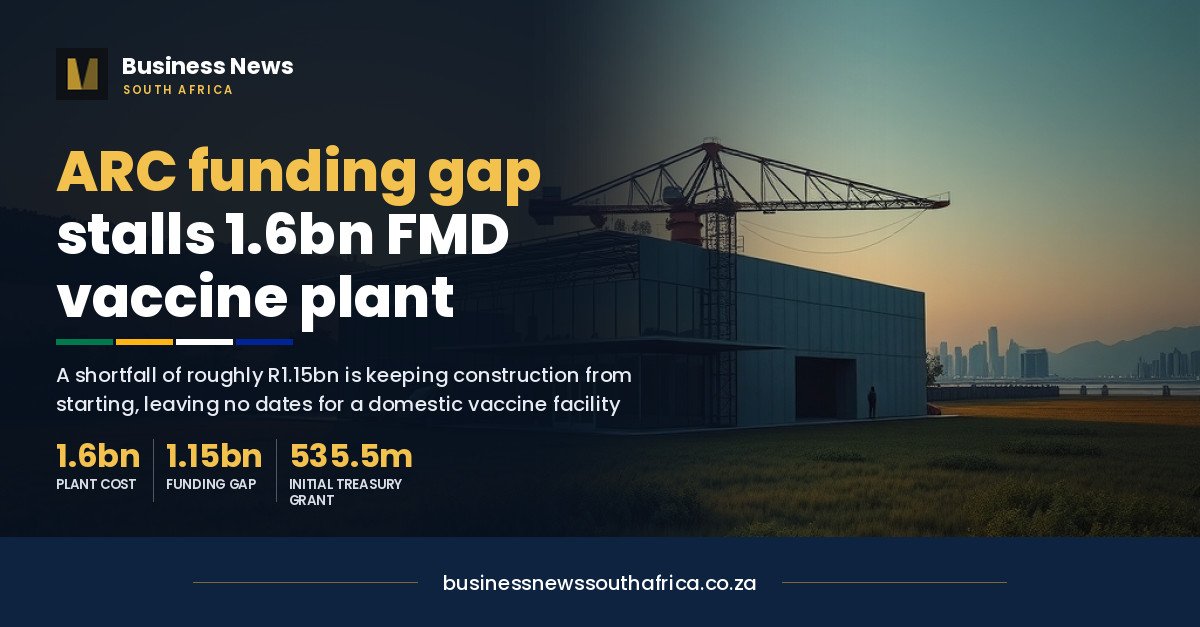
The Agricultural Research Council (ARC) says a funding shortfall is holding up its planned R1.6 billion FMD vaccine facility, a plant meant to let South Africa make foot-and-mouth disease vaccine at home. According to a Farmer’s Weekly report, construction has not started and the ARC has given no start or completion dates.
What the money has done so far
The figures were raised at Parliament’s Portfolio Committee on Agriculture on 6 October. The ARC received about R535.5 million from National Treasury for the project. By 31 March 2026 it had spent R81.7 million, and R453.8 million remains ring-fenced. The estimated cost of the plant is now about R1.6 billion. Farmer’s Weekly calculates the funding gap at roughly R1.15 billion, which is the outlet’s own arithmetic rather than a figure the ARC stated.
The first funding arrived in 2011/12, with a further major allocation in the 2019 to 2022 spending cycle. The ARC says the R81.7 million, spent over more than 15 years, went on vaccine efficacy and safety testing, production process redesign, training, engineering and architectural services, surveys, bulk infrastructure assessments, and legal and regulatory compliance. Farmer’s Weekly reports that the ARC gave no itemised breakdown by activity or service provider.
The ARC’s account of the delay
The ARC attributes the hold-up to insufficient and intermittent funding, revised designs, higher construction and equipment costs, exchange rate effects on imported items, and changes to health, safety and environmental rules. It says the plant cannot be built in phases and that it can only commit service providers once full funding is confirmed. It also warned that further delay would push costs higher.
The ARC’s vaccine was registered as a stock remedy in 2022, according to Farmer’s Weekly. The council has also been building a smaller production capability. At a committee briefing in October 2025, recorded by the Parliamentary Monitoring Group, the ARC said system delivery was completed in May 2025, staff had been trained and equipment was being installed, with a target of 2,000 doses. It said additional funding was needed to finish the facility, and the minister had told it to explore options including public-private partnerships and licensing agreements.
What the Auditor-General said
Desmond Phungula, a senior manager at the Auditor-General of South Africa (AGSA), told the 6 October meeting, as reported by Farmer’s Weekly, that the ARC received an unqualified audit opinion for a second consecutive year, an improvement on earlier qualified opinions. The AGSA said problems remain in financial reporting, asset management and procurement, including uncompetitive procurement and contracts extended without approval, as well as late payment of creditors. It named the ARC and Onderstepoort Biological Products (OBP) as significant contributors to unresolved irregular expenditure in the portfolio, and recommended quarterly progress reports on corrective action plans and regular updates on both projects.
The AGSA also said it could not obtain enough evidence to decide whether the Department of Agriculture’s R311 million spend on 3.42 million imported FMD doses was economical or good value. It found no wrongdoing, but noted that import and handling charges through OBP raised prices and reduced the number of doses bought. Minister of Agriculture Willie Aucamp said OBP’s board is investigating the prices paid.
OBP faces its own delays
OBP, the state vaccine producer, received another qualified audit opinion for 2025/26. It was given about R492 million in 2013 for a good manufacturing practice facility, and construction was halted in 2021. Farmer’s Weekly reports that Aucamp said an oversight visit found “nothing to show” apart from a storeroom and building supplies. The Special Investigating Unit has started an investigation and the minister is awaiting its report.
Why it matters to farmers and exporters
South Africa is relying on imports to fight the outbreak. In May, the Department of Agriculture told the committee, per the PMG record, that “Foot and Mouth Disease outbreaks have been reported in all provinces,” with reported outbreaks rising from 932 on 2 March to 2,034 on 22 May. Doses have come from Biogénesis Bagó in Argentina and Dollvet in Türkiye. In April, TimesLIVE reported that a further 5 million Biogénesis Bagó doses had been ordered through OBP, pending approval of a Section 21 importation application by the health products regulator, and that the government’s aim is to vaccinate the national herd so the country can regain a recognised FMD-free status with vaccination and reopen export markets.
A local plant would reduce dependence on foreign supply and on the price and handling layers the AGSA flagged. For cattle farmers, feedlots and red meat exporters, the speed of vaccination and the route to export markets both depend on vaccine supply. Neither facility has a date.
What remains unknown
The ARC has not said when construction could begin, where the remaining R453.8 million is held, or whether a revised feasibility study or business plan exists, according to Farmer’s Weekly. It also did not say whether an internal review followed the spending questions. The cost figures are not consistent across sources. At the May committee meeting the department’s written response cited about R1.2 billion for the ARC plant, and said Treasury had asked the ARC for a revised Budget Facility for Infrastructure application, which the ARC has submitted. A committee member also referred to a R2 billion gap cited in an earlier report, and the PMG record shows no firm answer on a timeline. Treasury’s decision on the application has not been reported.