South African dairy farmers have trimmed their costs about as far as they can, and growing their way out is not working either, according to a panel reported by Farmer’s Weekly. Milk SA’s own figures, published in its May 2026 Lacto Data report, show why: the country makes slightly more milk every year, from fewer farms, at a farm-gate price (what a farmer is paid per litre by the processor) that has barely moved in three years.
At the Royal Show panel on 9 October, dairy farmer Tom Turner said the number of South African dairy farmers had fallen from about 7 500 to 830 during his career. In a study group of 65 farmers, he said, only the top 20% consistently earned a return above bank interest, and most would be better off selling up and banking the money. Those are his figures, not an official count.
Fewer farms, more milk each
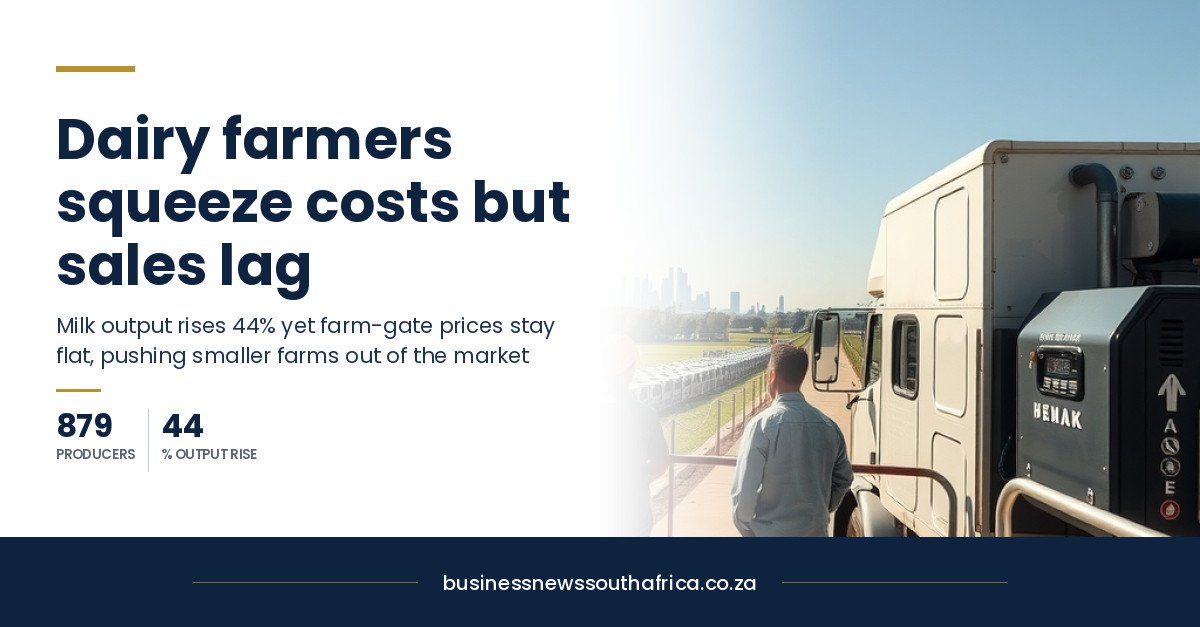
The official count is higher but points the same way. Milk SA, the umbrella body of the Milk Producers’ Organisation (MPO) and the South African Milk Processors’ Organisation (SAMPRO), counted 879 milk producers in January 2026. That is down from 1 053 in January 2021, with the Free State dropping from 91 to 74 producers and North West from 57 to 44 in the past year alone. Gauteng rose from 48 to 64.
The same report puts the milk bought by processors in 2025 at 3 483 993 tonnes, up 0.75% on 2024. Milk SA’s summary panel says output per producer rose 44% between 2020 and 2025, from 2 740 tonnes to 3 937 tonnes. The report puts average daily output at 20.5 litres per cow in 2025.
Between January 2025 and January 2026, registered processors fell from 129 to 119, and producer-distributors (farmers who sell milk directly to shops or consumers) from 60 to 56.
A price that has gone sideways
Milk SA puts the average farm-gate price for 2025 at R7.06 a litre, easing to R6.94 in December. Its preliminary MPO price survey for February 2026 shows R7.17, against R7.75 in February 2024 and R5.55 in February 2021. By the report’s own comparison, European producers averaged €0.54 (R10.93) a litre in 2025.
Stats SA producer price data, as summarised by Milk SA, shows the 2025 average for unprocessed milk down 1% on 2024, while the producer price index for dairy products rose 2%. The consumer price index for milk, other dairy products and eggs fell 0.5%. Milk SA says the gap between farm-gate and processed prices narrowed during the year.
Meanwhile, Andrew Morphew, a dairy farmer and spokesperson for FMD Response SA, told the panel that a farmer needed 1.49 litres of milk to buy one litre of diesel in 2016, against 3.6 litres in 2026. Turner said he needs to grow production by 5% to 10% a year just to keep pace with costs, and that the market is not growing.
Costs are less one-directional than that. In the Department of Agriculture’s farm requisite price indices (2015 = 100) quoted in Lacto Data, the index for machinery and implements climbed from 126.6 in 2021 to 151.7 in 2024. Intermediate goods and services, a category that sits alongside machinery in that table, fell from 151.5 in 2022 to 135.0 in 2024. The International Farm Comparison Network analysis cited by Milk SA says feed is about 60% of milk production costs.
Is demand really stuck?
Morphew told the panel that rising output is meeting a market with limited buying power, with population growth outpacing economic growth. The retail data is more mixed. NielsenIQ figures in the Milk SA report show 2025 dairy sales improved markedly on 2024, with UHT milk, cream, cream cheese and maas each up more than 5%. Milk SA links that to slower price increases and says five of nine monitored dairy product prices fell between December 2024 and December 2025.
Export markets did better. South Africa imported 32 000 tonnes of dairy products in 2025 and exported 70 000 tonnes. Imports fell 6% and exports rose 31%, making the country a net exporter for a second year running, a status Milk SA says was last reached in 2014. Skimmed milk powder and UHT milk led the exports. Turner called for more economic growth, stronger export markets and more spending on dairy marketing and product innovation, which he estimated at under 1% of revenue.
Disease has added to the strain. Milk SA says foot-and-mouth disease slowed output growth in 2025, most severely in KwaZulu-Natal, Gauteng and the Free State, and it estimates January and February 2026 output at 517 million litres, down 2.58% year on year. On 24 February, Agriculture Minister John Steenhuisen announced that milk from vaccinated, uninfected farms, and from farms not infected or suspected of infection, would face no restrictions, Business Report reported.
The January 2026 producer count was 0.7% down on the year, a gentler fall than the 9.5% recorded in January 2023.