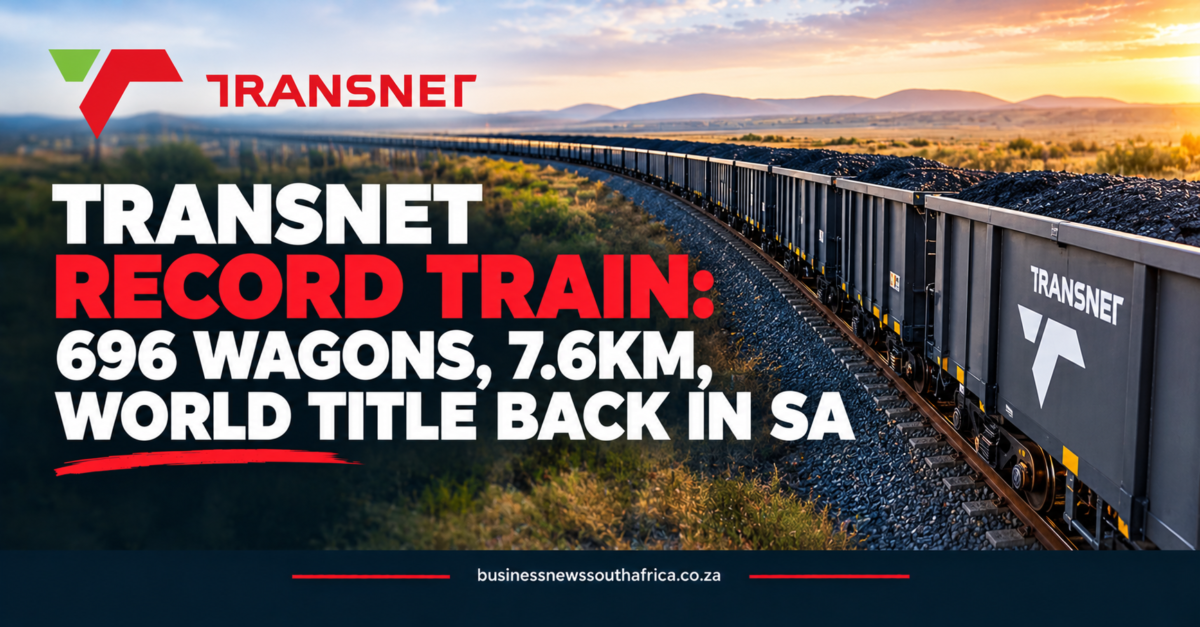
A Transnet record train of 696 wagons, about 7.6km long, has given South Africa back the world title for the longest freight train, after Transnet Freight Rail (TFR) ran it on the Iron Ore Export Line between Saldanha in the Western Cape and the Northern Cape. The empty train reached Loop 18 on 18 October 2026, completing what TFR describes as the longest train ever compiled and operated on the heavy-haul corridor, according to a TFR media release reported by Moneyweb and BusinessTech.
How the 696-wagon train was put together
The train was made up of 696 empty CR13/14 iron ore wagons. It was hauled by a mix of Class 15E electric locomotives and Class 43D diesel-electric locomotives, spread through the length of the train rather than grouped at the front. TFR has not published how many of each locomotive class were used, or the total weight of the consist.
The locomotives were linked through Radio Distributed Power (RDP), a system that lets units placed at intervals along the train work together as one. Spreading traction and braking effort along the train in this way limits the forces between wagons and reduces stress on the track, which is what makes a train of this length possible to control on a single-track heavy-haul line.
The Iron Ore Export Line, also called the Sishen-Saldanha line, is an 861km corridor that carries iron ore from the Sishen mines in the Northern Cape to the Port of Saldanha, according to BusinessTech. It is one of South Africa’s main export routes for bulk minerals.
Reclaiming a record Australia held since 2001
BusinessTech reports that the run returns the longest-train title to South Africa after Australia held it from 2001. That record belonged to BHP Iron Ore, whose train in Western Australia measured 7.35km and had 682 wagons.
According to the Wikipedia list of longest trains, the BHP train ran on 21 June 2001 on the line to Port Hedland, measured 7.352km, was pulled by eight diesel locomotives and weighed 99,734 tons. The same list records an earlier South African run on the Sishen-Saldanha line on 26 and 27 August 1989: 660 wagons over 7.302km, pulled by 16 locomotives. BusinessTech also notes that South Africa first set the record on this line in 1989.
One difference is worth stating plainly. The BHP train and the 1989 South African train were loaded with ore, while the TFR train ran empty. The new mark is a record for train length and wagon count, not for the heaviest load moved in a single train.
A test programme as much as a record attempt
TFR presented the run as part of a dynamic train evaluation programme with two aims: setting a world record and building technical knowledge in train design, handling and operating performance. The work was led by TFR’s train design technology and operations teams, with Transnet Engineering, the Transnet Rail Infrastructure Manager (TRIM) and the Railway Safety Regulator also involved.
According to Moneyweb, the trip followed extensive pre-run planning, dynamic modelling and simulation by train design specialists, who assessed train handling and where to place the locomotives. Specialist staff travelled with the train along the corridor to monitor its performance in real time. Data collected from the locomotives during the run will be compared with earlier simulation models to refine future heavy-haul operating strategies and add corridor capacity.
What Transnet says it gains
TFR chief executive Russell Baatjies said in the company’s statement that while the world record is a significant achievement, “the real value lies in the technical knowledge and operational insights gained through this exercise.” He said the lessons learned “will contribute to the continued advancement of rail operations,” and would support innovation and strengthen the company’s freight rail capability.
In its own statement quoted by BusinessTech, TFR said the result showed the strength of its railway operations capability.
The practical question for mining companies, exporters and logistics firms that depend on the ore line is whether the findings translate into longer loaded trains in regular service. Running more wagons per train slot is one way to move more tonnes on a fixed corridor without laying extra track. TFR has not said whether, or when, trains of this length could enter routine operation, and the record run itself carried no ore.
The record comes in the same month that government launched its R8.9bn restoration programme for the line, which Business News South Africa covered separately. TFR has framed the 696-wagon run as engineering groundwork. Its value to exporters will show only when the simulation findings feed into everyday schedules on the corridor.