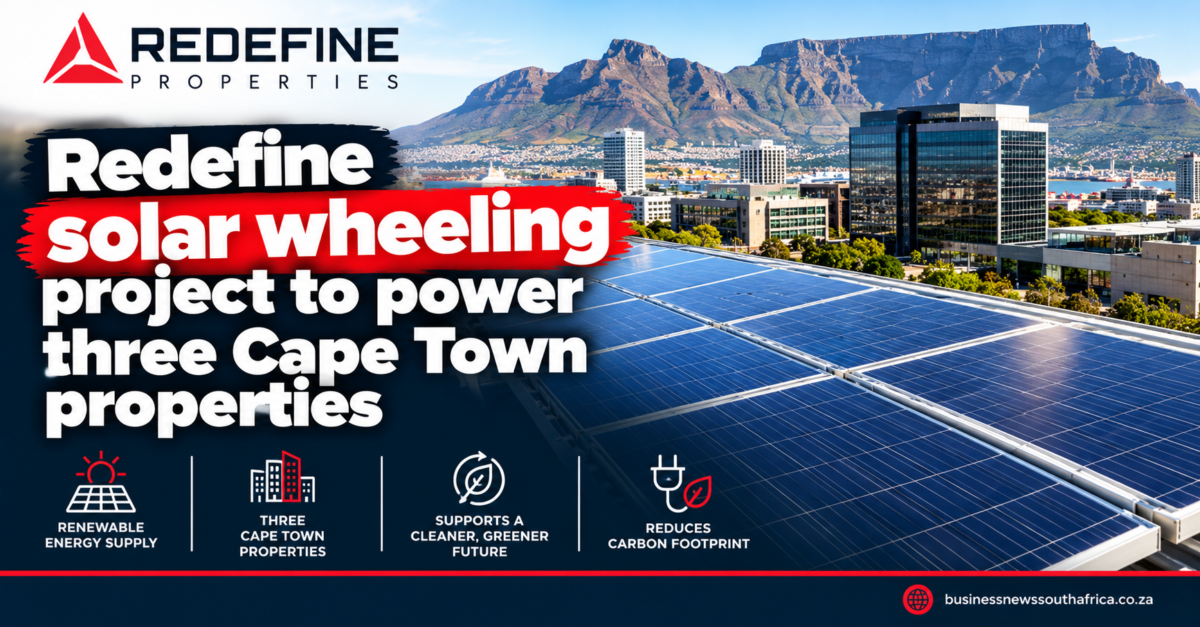
Redefine Properties has launched a R106 million solar wheeling project in Cape Town that generates power on the roof of a distribution centre and sends it through the city’s grid to three of its retail and office properties. The Redefine solar wheeling project uses a 7.014MWp rooftop plant at the Massmart Distribution Centre in Brackengate, and is expected to produce 9,889MWh of electricity a year, according to Green Building Africa and Lifestyle & Tech, both reporting the launch on 20 October.
Rooftop generation, wheeled to three sites
This is a wheeling project, not a rooftop system that feeds the building it sits on. The plant has 11,691 panels across about 57,000 square metres of the Massmart roof. Its output is fed into the City of Cape Town’s network and allocated to Kenilworth Centre, Blue Route Mall and The Towers office precinct, BusinessTech reported. Redefine describes wheeling as feeding renewable energy into the grid and allocating it to other properties, with the municipality balancing supply and demand.
The project is part of the City of Cape Town’s wheeling pilot programme, which falls under the City’s 2050 Energy Strategy. It has been described in the launch coverage as the first purpose-built rooftop solar wheeling project of its kind on the City’s network.
What was built
Redefine had to build its own grid connection to make the scheme work. The installation includes a dedicated mini-substation building with switchgear and meters, an inverter station and a transformer yard, about 300km of cabling and 2km of rooftop walkways for access and maintenance. The system connects to the grid at the Rubicon Substation and operates at 800V.
Chief operating officer Leon Kok said the project goes beyond a conventional rooftop installation because it lets the company manage energy across its portfolio. “By using the capacity of one asset to support others, we’re creating a more efficient and resilient portfolio,” he said.
Alderman Xanthea Limberg, the City’s mayoral committee member for energy, said the wheeling programme would strengthen the city’s business sector, and that the reforms have liberalised the local energy market. She thanked Redefine as the City’s private-sector partner in the pilot.
Savings and share of consumption not disclosed
The launch reports give the project’s cost, capacity and expected output, but none of them state how much the three properties will save on electricity or what share of their consumption the wheeled power will cover. We found no published figures from Redefine on either point for this project.
The company expects the project to avoid about 9,645 tonnes of carbon emissions a year, and the arrangement carries a 20-year commitment, according to the launch coverage.
Part of a wider move away from grid supply
Brackengate adds to a portfolio that was already sizeable. In its interim results for the six months to 28 February 2026, Redefine reported 62.23MWp of installed solar capacity across its properties, up 7.2% year on year, Green Building Africa reported in May. Retail properties account for about 47.79MWp of that, industrial 8.23MWp and office 6.21MWp.
The company said its solar investments had produced cumulative savings of R107.5 million. It also had 5.6MWp of further solar capacity under development, valued at about R101 million.
Redefine is also wheeling power outside Cape Town. In June 2025 it signed an agreement with renewable energy utility NOA covering 11 Eskom-connected properties, which is expected to deliver 37GWh a year over 20 years.
For a landlord with malls and office blocks that draw heavily on grid power, the Brackengate model shows a different route: generate where there is roof space, and use the municipal network to deliver it where demand sits. Whether it pays off will depend on figures Redefine has not yet shared.