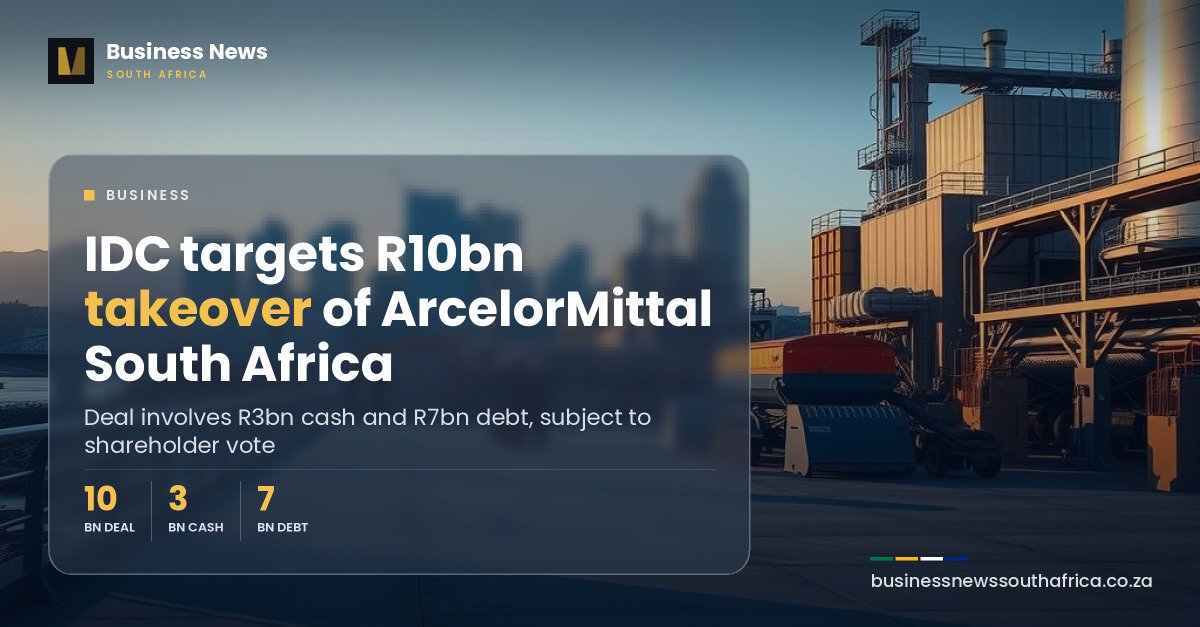
The Industrial Development Corporation (IDC) has reached an initial agreement to take over ArcelorMittal South Africa (AMSA) in a deal worth about R10 billion, according to people familiar with the matter cited by Bloomberg. The terms have not been confirmed by either company, and AMSA declined to comment. The IDC, South Africa’s state-owned development-finance institution, says only that talks continue.
What the reported terms say
Bloomberg’s account, republished by News24 and BusinessTech, puts the IDC’s offer at a cash component of about R3 billion, with the financier also taking on about R7 billion of debt that AMSA has accumulated. The sources asked not to be identified because the information is private. The aim is to conclude the transaction, which would be subject to a shareholder vote, by the end of the year.
The IDC’s public statement was more cautious. It said it remains in talks “to find a lasting solution to the challenges facing the steelmaker with the objective of protecting South Africa’s vital steel-manufacturing capabilities,” and that it would communicate any outcomes.
Market reaction
Shares in AMSA surged by as much as 21% in Johannesburg trading, the biggest move since September last year, according to Bloomberg. That put the company’s market value at about R1.3 billion. The figure shows how small the equity is next to the reported debt: the R7 billion of obligations the IDC is said to be taking on is more than five times the company’s market value. According to News24 reporting from August, the shares have lost more than 80% of their value over five years.
How the talks reached this point
The negotiations date back to November 2023, when AMSA announced plans to shut two steel mills that produce grades regarded as crucial to the automotive and mining industries. That prompted the IDC, already a shareholder, and the Department of Trade, Industry and Competition to step in to try to save an industry seen as key to South African manufacturing.
News24 reported in August that AMSA had said it was in an “advanced stage to finalise agreement” with the IDC. At that point the IDC owned about 8% of AMSA and had extended a R2 billion loan earlier in the year, which was not enough to prevent the closure of AMSA’s Newcastle and Vereeniging plants. News24 also reported that KPMG had finished a second due diligence report on the transaction, and that AMSA had previously set a price of R8.5 billion for its assets.
The same report lists the pressures on the business: high power and rail costs, low economic growth, a flood of cheap imports, and competition from smaller mills that make steel from scrap metal. AMSA lost R3.4 billion in the year to end December 2025, after a R5.1 billion loss the year before.
What AMSA still runs
AMSA has closed two steel mills and an iron-ore mine. It still operates a facility in Vanderbijlpark, south of Johannesburg, which produces steel sheets and other products. Its facilities in Pretoria and in the West Coast town of Saldanha are idle. Bloomberg says the IDC sees the company’s mills as crucial to the nation’s industrial sector.
The company was formerly known as Iscor. It came under the control of Indian billionaire Lakshmi Mittal’s LNM Holdings in 2003, and in 2006 Mittal Steel combined with Arcelor to form ArcelorMittal.
Ownership, empowerment and the road to a vote
Bloomberg’s sources say a 10-year agreement with local black economic partner Likamva Resources, which has a stake in AMSA, ends in early December and is unlikely to form part of the new ownership structure. Bloomberg notes that the government requires large companies to take on black-owned partners to broaden wealth, so how that stake is replaced or settled will be part of the transaction.
If the deal closes, the reported plan is for the IDC to start a strategic review of the businesses and possibly seek industry partners to operate or invest in specific divisions. Bloomberg’s sources say a detailed process will be followed to allow the transaction to be completed. The report described the deal as one of the government’s biggest industrial interventions in years, and one that would effectively place a key industrial asset under the control of the state-owned IDC.
What it could mean for buyers of steel and for investors
For manufacturers that rely on locally produced flat steel, the immediate message is continuity rather than change: Vanderbijlpark keeps running, and the sources describe the aim as protecting domestic steel-manufacturing capability. What customers will actually see in pricing, supply or product range is not covered in any source and would be speculation at this stage.
For investors, the unconfirmed terms and the vote are the main facts. Minority shareholders will have a say, and neither company has published the price, the structure or the timetable. Readers should treat the R10 billion figure and the year-end target as the aims reported by unnamed sources, not as a signed agreement.
What is still unknown
Several questions remain open: whether AMSA and ArcelorMittal’s Luxembourg parent will confirm the terms, whether the cash and debt split holds, who the industry partners might be, what happens to the idle Pretoria and Saldanha facilities, and what the Likamva exit looks like. Further coverage of industrial policy is in the Business section.