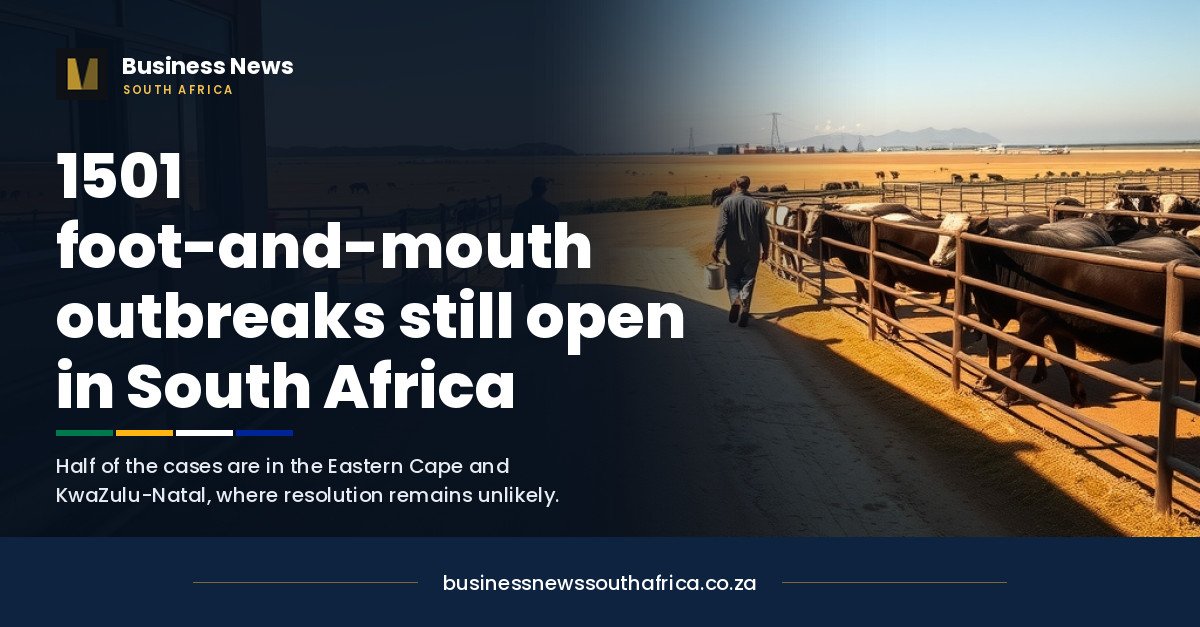
South Africa still has 1,501 open foot-and-mouth outbreaks, even though the disease has dropped out of the daily headlines. The figure comes from a Department of Agriculture report dated 30 September 2026, which Farmer’s Weekly reported on 16 October. The report lists 2,871 outbreaks nationally. Of those, 1,370 have been reported to the World Organisation for Animal Health (WOAH) as resolved and closed, which leaves the 1,501 still open.
What the department means by unresolved
An open outbreak is not the same as an active one. According to the department, an open case does not necessarily mean the virus is still circulating. Some properties may no longer be infected but stay under quarantine until the official closure steps are complete.
The report does not say how many of the 1,501 still involve live infection, so the true size of the current problem cannot be read from the headline number. The SAT1 and SAT2 strains continue to affect livestock, mainly in the northern and eastern parts of the country.
The Eastern Cape and KwaZulu-Natal carry half the open cases
The provincial split is uneven. The Eastern Cape has 421 open outbreaks and KwaZulu-Natal 346, together 767, or about 51% of the national total. The Free State follows with 163 open, then North West with 143, Gauteng with 136, Mpumalanga with 123, Limpopo with 99, the Northern Cape with 39 and the Western Cape with 31.
The Free State has the most closed outbreaks at 634, against only 12 closed in the Eastern Cape and 30 in KwaZulu-Natal.
The department says many KwaZulu-Natal cases trace to a SAT2 outbreak that began in May 2021 and that five neighbouring game reserves are affected. It warns that complete resolution there is unlikely because buffalo in the reserves can carry the virus. The same SAT2 virus was linked to a 2024 outbreak in East London and, in 2025, to cases in Mpumalanga, Gauteng, North West and the Free State. A SAT1 strain found in KwaZulu-Natal in February 2025 resembles a virus previously found near the northern Kruger National Park, but how it arrived is unknown. A different SAT1 strain identified in Gauteng in October 2025 has since turned up in outbreaks in every other province.
New rules are closing cases faster
The department credits part of the closures to amendments to the 2024 FMD Contingency Plan, published in the Government Gazette on 7 July 2026. For dairy, breeding and communal dipping-tank clusters, quarantine can be lifted if no clinical signs appear for at least 42 days after a “Day Zero” set by the supervising state veterinarian.
Controlled slaughter is also now an option. It requires no obvious viral circulation for at least 14 days before Day Zero, approved slaughter procedures and safe disposal of potentially infectious material. Meat from controlled slaughter may be sold domestically. It can be exported only where the importing country has specifically agreed.
Animals that are vaccinated, infected or suspected of infection must be individually identified and recorded in a database that gives lifelong traceability.
Vaccine supply and the cost of the outbreak
Farmer’s Weekly gives no current vaccination figures, so the latest numbers we could confirm are older. In February, Agriculture Minister John Steenhuisen said there were no delays in vaccine arrivals, according to Daily Maverick. A first shipment of 1 million doses from Argentina’s Biogénesis Bagó arrived on 21 February, and the government set a goal of vaccinating 80% of the national herd by December. By early March, about 2.5 million doses were available, including 1 million from Argentina and 1.5 million from Türkiye, Business Day reported.
In April, Reuters reported that a further 2 million doses had arrived from Türkiye’s Dollvet, with 4 million more ordered from Dollvet and 5 million from Argentina, the latter awaiting import approval from the South African Health Products Regulatory Authority. Our earlier report covers the funding gap at the ARC vaccine facility, which is meant to reduce reliance on imports.
The trade damage is the clearest cost measure. Beef exports fell 26% in 2025, and shipments to China dropped 69% to 1,687 tonnes after Beijing banned South African red meat in May 2025, according to Red Meat Industry Services data cited by Reuters. China was South Africa’s third-biggest beef market in 2024, after the United Arab Emirates and Jordan.
On the farm, Mooi River dairy farmer James Kean told Reuters that his seasonal expenses rose by R1 million as he tried to keep infection out, and that milk output fell from about 26,000 to 23,000 litres a day within days. That is his own account of one farm, not an industry figure. He also warned the national livestock population could halve in two years, a prediction rather than a measured result. For the regional angle, see our report on the Namibia outbreak and South African sheep supply.
What remains unknown
Several gaps limit what can be said. The department has not published how many of the 1,501 open outbreaks involve active infection. Farmer’s Weekly gave no current vaccination totals, no import figures and no cost estimates, and quoted no farmer organisation. We did not find a recent statement from the Red Meat Producers Organisation, Milk SA or the feedlot association to set against the department’s account.
Earlier figures also show how fast the picture can shift. Business Day reported in March that a department official, Dr Botlhe Modisane, said the true number of outbreaks exceeded reported figures because of reporting delays and pending laboratory confirmations. The route by which the KwaZulu-Natal SAT1 strain entered the country is still unexplained.
What the 30 September report does show is a disease that has stopped making news without stopping. Half of the open cases sit in two provinces, and in KwaZulu-Natal the department itself says full resolution may not be possible.