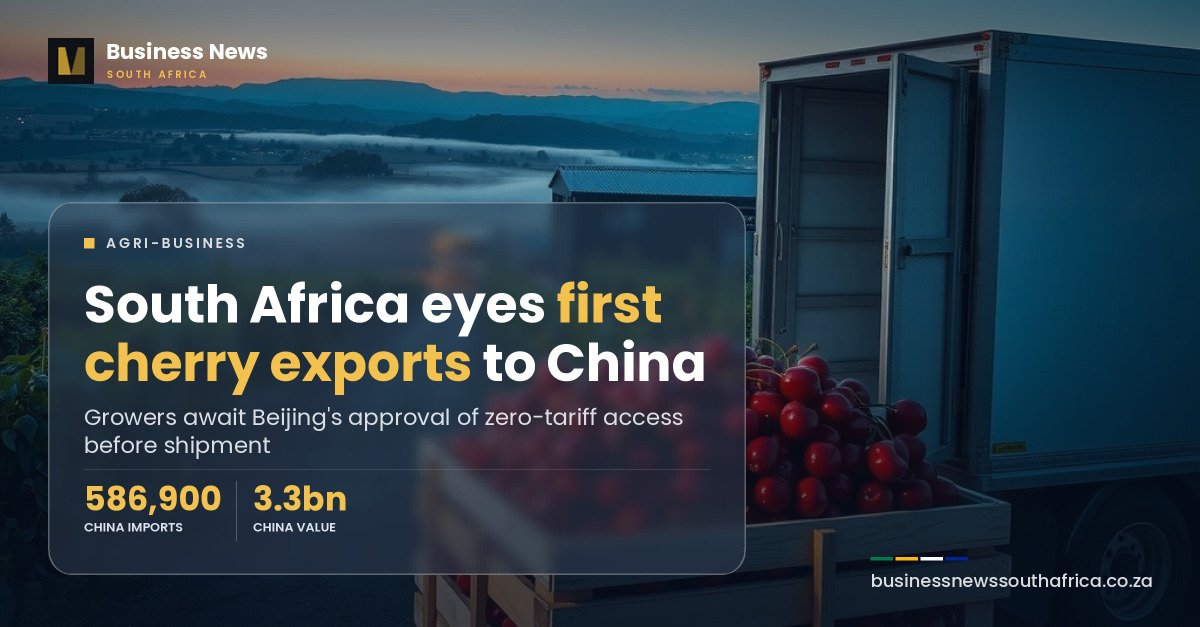
South African cherry growers are lining up for their first shipments to China, but the fruit cannot leave until Beijing confirms that South Africa has met its import requirements. Agriculture Minister Willie Aucamp told Reuters he expects that approval by the end of the year, according to a report carried by Engineering News on 21 October 2026.
A protocol is signed, but the market is not yet open for trade
Aucamp signed a market access protocol for cherries with Sun Meijun, minister of China’s General Administration of Customs, in Beijing on 8 September 2026. The signing took place at the ninth Sanitary and Phytosanitary Ministerial Meeting, according to a government statement. It was the first time South African cherry producers have been granted access to the Chinese market.
The same statement notes that this was the first time two market access protocols had been signed with China within a year. Aucamp said negotiations on blueberries are at an advanced stage, and that China has tabled a draft protocol for South Africa to consider. He has asked officials to fast-track the work with a view to finalising it before the end of the year.
The statement describes the cherry protocol as confirming commitments under the Framework Agreement on Economic Partnership for Shared Development, which it says gives South Africa 0% tariff access to Chinese markets. BusinessTech reported the protocol as granting zero-tariff access for cherries specifically. The sources frame the tariff terms slightly differently, so exporters should confirm the exact duty treatment with the customs authorities before pricing a shipment.
China dwarfs South Africa’s cherry industry
The numbers explain the interest. According to the government statement, China imported about 586,900 tons of cherries in 2025, valued at US$3.3 billion (R52.8 billion), making it the largest importer in the world. Reuters puts the figure at nearly 600,000 metric tons a year, with Chile and Argentina the two biggest suppliers.
South Africa is a very small player. Reuters reports that it accounts for just 0.2% of global cherry volumes, which leaves growers little prospect of competing on scale. Agbiz chief economist Wandile Sihlobo told BusinessTech that this year’s local harvest is around 3,006 tonnes, which he said means South Africans can still expect affordable cherries in shops and that exports will not take everything away from the domestic side.
Growers are betting on timing, not volume
The commercial case rests on getting fruit to China before Chilean cherries arrive. Karien Bezuidenhout, manager of alternative crops at deciduous fruit association Hortgro, told Reuters that arriving in September or early October creates the opportunity to beat the Chilean fruit. She said South African cherries have an excellent taste profile.
One of the growers preparing is Gert Eastes, chief executive of Ridge Cherry Farms, which runs a 125-hectare farm near Rustenburg in the north of the country. Reuters reports that he has spent 12 years preparing for this market and has refined production to harvest in October. “We’ve been asking for this for ages,” he said.
Eastes is aiming to grow volumes from 600 tons to eventually reach 2,000 tons. He said that if he could send 1,000 tons to China in October, it would change his business model. He is also preparing to potentially quadruple a seasonal workforce of around 300 people. The government statement projects that opening the Chinese market will stimulate investment in production and create about 600 new jobs, although it does not say how that figure was calculated.
What it means for businesses beyond the orchard
The potential benefits reach past growers. Packhouses, cold-chain and air freight operators, port agents and seasonal labour contractors all stand to see demand if the first shipments move, since cherries are a perishable, time-critical export. Sihlobo told Reuters that South Africa exports about US$15 billion worth of agricultural products annually, while China buys about US$200 billion in total. He said the country already exports 55% of what it produces and could see export value expand by at least 20% over the coming years. That is his estimate, not an official forecast.
Aucamp framed the China push as diversification rather than a reaction to any single trading partner. He told Reuters that South Africa has to open up new markets, and the same report notes the country is also seeking to crack Egypt, the United Arab Emirates and the wider Middle East.
What is still unknown
Several questions remain open. China has not yet confirmed that South Africa has met all its requirements, so no commercial shipment can be made, and the minister’s year-end expectation is an expectation rather than a commitment from Beijing. If approval slips past the year-end, growers would miss the early window the strategy depends on, because the early-season advantage is tied to the Chilean calendar.
It is also unclear how many South African growers will qualify at the outset, what volumes can realistically be shipped in a first season given that local production is only a few thousand tonnes, and how freight and phytosanitary costs will compare with competitors who have supplied China for years. Eastes’s targets are his own plans and depend on both approval and demand. The 600-job estimate comes from government and has not been independently verified.
For now, the facts are limited to a signed protocol, a minister’s expectation of approval by December, and growers who say they are ready to ship.