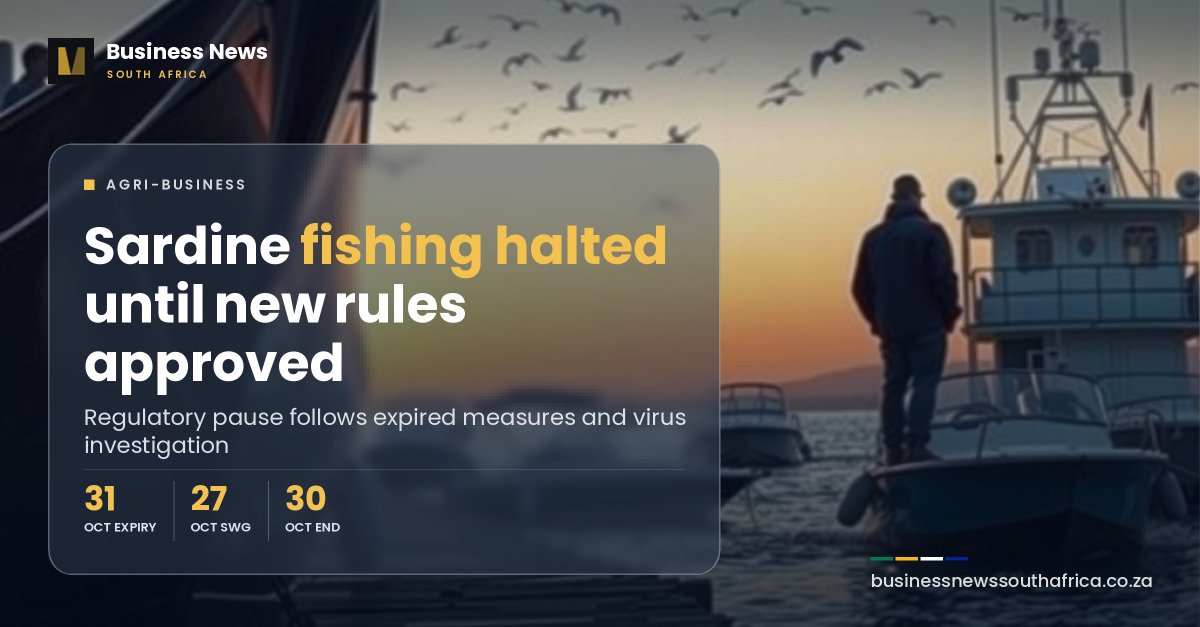
No sardine may be caught in South African waters at the moment. The Department of Forestry, Fisheries and the Environment (DFFE) said in a media statement dated 2 November that the previous management measures expired on 31 October, and that fishing may resume only once new measures have been approved and communicated. The department has received a scientific recommendation for November but has not yet announced its decision.
What the department has said
The statement says the Small Pelagic Scientific Working Group (SWG-PEL) met on 27 October. It reviewed updated sardine catch information, automated penguin weighbridge data, fishery-related socio-economic information and sardine population model projections, and it submitted a recommendation for November management. DFFE has not published that recommendation. The department says it will provide an update when its decision process is complete.
The department also reports that it has received no reports of a recurrence of the widespread sardine mortality event recorded between late July and early September 2026. A small number of juvenile sardines washed up sparsely near Mossel Bay on 23 October. Samples are being tested for pilchard herpesvirus (PHV), and DFFE says it is not yet known whether that wash-up is related to the earlier event.
How the catch limits got here
The restrictions have been tightened in steps since the die-off. Daily Maverick reported in September that DFFE capped permit holders at 25% of their outstanding 2026 total allowable catch until 2 October. It quoted the department as saying that, although the size of the mortality remained uncertain, the available evidence did not indicate a large enough reduction in the sardine population to justify a complete closure of the fishery. The working group had recommended a temporary precautionary limit while more information was gathered, and DFFE adopted it.
A later notice set a limit on directed catches through to 30 October, according to a SAnews report of a 26 October DFFE statement. The new 2 November statement goes a step further than either: with the earlier measures lapsed, no sardine fishing is permitted at all while the department considers the working group’s advice. One small discrepancy is worth flagging. The 26 October statement gave 30 October as the end date of the limit, while the 2 November statement says the measures expired on 31 October. Either way, the effect on the water is the same: the limit has run out and the new rules are not yet in place.
What the science says so far
DFFE’s position is that PHV is the most likely primary cause of the die-off, but that it cannot yet say how large the loss was. According to the department’s 26 October statement as carried by SAnews, PHV has been detected substantially more frequently in affected or dead sardines than in apparently healthy fish, which strengthens the association between the virus and the event. Further testing, quality control and sequence confirmation are continuing to clarify when and where the virus occurred.
Daily Maverick reported that the investigation could not rule out harmful algae, marine biotoxins or other environmental factors as contributing stressors, though DFFE said they were not the main cause. It also quoted the department as saying there was no clear indication of how or when the virus reached South African waters. The department has also stressed that PHV is a fish virus and is not known to infect people, and that commercial sardine products released through regulated channels remain safe.
The department’s own catch observations are limited. It says limited directed catches and bycatch recorded in several areas in October confirm that sardines remain present in parts of the coast, but that this cannot on its own show total abundance. That is why the end-of-year hydroacoustic survey matters. DFFE says it is intended to give the first fisheries-independent estimate of sardine biomass, distribution and size structure after the mortality event. The tender to charter a research vessel closed on 23 October, according to the earlier DFFE statement, and bid evaluation was due to begin the following week. The 2 November statement says planning for the survey continues.
What it means for fishing businesses and consumers
For vessel owners, processors and crews, a stop with no end date is a cash-flow problem. Sardine boats and canneries cannot plan landings, shifts or orders until the decision is announced. DFFE has not said how long the decision will take, and nothing in the statement indicates whether the new limit will be tighter, looser or the same as the previous one. We have not seen industry comment on the 2 November statement, so we cannot say how many workers or firms are affected by the pause.
For shoppers, the immediate effect is unclear. Canned pilchards and fresh sardines are affordable protein, and any prolonged shortfall would show up in shelf prices and availability, but we found no price data on this and DFFE does not make that claim. Inflation is currently being driven elsewhere. Stats SA’s September reading was 4.5%, lifted by fuel and transport costs, with food not yet showing broad price pressure. Food producers elsewhere in the supply chain are also under strain, as in the weather and credit pressure described in our report on planting intentions, El Niño and the closed Land Bank grants, and in the closure of a R1 billion fruit cannery in the Western Cape.
Conservation is part of the same decision. Daily Maverick reported that the loss of a key food source raised concerns for Algoa Bay’s already depleted African penguin colonies, and the working group’s inputs include automated penguin weighbridge data. The department has to weigh jobs and supply against evidence of how much food is left for predators.
What is still unknown
- The content of the working group’s November recommendation, and whether DFFE will follow it.
- How long the stop will last, and whether any limited catch will be allowed before the year-end survey.
- Whether the juvenile sardines found near Mossel Bay on 23 October carried PHV. The department says testing is under way.
- The true size of the die-off. SWG-PEL has said it cannot compare fish washed ashore with fish that may have sunk.
- When the research vessel will be chartered, and when the survey results will be published.
The department’s next statement is the one that matters. Until it arrives, sardine fishing stays shut, the science stays incomplete, and anyone whose income depends on the catch has no date to plan around.