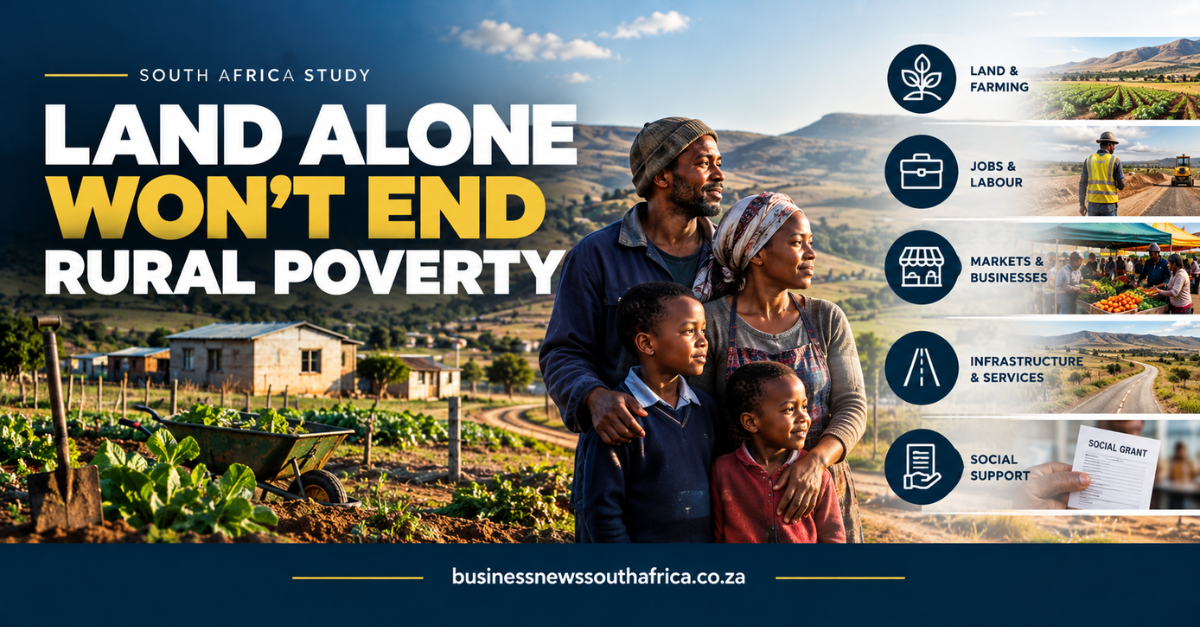
Two University of the Free State researchers, Neo Mathinya and Linus Franke, argue that giving rural households more land will not on its own lift them out of poverty. They set out their findings in an article for The Conversation, republished by Moneyweb. This is the authors’ own account of their research and has not been independently checked.
The researchers say their farming systems team engaged 132 small-scale farming households in two former homeland areas: Emmaus, near Bergville in northern KwaZulu-Natal, and Thaba Nchu, about 60km from Bloemfontein in the Free State. They used household surveys, life history interviews, farm mapping and focus group discussions.
They write that policy documents such as the National Development Plan 2030, the Comprehensive Rural Development Programme, the Strategic Plan for Smallholder Support and the Agriculture and Agro-processing Master Plan expect farming to act as the main engine of development in the former homelands.
What they found:
- Farming remained important to food security and income but was rarely the main source of income. Households combined it with wage employment, small businesses, social grants and other activities.
- Only 16% of households in Emmaus and 19% in Thaba Nchu surpassed the South African Food Poverty Line, currently R868 a person a month, and off-farm sources contributed the most to their income.
- Only 12% of household heads in Emmaus and 36% in Thaba Nchu aspired to farming as a business. Among dependants aged 18 to 32, 64% in Emmaus and 80% in Thaba Nchu aspired to education, wage employment or migration.
- Land was not necessarily the biggest obstacle to production. The authors list four: labour, infrastructure (poor roads and water in Emmaus), conflicts over communal grazing in Thaba Nchu, and limited ability to develop alternative farm enterprises.
The authors conclude that rural development programmes should be designed around a mix of livelihood activities, and say better opportunities for younger people may lie partly outside agriculture. They do not say farming has no future in the former homelands.
For businesses serving rural markets or the agricultural sector, the study’s point is that these households earn from several sources, not from farming alone. Related coverage: Ramaphosa: 2.5 million hectares of state land for black farmers and R150m reaches Land Bank, but no reopening date for blended finance.
Correction, 2 November 2026: an earlier version of this article presented the researchers’ own opinion piece as a university release, and added product ideas for entrepreneurs, policy claims and a description of the study’s methods that the source did not support. It has been corrected.