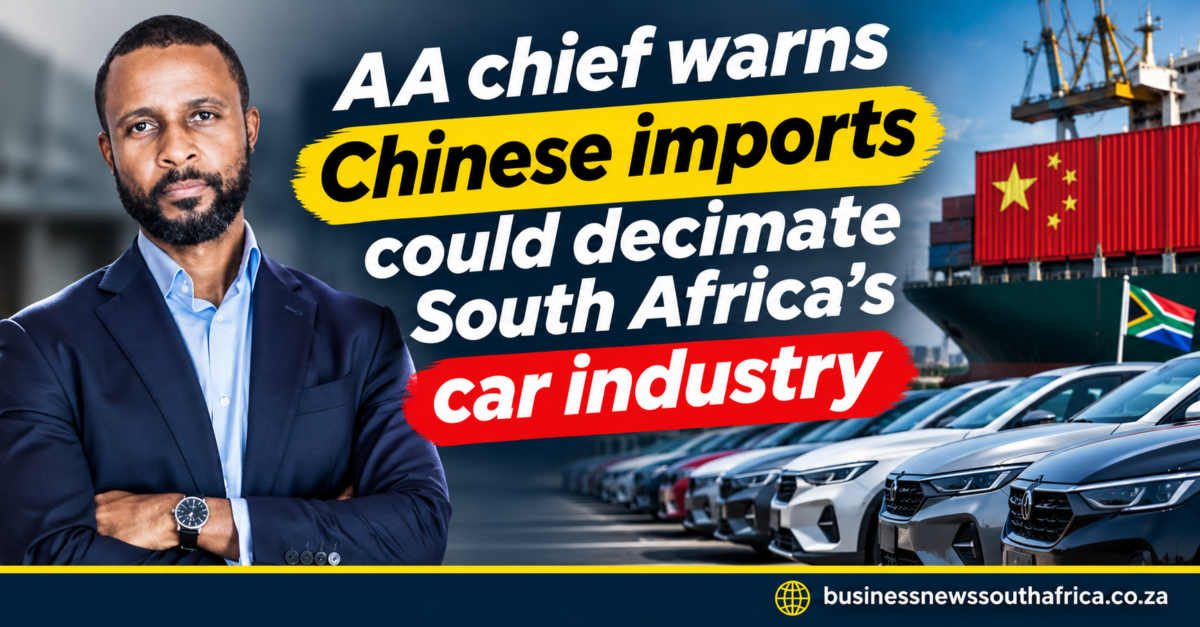
Automobile Association of South Africa chief executive Bobby Ramagwede has issued some of his starkest warnings yet about the state of South Africa’s car manufacturing sector, telling an industry audience that the current pace of vehicle imports from China will decimate local vehicle and parts manufacturing unless policymakers act. Speaking at the Automechanika CEO Breakfast in Cape Town, reported by Engineering News on 30 September 2026, Ramagwede described the local industry as being in big trouble, with both exports and domestic sales of South African built vehicles in sharp decline.
Strong headline sales mask a weaker story
On the surface, South Africa’s new vehicle market looks resilient. Industry body Naamsa recorded 61,645 domestic sales in September 2026, up 12.7% on the 54,706 units sold in September 2025, while sales for the year to August 2026 reached 305,899 units, a 13.5% increase on the same period a year earlier. Ramagwede argues those headline figures disguise a less comfortable reality. In comments carried by TimesLive, he said most of the vehicles being sold, whose statistics are being published, are entry level vehicles, and that the figures look rosy only until you scratch beneath the surface of what is actually being bought.
That shift towards cheaper models points to households under growing financial pressure, choosing lower priced, often imported vehicles over the locally manufactured models that anchor South Africa’s automotive export industry, even as our own coverage of October’s sales figures showed exports themselves recovering. Chinese brands took 19.3% of car and light commercial vehicle sales in October among manufacturers that report to Naamsa, up from 16.1% a year earlier, according to TechCentral’s analysis. Chinese manufacturers have been gaining share mostly in this more price sensitive segment of the market, while hybrids are also drawing interest from fuel conscious buyers.
“I’ve given it five years”
Ramagwede has now put a specific timeframe on his warning. In an interview with TechCentral’s motoring show Watts & Wheels, he said: “I’ve given it five years. If we continue in the same vein, allowing this rampant importing of not just Chinese vehicles, vehicles from many a country, we’re going to decimate this sector.” He went further, naming manufacturers directly: BMW, he said, operates in South Africa “because they’re doing us a favour”, Toyota has “found a comfortable home”, Volkswagen is “sitting on the edge of their seat, probably ready to go”, and Mercedes-Benz has “got one foot out the door”.
The carmakers pushed back hard. Volkswagen’s head of group communications, Andile Dlamini, said the company remains committed to South Africa and pointed to a R4 billion investment behind the Tengo compact SUV it plans to launch locally in February 2027. BMW said its Rosslyn plant, which built more than 79,000 vehicles in 2025, is “grounded in commercial considerations” and is the only plant worldwide making the X3 plug-in hybrid for export. Toyota said it could not speculate on specific timelines but that its commitment to local manufacturing “remains unwavering”, pointing to a R10.4 billion investment in its Prospecton plant. Ford’s Africa president, Neale Hill, rejected Ramagwede’s suggestion that its local output could fall to “next to nothing” if South Africa signed a free trade deal with Thailand, saying its Silverton plant exports the Ranger to more than 100 markets. Mercedes-Benz had not responded at the time TechCentral published its report.
Naamsa itself disputes the five year framing. Chief policy officer Tshetlhe Litheko told TechCentral: “We would not characterise the industry’s future through a five-year countdown,” adding that the industry is waiting on the 2027 budget speech for clarity from the automotive policy review, and that “imports contribute to consumer choice and affordability.”
Policy drift, not just import competition
Ramagwede’s criticism is not limited to Chinese competition. He has repeatedly pointed to a lack of coordinated government planning as the deeper problem, telling TimesLive that the challenge the industry faces right now is the lack of real central planning. Direct automotive manufacturing contributes roughly 3% of South Africa’s GDP, according to the Engineering News report, a figure Ramagwede separately put at about 5% in the TechCentral interview, broadly in line with the 5.3% President Cyril Ramaphosa has cited. He has suggested that South Africa could, in principle, move towards an import only vehicle market, but has stressed that the real problem is the absence of a clear policy decision one way or the other, rather than a preference for either path. He pointed to Thailand as a cautionary tale, where Chinese manufacturers captured 89% of the electric vehicle market by the end of 2025 and two carmakers have since ended local production there.
Ramagwede has also linked the car industry’s fortunes to the troubled domestic steel sector, telling TimesLive that the car sector cannot be expected to single handedly rescue a steel industry that is itself in serious difficulty, warning that allowing steel producers to fail would carry damaging downstream implications for construction and other steel dependent industries. His comments echo testimony from the South African Iron and Steel Institute’s Charles Dednam, who has told Parliament that domestic steel production has fallen 18% since 2018, with ArcelorMittal South Africa’s Newcastle plant remaining under care and maintenance and the department of trade, industry and competition temporarily permitting steel imports to supply carmakers. The steel sector’s troubles have also drawn in the Industrial Development Corporation, which is reported to be nearing a takeover of ArcelorMittal South Africa, while a separate surge in Chinese imports more broadly has been squeezing manufacturers across several sectors, not only cars.
What we could not confirm
Ramagwede has used forceful language in several recent public appearances, at one point describing himself as often quoted as a guy who walks into a room and says that the emperor is naked, and has separately raised safety concerns about some Chinese built vehicles sold in South Africa. We could not independently confirm the rand value of the investments Volkswagen, BMW and Toyota cited in their responses beyond what each company stated, or the precise terms of any free trade discussion between South Africa and Thailand, which Ramagwede raised as a hypothetical rather than an announced negotiation.